In the summer of 1956, 26-year-old Bernie Widrow drove from MIT, his alma mater, to Dartmouth, where a handful of preeminent researchers were holding a workshop of sorts. “They were talking about building machines that could think,” Widrow said in a 2023 interview with the Computer History Museum. “It was like a monkey on my back. I couldn’t get it out of my head—the idea of building a thing that thinks.”
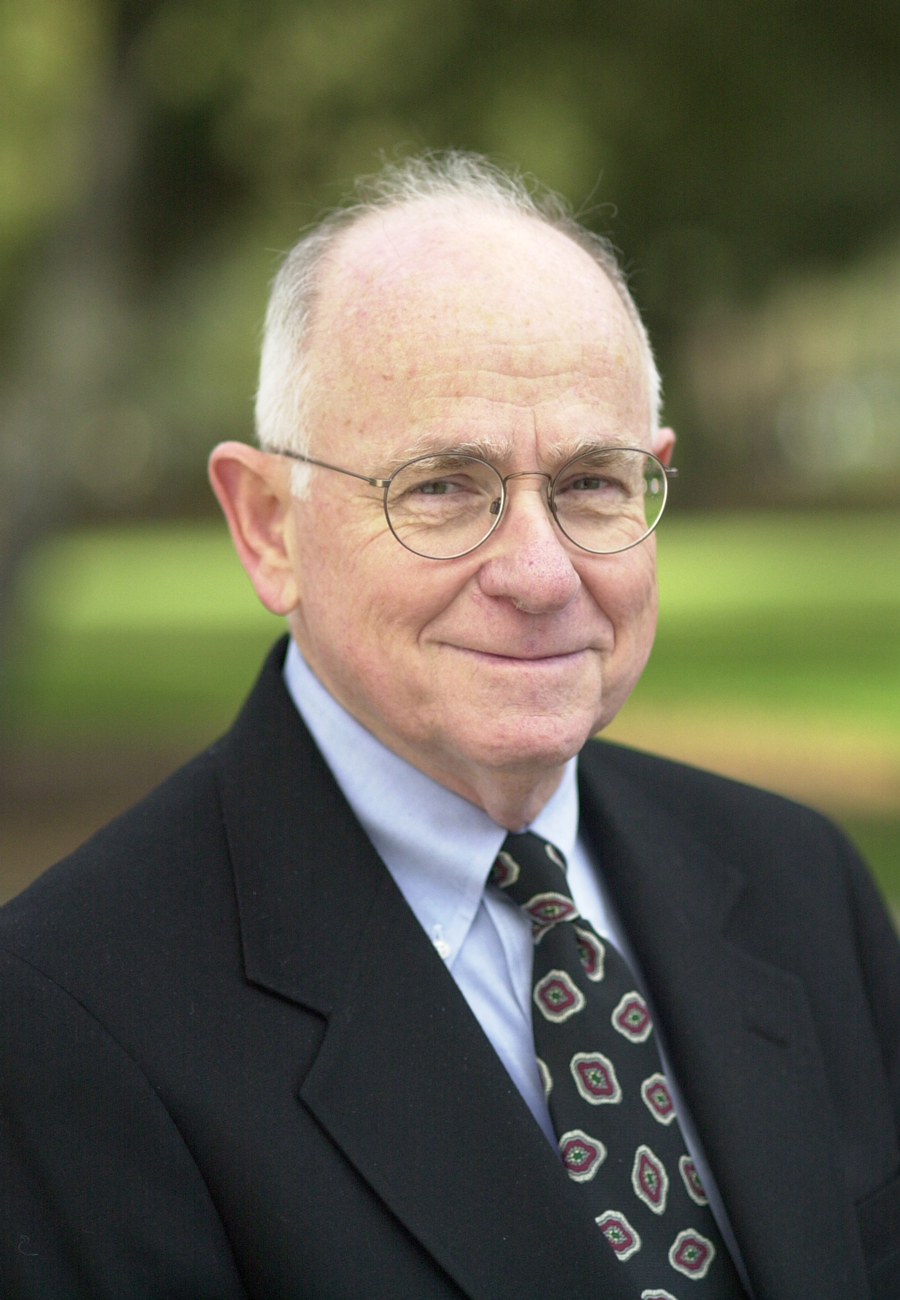 Photo: Stanford University Communications
For three years on the faculty at MIT and for half a century at Stanford, Widrow devoted his career to modeling machines on the elegant machinations of human thought. His breakthroughs, which led to 21 patents, are at the core of technologies such as artificial intelligence, telephone modems, and heart monitors.
Bernard Widrow, a professor emeritus of electrical engineering and a pioneer of neural networks, died on September 30. He was 95.
Soon after Widrow arrived at Stanford in 1959, he and his first graduate student, Marcian “Ted” Hoff, MS ’59, PhD ’62, invented an algorithm that would become one of the most widely used learning tools in engineering. Their Least Mean Squares (LMS) algorithm enables machines to measure and quickly correct their errors step by step (the mathematical equivalent of a children’s warmer-or-colder game). From telephone modems to mobile phones to seismic monitors, the approach “tunes” filters that equalize high and low frequencies, making it possible for data to travel swiftly and efficiently over noisy, shared lines, or to remove noise from data in the hunt for oil underground. The algorithm “powered much of the world’s machine learning,” says professor emeritus of electrical engineering Gregory Kovacs, PhD ’90, MD ’92.
Within a year, Widrow had used LMS to train a black, shoebox-sized device with an array of knobs and switches called ADALINE, for adaptive linear neuron—essentially a single neuron of a neural network, able to recognize patterns after being trained by humans. In 1963, the California Academy of Sciences recorded a video of Widrow using ADALINE and its successors to do things like transcribe spoken words and forecast rain.
Widrow’s career expanded far beyond neural networks—he published a seminal textbook on signal processing in 2002, for example—but the ADALINEs have received perhaps the most attention.
“Mark my words, this will be in the Smithsonian one day,” said the host of the 1963 Cal Academy video. That prediction came true in 2018: The Smithsonian is now the custodian of two ADALINEs. An additional ADALINE model resides in Mountain View’s Computer History Museum, in a new exhibition chronicling the history of AI chatbots.
Widrow was predeceased by his wife, Ronna. He is survived by his daughters, Leslie Derbin, ’82, and Debbie Sklarin, ’85, MA ’87; two grandsons; and sister.
Kali Shiloh is a staff writer at Stanford. Email her at kshiloh@stanford.edu.