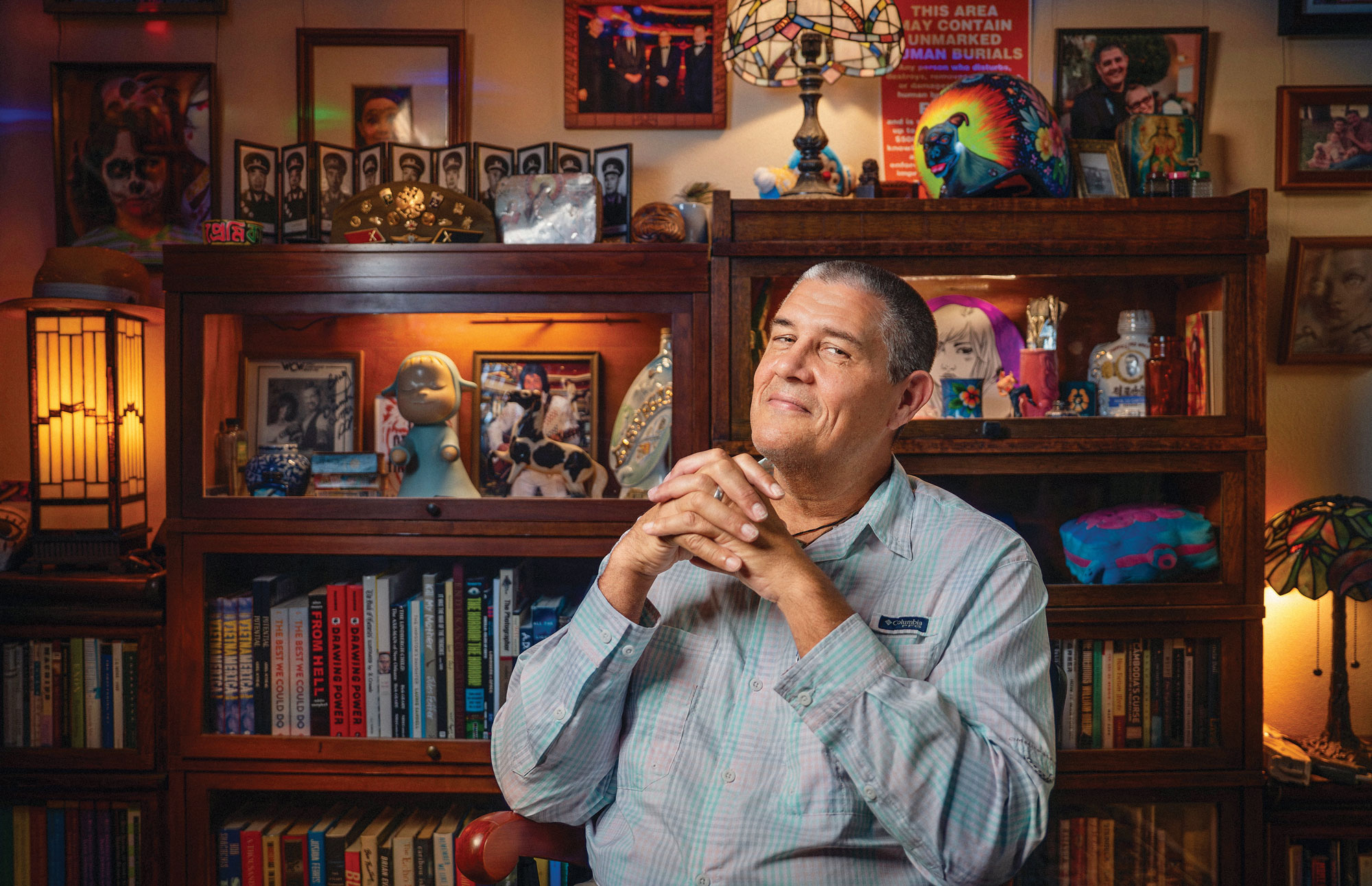
Adam Johnson can’t seem to answer a question without telling a story. They crowd his head, tumble from his mouth, and fill books. Forbidden stories, lost stories, half-told stories—these, in particular, capture the English professor’s imagination. The hidden lives of North Korea citizens, a teenage sniper, suicidal Polynesian princes. His stories—funny, brutal, apocalyptic, despairing, hopeful—are simply the result of his ongoing search for truths about himself and about our world.
“When I was a kid, my dad worked at the zoo,” Johnson says. He’d been a night watchman. “One night there was a pregnant rhino having a difficult labor. No one wanted to shoot it with the tranquilizer gun. My dad said, ‘Give me the gun.’ I’ve never been so afraid in my life. He went in with an angry rhino and shot it.” His dad had brought him to the zoo to learn about life, so Johnson kept his eyes wide open.
“I’ve just never been one to avert my eyes,” he says.
Johnson, who came to Stanford as a Stegner Fellow in 1999 and has taught creative writing here since 2001, has received some of the highest accolades for his deeply researched fiction. The 2013 Pulitzer Prize for the novel The Orphan Master’s Son, set in the secret, brutal world of North Korea, made him a celebrity author. In 2015, he won the National Book Award for his second published short story collection, Fortune Smiles—six stories that explore love, loss, and the impact of personal and historical trauma, about which novelist Lauren Groff warned in a New York Times review: “Each of these stories plants a small bomb in the reader’s head.”
And now, his novel The Wayfinder, published in October at a whopping 736 pages, takes readers on an epic voyage through the danger-ous ocean waters of ancient Polynesia as Johnson recounts mythic tales of war, kidnappings, a rapist with a jellyfish tattooed on his hand, and a girl who believes in the power of stories to save lives. The plot loosely follows two storylines: one of Kōrero, an island girl destined to be a queen, whose family lives near starvation on an island bereft of natural resources; the other of a warmongering King of Tonga and his three sons.
The book was inspired by his chance encounter with a Māori storyteller 12 years ago whose origin stories triggered in him a longing to uncover his family’s own—those of his late grandmother, born and raised on the Cheyenne River Sioux Reservation in South Dakota, who went missing when his mother was 4 years old.
The Wayfinder took 10 years to write, during which Johnson disappeared for hours on end into his basement, researching and listening to podcasts. Then he traveled through the Tongan islands, talking to native Polynesians and gathering stories.
“When I wrote The Wayfinder, I was working out of the oral tradition,” he says. He explored experimental methods of writing, weaving a narrative that moves back and forth through time, forgoing the chronological tradition of the western novel. It tells the story of a mostly forgotten world that few know anything about.
“I wrote a Post-it note that said, ‘Forget the word novel.’ I put it on my monitor, and it sat there till the sticky note didn’t stick anymore.”
Family Lines
“I come from a family of storytellers,” Johnson says. He has tucked his 6-foot-4-inch frame into a chair at his dining room table. He lives in a house in the Haight district of San Francisco, within walking distance of Golden Gate Park, the Booksmith bookstore, where he’s a regular, and the former home of the infamous cult leader and murderer Charles Manson. He tells you all this in one of his published stories.
It’s a Monday, Mahjong Monday. He can chat for a while, until his wife, Stephanie Harrell, also a fiction writer, returns from walking their two dogs, Wally and Bubbles. Then the two will head off to the neighbors’ for their weekly rounds of the game. The couple chose this house in part for the three nearby parks—a boon for their three children, James, Jupiter, and Justice, all away at college now. Once, Johnson wrote about taking his kids to Golden Gate Park one evening for archery practice when he was struggling with the fear of losing his wife to breast cancer. But that’s another story.
“My uncle was a great storyteller,” he says, recounting his earliest exposure to oral storytelling. “My dad’s a great storyteller. My grandfather is a great storyteller. And they would get in these storytelling circles, and someone would start a story and someone else would take it over. And they would tell tall tales about a giant catfish. And they would tell mythic stories about the founding of the prairie, and there would be war stories. And no one ever asked, are those true? I never did. Like, whether something was fiction or nonfiction seemed completely beside the point.”
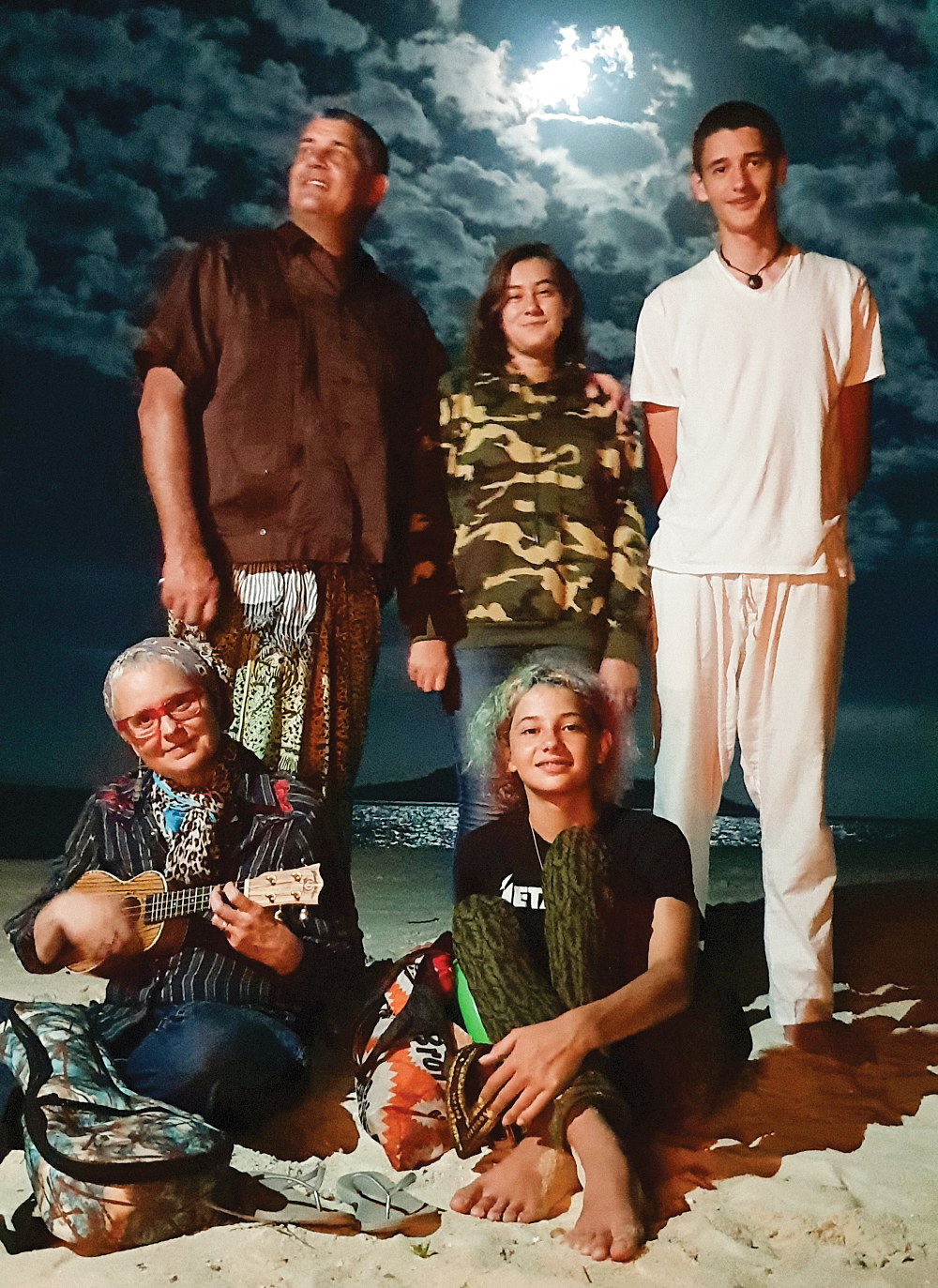 VOYAGERS: Clockwise from top left, Johnson in Tonga with his children Jupiter, James, and Justice, and his wife, Stephanie Harrell. (Photo: Courtesy Adam Johnson)
Johnson’s own story begins 58 years ago when he was born in South Dakota, then moved to Arizona. His parents divorced when he was young, and he was raised by his mother, Patricia, while regularly seeing his father, Don, who lived nearby. It was in the summers, when he was sent to stay with relatives in South Dakota, that he joined the storytelling circles, with the catfish tales and war stories—those, in particular, stuck with him, so much so that he co-taught a fiction writing course for veterans at Stanford, to help them share their stories.
“What [my relatives] were doing was, like, honing the stories, making them sharper. You make it funnier, you make it more animated, and you also separate yourself a bit from that story so that the terrible things that you saw or did at war, you can hold in your hand and entertain people with. That’s something I think about a lot as a writer and as an educator at Stanford: trauma narrative. How and why and which tools we use to tell a story, to sort of create a piece of art in some way about something that might be too terrifying to look at head-on.”
His father’s father, a jovial man named Bud who was a mechanic during World War II, told such a story, about how one of his duties was to clean out the tail of B-17s just returned from combat. Often a dead tail gunner was still inside, frozen. The space was so small, a body couldn’t be removed until it was defrosted. As Johnson recalls it: “My grandfather would defrost them with a steam cleaner so they could get them out.
“I think what he was saying was, ‘I want you to know the whole me. Not just your happy grandfather.’ ”
Fact and Fiction
Johnson takes a break from his storytelling, getting up to walk around the dining room and adjoining living room. He points to row upon row of photographs covering the walls.
“It’s fun for me to frame pictures,” says Johnson, who keeps his frame-making tools in the basement, along with his computer and an exercise bike. “That way they never disappear, and I still see my kids at all their different ages.” There are photos of his mother, and lots of family vacation photos. There are also a framed Godzilla poster and a tour poster for Nirvana—the grunge band that was inspiration for a short story of the same name in Fortune Smiles.
“Here’s me,” he says, pointing to a photo of a smiling teenager wearing a hard hat. “My father had a small construction company when I was in high school. He would just tell stories all day long, building decks in the Arizona sun, sweating and telling stories.”
After high school, Johnson attended Arizona State University, earning a bachelor’s degree in journalism in 1992. He decided that fiction writing suited him better than nonfiction—facts, for him, were not sufficient. “I’ve personally felt that I could tell bigger, more important stories through relinquishing facts for human truth,” Johnson says. He went on to earn an MFA in fiction in 1996 at McNeese State University in Lake Charles, La., and a PhD in English from Florida State University in 2000.
One of his early mentors, Robert Butler, then a professor of creative writing at McNeese State, says Johnson contacted him before arrival to ask about Butler’s Pulitzer-winning book, A Good Scent from a Strange Mountain, told in the voice of Vietnamese exiles in Louisiana.
“From the first day, what Adam really wanted to know most was where to go to see cockfighting and the zydeco bands,” says Butler, now a professor at Florida State. “He wanted to immerse himself in the deep Cajun culture of Louisiana. That is so characteristic of him. And it’s what makes him a great writer. He’s ravenous for life experience, ravenous to understand the world as it really works away from academia, away from structures, into the moment-by-moment experience of life. It’s his way of answering the greatest enduring question, ‘Who the hell am I?’ ”
It was one of Johnson’s early published stories, The Canadanaut, about a team of Canadian weapons developers who send a small fur trapper named Jacques to the moon but can’t bring him home, that garnered him a Stegner Fellowship, bringing him to Stanford. In 2002, he published his first book of short stories, Emporium, which was followed by his first novel, Parasites Like Us, an apocalyptic adventure tale of an anthropologist in South Dakota who mistakenly triggers the end of civilization. It won a California Book Award in 2003. Next came The Orphan Master’s Son.
An Orphan’s Life
Johnson didn’t set out to write about North Korea. But when he read two books about the country—The Aquariums of Pyongyang, a memoir by Kang Chol-hwan, and David Hawk’s The Hidden Gulag—they piqued his interest. “I couldn’t believe this place existed,” he says. “I wondered what was it like to be a dad in North Korea? Do you get to pick the person you love? What do you have for breakfast? What is normal life? I became obsessed about it in the same way I became obsessed about the Pacific.”
For a year, Johnson read books about North Korea in his basement, but they only taught him about geopolitics, the military, and economics—not what he really wanted to know. So, he started reading online transcripts of interviews with North Korean defectors posted by NGO and aid workers, then began doing his own interviews. That’s where he got answers to his questions about what it is like to live in North Korea, stories about falling in love and finding enough food to eat, about the hardship of daily life, about the choices people made to survive and how those choices tested families.
“I interviewed a man named Jang Jin-sung, and for his freedom, his brother and his uncle were tortured to death,” he says. “His story came out in little pieces, with missing parts. I came to understand that people wanted the catharsis of telling their stories, but when they told them, they were trying to minimize their story’s power to hurt them, to debilitate them, so they told them out of order.”
Several years into his research, he took a six-day trip to North Korea under strict state supervision. And in 2011, seven years after he’d begun probing, he finished the story of the fictional Jun Do (John Doe), an orphan raised to serve a state ruled by daily propaganda blasted from loudspeakers erected in homes and workplaces and the streets. It’s a harsh story, with moments of dark humor, of lives spent in tunnels, in prison camps, and in poverty. The novel doesn’t follow an expected structure. It bounces around, changing timelines and narrators. It’s built upon the daily lives of citizens.
“When I wrote that novel, I realized I couldn’t just write a simple beginning, middle, and end,” Johnson says. “That would be a lie to the stories that I had inherited and been entrusted with. And so, I had to write a different kind of book. One that was a little more broken, a little more jangly, that changed point of view.”
Johnson met up with Jang just after the North Korean poet had read The Orphan Master’s Son. “He hugged me and said, in English, ‘Your character Jun Do, he is me.’ Then his translator explained all the ways in which Jang found parallels with his experiences living in Pyongyang.”
Tales from Polynesia
Johnson was with his family in New Zealand for a writing event when he met the Māori storyteller who sparked The Wayfinder. At a pōwhiri, or welcome ceremony, she told the Māori myth of Rangi (sky) and Papa (earth) locked in an endless embrace holding the world in darkness until their children pried them apart, bringing light into the world.
“I don’t know if I’d ever been in the presence of such a great storyteller,” Johnson says. “It was an origin story. And it became personal. It had been orally transmitted through generations, and it had the weight and support of generations. For 40 or 50 generations it had been safeguarded like a tender flame.
“And I remember thinking, She has something I don’t have and how I want my stories to have this effect, and that I can be a better storyteller.” Later, she told him the name of the canoe that brought her family to New Zealand, and she named all 26 people in that canoe. “And I thought, Just because something was written down and saved somewhere in an archive, is it any more valid or confirmable or useful or meaningful or accurate than this story which had been attended to? And I—I thought, No.”
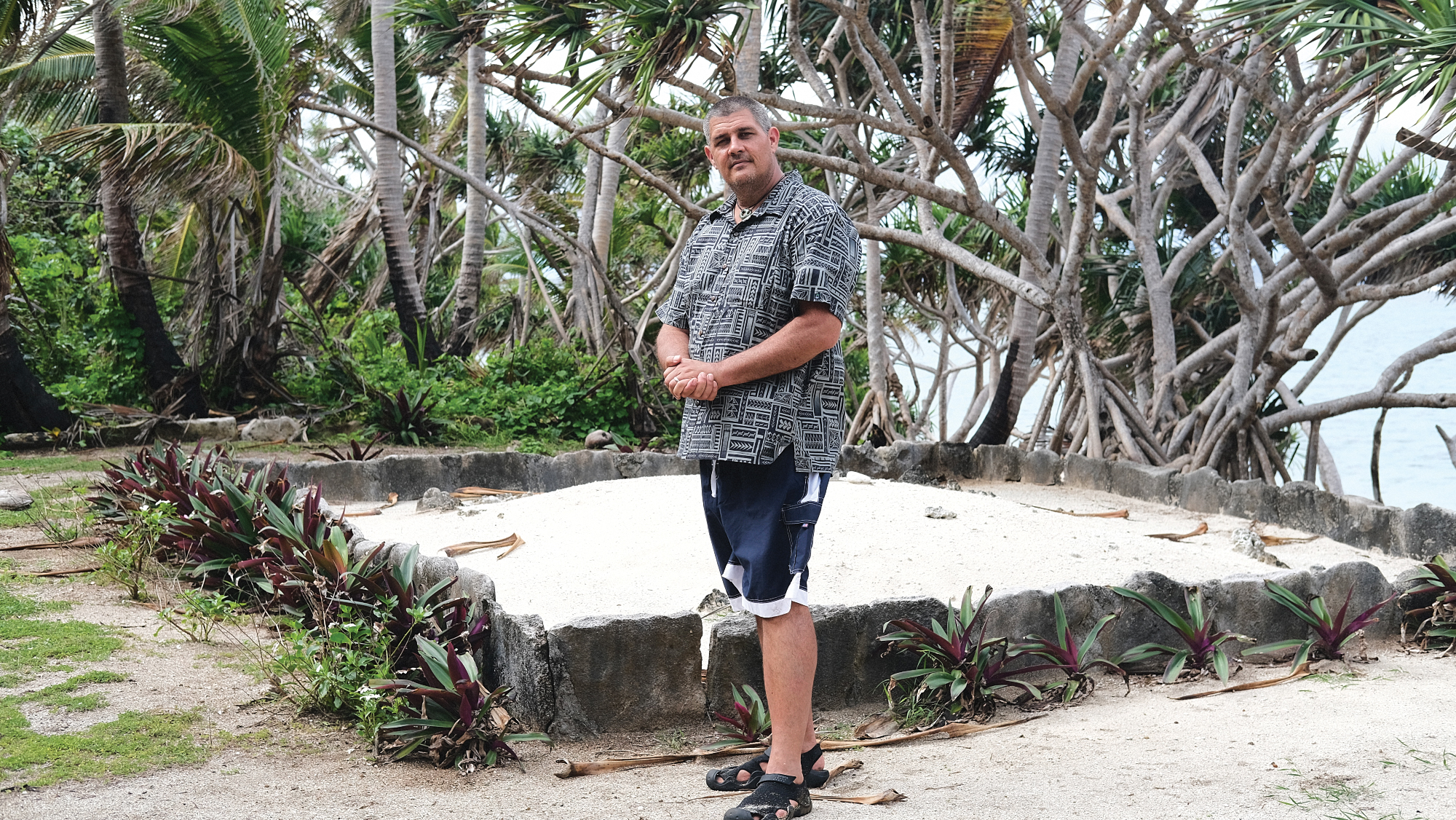 WAY-FINDING: To write his latest novel, Johnson, pictured on ‘Uiha Island, Tonga, studied the Tongan language, learned methods of ancient navigation, and researched medicinal botanicals used in Polynesia. (Photo: James Johnson)
And so, it was back to the basement (and frequently to Green Library)—this time to study the Tongan language, learn methods of ancient navigation, and research medicinal botanicals long used in Polynesia. Johnson visited more than a dozen Tongan islands and corresponded with Tongan scholars, eventually working with linguist Vasalua Jenner-Helu to write poetry in verse similar to that of the ancient Tongans.
“I would write my poetry with my Tongan dictionary, and then I would contact her, and she would help make sure it’s right and change everything,” he says. “Then we’d go back and forth. We wanted to try to construct the oldest version of Tongan verse that we could.”
“I think Adam’s book gave us an insight into what it was like during the nearly 1,000-year span of the Tu‘i Tonga empire, of how life used to be,” says Jenner-Helu, who lives in Mataika, in Nuku‘alofa, Tonga’s capital. “The Wayfinder gets to the nitty-gritty of life, of daily life.”
The Translator
“So, there was this dude named Steve,” says Johnson, who is telling stories about researching The Wayfinder to a crowd of fans at Kepler’s bookstore in Menlo Park. Steve, he says, hears that there are very few navigators skilled in ancient navigation techniques left on Earth, so he flies to Micronesia, then voyages to the tiny atoll Satawal to track down the youngest one still living—a man in his 70s. “He found Mau Piailug, who knew the ancient ways of navigation, and he said, ‘Mau, will you teach me.’ Here’s this white dude from the United States who shows up and says, ‘Teach me your sacred knowledge.’ ” This is a true story, Johnson says, one he read about in Steve Thomas’s memoir, The Last Navigator.
“In writing my own book, I often felt like Steve,” Johnson says to the crowd. “I went to these islands and I would say, ‘Do you know the story of the man with the jellyfish tattooed on his hand? Or the princess buried alive?’ ” In the book, he recounts stories of ancient methods of castration, of royalty using oyster shells to carve out the souls of the dying, and of an era of environmental destruction, when islanders faced extinction due to their misuse of natural resources.
“When I wrote The Wayfinder I was thinking, You have to be true to your research. You have to be true to that storyteller I first met. And you have to try to capture a different kind of storytelling, one that’s alive.”
Many critics have praised his efforts, some noting the unusual structure of the narrative. Both the Washington Post and the Wall Street Journal recognized it as one of 10 best books of 2025.
“Don’t hesitate to lash yourself to the mast of this remarkable voyage,” wrote Ron Charles in a Washington Post review of the book. “It feels less created than unearthed.” In a New York Times review, author Ian McGuire described it as “a sprawling novel that combines myth, poetry, and magical realism into a great roiling, oceanic mass.” He noted that the narrative at times “may lack focus and a clear direction, but it never wants for inventiveness or energy.”
Future Worlds
Johnson gets up from the dining room table on Mahjong Monday and disappears downstairs to the basement, returning with a weathered Tongan dictionary from the library and a black-and-white photo of the grandmother he never met. In the years since the Māori storyteller started him wondering about his own origin stories, he’s been able to learn more about his missing grandmother.
“It turns out that among my grandmother Lavina’s family of nine, the seven boys were sent to boarding schools,” he says. “But Lavina and her sister were sent to the mission schools. This one photo I have of her is on the reservation. There’s a nun and there are Singer sewing machines and they’re in a wooden house. She’s being taught to be a seamstress.” He worries over the photo—the young girls’ unhappy faces.
As an adult, Johnson’s mother, Patricia, discovered Lavina had other children after she left. “My mom is now close to those other siblings,” he says. “They’ve helped fill out this missing part of her life. Those siblings led to other relatives and other stories and led us back to the reservation. We were on the reservation this summer, and I met some uncles.” Both Johnson and his mother have since become enrolled members of the Cheyenne River Sioux Tribe. He thinks he may write his grandmother’s story someday. But for now, he’s exploring the idea of writing a book about his newest obsession—quantum theory and black holes.
“When I work out and ride my bike in the basement, I watch YouTube videos, and that’s like hours every week. And I just watch video after video of people who have podcasts about black holes. And, like, what are the implications of consciousness, of reality, of time, of where we came from, of what the universe is?” he says. “What’s the future of the universe? What’s the past?”
Then the front door opens, and Johnson leaves his imaginary worlds and returns to his real life, the one with his family and dogs and social engagements.
“Here comes my wife, Stephanie, and there are two dogs that are going to come in,” Johnson says, and he wraps up his stories and goes to get ready for a few rounds of Mahjong.
Tracie White is a senior writer at Stanford. Email her at traciew@stanford.edu.