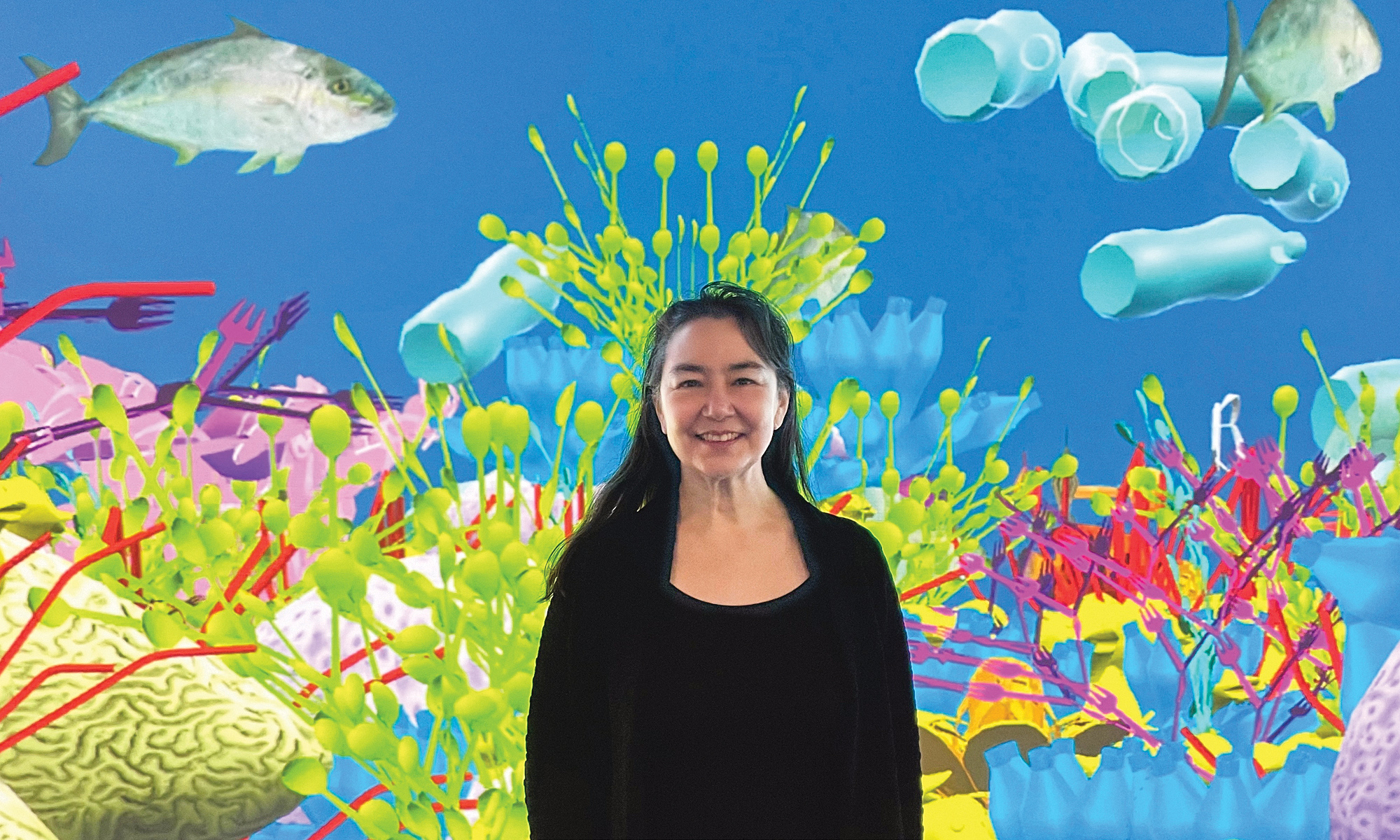
In the hands of Tamiko Thiel, technology has been a gateway to art.
In 1983, Thiel, ’78, was the lead product designer on Thinking Machines Corporation’s Connection Machine. A standout for its use of 64,000 “massively parallel” processors, it was among the fastest computers on the planet and heralded a possible future with artificial intelligence. So its creators wanted it to stand out among the beige, refrigerator-like supercomputers of the day. How can I express the fact that this machine is different from anything else? Thiel wondered. Inspired by the highly organized network of processors within the machine, she designed a sleek, matte black cube measuring 5 feet by 5 feet and constructed of eight smaller cubes. Blinking red lights on the cube faces indicated the status of each of the 4,096 chips within.
When the Connection Machine was released in 1986, its design dazzled. (A later model’s twinkling array would even make a cameo in the first Jurassic Park film.) But Thiel had already left the company—and the country—for an artist’s life. Her move could have been read as a sharp, techie-to-fuzzie career pivot. But in fact, it was the natural flow of a life that would trailblaze the fusing of digital technology and art—a life not destined to fit neatly into a box, or into eight cubes, for that matter. More than two decades later, in November of 2017, things came full circle: The Connection Machine earned a spot in an exhibition at the Museum of Modern Art.
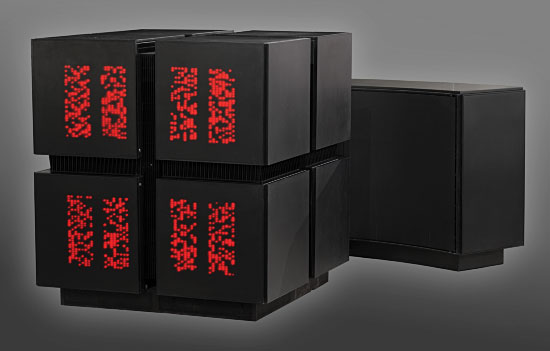 CONNECTING THE DOTS: The Connection Machine fused computing power and design. (Photo: Logg Tandy/Wiki Commons)
Thiel has been enchanted by mechanical forms since childhood. She had crossed the Pacific Ocean by freighter four times by age 11 as her mother, an artist, and father, an architecture professor and former naval ship designer, chased funding around the globe. Down in the engine rooms of those ships, her father talked shop while Thiel peered up in awe at the turbines thumping away. “It seemed like with math and science you could really understand the world in a very wonderful and almost mysterious way,” she says.
She graduated from Stanford with a degree in general engineering, but while working at Hewlett-Packard, she found that each project eventually turned into months of tedium over whether one needed six No. 4 screws or four No. 6 screws. That can’t be all there is to life, she thought.
At least, that was how she felt in Silicon Valley—able only to imagine being an engineer or engineering manager. Perhaps a change of scenery would help. She enrolled in a master’s program on the other side of the country, at MIT. Although she studied mechanical engineering, it was during elective courses in computer graphics and visual imaging (in what would become the MIT Media Lab) that she found her place. Artists, she realized, “spend their time sitting around, thinking about the meaning of life and nature and humans’ position in the universe.” That’s what Thiel wanted to spend the rest of her life doing.
There was one more quick stop to make on the bridge between engineering and art. Three days after Thiel graduated from MIT in 1983, Danny Hillis, the founder of Thinking Machines, asked her to work directly with Nobel Prize-winning physicist Richard Feynman on what would become the Connection Machine. “I was like, ‘Where do I sign?’ ” she says. She jumped at the opportunity to work with Feynman, but months after she finished the computer’s look—before the product even launched—she moved to Germany, where she attended the Academy of Fine Arts in Munich and became one of the world’s early augmented reality artists.
‘If you have artistic ability, you’ve been given an incredible tool
to investigate life.’
Augmented reality (AR), sometimes called mixed reality, integrates digital information with the real, physical world by superimposing computer-generated content onto the view users see through camera-equipped devices. (Think of those apps that allow you to see how a piece of furniture will look in your living room, or games like Pokémon GO.) Thiel’s AR work is site-specific, so viewers typically see her art through the screen of their smartphone or tablet in a particular geographic location—say, while standing in front of a bronze statue of Juliet Capulet in Munich. But that makes it no less real, Thiel says. “We look through these tiny lenses in a microscope or in a telescope to see something that’s there,” she says, referring to the cells and galaxies that are imperceptible to the naked eye. From her view, smartphones are AR scopes that “allow us to see an invisible but real layer.”
Augmented reality art requires a distinctive combination of skills from people working across disciplines. Thiel is “a pioneer of that type of work,” says Camille Utterback, an associate professor of art and art history at Stanford who focuses on digital media and interactive installations. At a time when pagers still outnumbered cell phones and the majority of U.S. homes didn’t have a computer, Thiel was already working with developers to build the creative technology she envisioned. “That’s such an important space to have artists engaging in,” Utterback says, “because it changes the whole direction of what’s possible in the field.” Artists can push the boundaries of technologies beyond their commercial applications, she says. “Do we want something that’s all about productivity, or do we want something that has this more renegade potential to ask different questions?”
The limitations of physics don’t apply in the digital world, so AR artists can create at any scale, defy the laws of gravity—whatever they need to get their point across. “It’s a way to create these kinds of fantastical situations that would be impossible to do in the real world,” Utterback says.
To that end, Thiel frequently collaborates with her husband, Peter Graf, a software engineer who goes by the artist name /p. Thiel’s projects, which have been commissioned by museums and art studios around the globe, have taken on topics as diverse as plastic pollution, feminism, and invasive plants. “I want to somehow use [my skills] to make meaning,” Thiel says. “I want to make a difference. I want to create things that interact with the world and with people in the world.”
Two pieces that debuted this winter lean heavily on Thiel’s ability to translate scientific concepts, like elements of quantum physics, into something anyone can understand. “If you have artistic ability, you’ve been given an incredible tool to investigate life,” she says, “to make sense of the world to yourself, and ideally also help other people to make sense of the world.”
Atmos Sphaerae
Photographed: 2026, TECHNE: Homecoming, Onassis ONX studio, New York. Originally created for DiMoDa 4.0: Dis/Location VR exhibition, Gazelli Art House, London
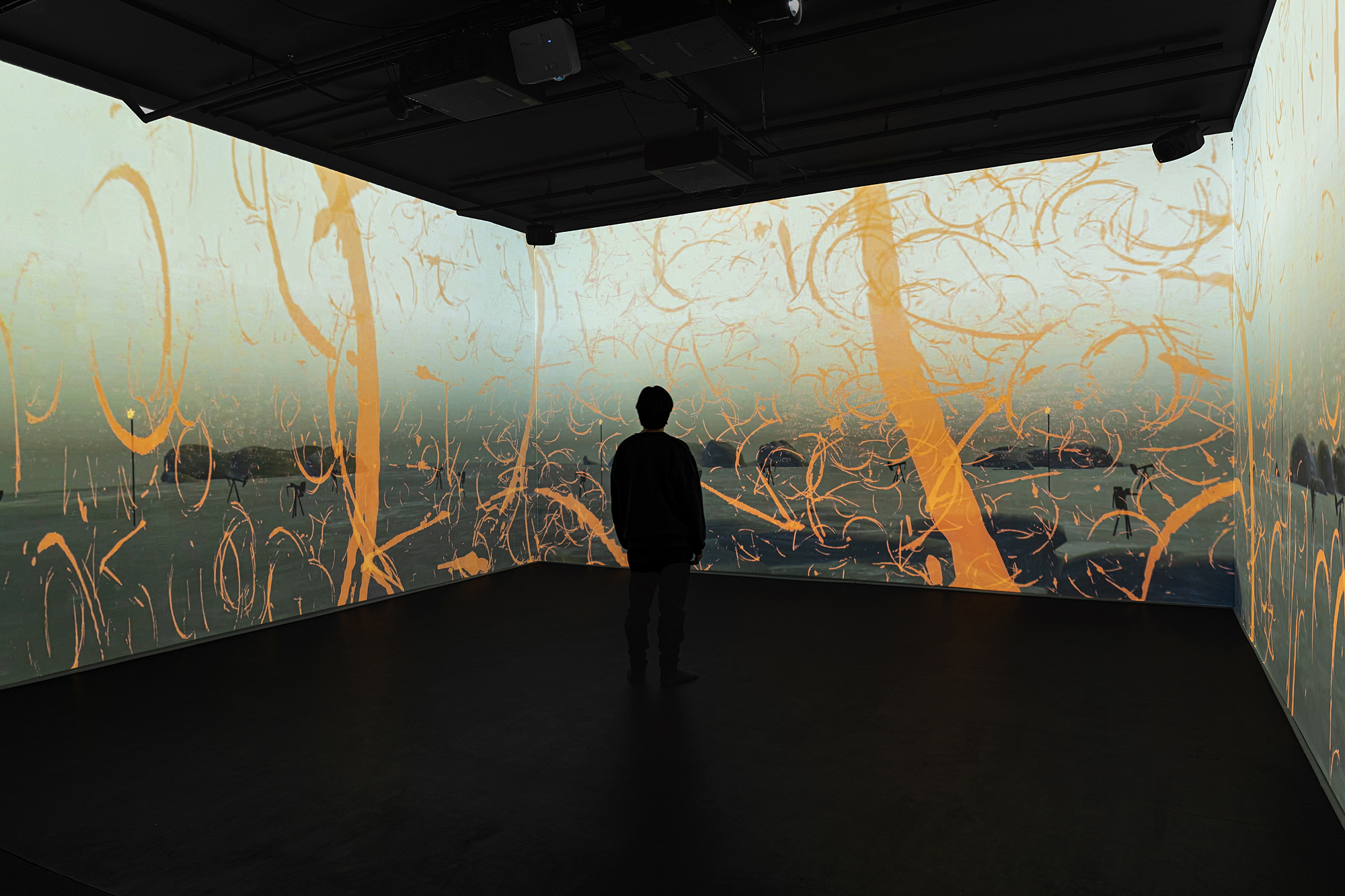 Photo: Mikhail Mishin
No need for smartphones here. Atmos Sphaerae surrounded New York viewers with an immersive video displayed on three floor-to-ceiling screens. The nine-minute piece chronicles the Earth’s atmosphere as it changes over billions of years, from a black void to gaseous clouds made of chemical compound symbols to oil jacks on a crust of desert releasing methane. In the Shinto shrines and Buddhist temples of Japan, the country where Thiel attended kindergarten, “there’s gold and incense and chanting,” she says. “It’s a whole sensory experience. That sort of immersion is what I’ve always wanted to go for in my artwork.”
Plastocene Reef
Debut: 2025, art karlsruhe international fair, Rheinstetten, Germany
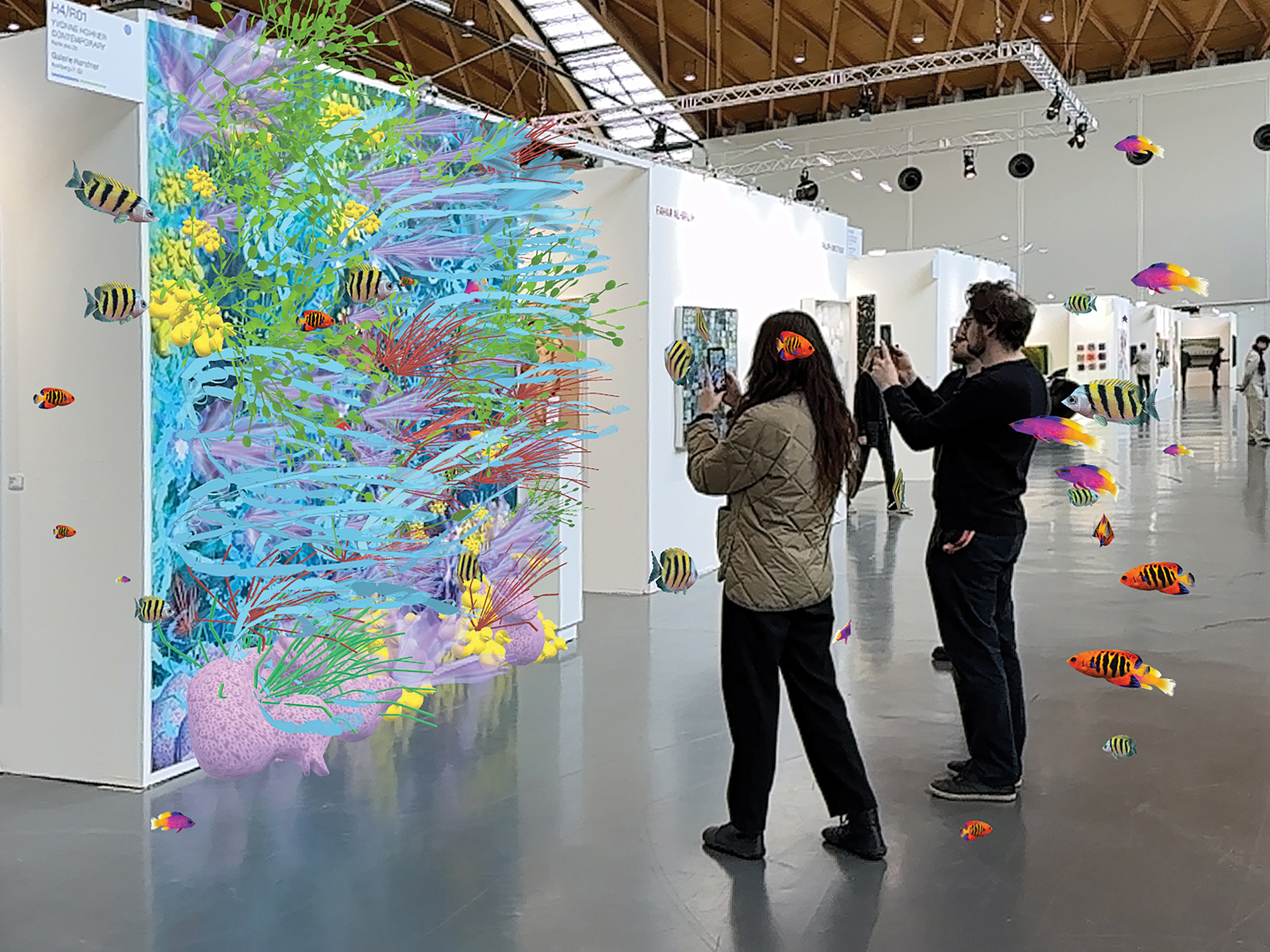 Photo: Tamiko Thiel
The 3-meter-by-3-meter flat wall installation becomes a moving 3D spectacle when viewed through a phone or tablet. Protruding from the wall are what at first appear to be corals, but upon closer inspection are “reefs” made of plastic garbage, representing the 91 percent of plastic waste that is not ultimately recycled. “A lot of adults say, ‘Don’t you think that’s a little obscure? People won’t understand,’ ” Thiel says. She likes to tell them about the 8-year-old who dawdled in front of the image while Thiel explained the life cycle of plastic waste. The next day, the boy’s father messaged Thiel to let her know that when his son had donned his flip flops later that afternoon, he proclaimed, “These are not going to go into the ocean.” “The 8-year-olds get it completely,” she says.
ReWildAR
Collaborator: /p
Debut: 2021, Smithsonian Arts and Industry Building, Washington, D.C.
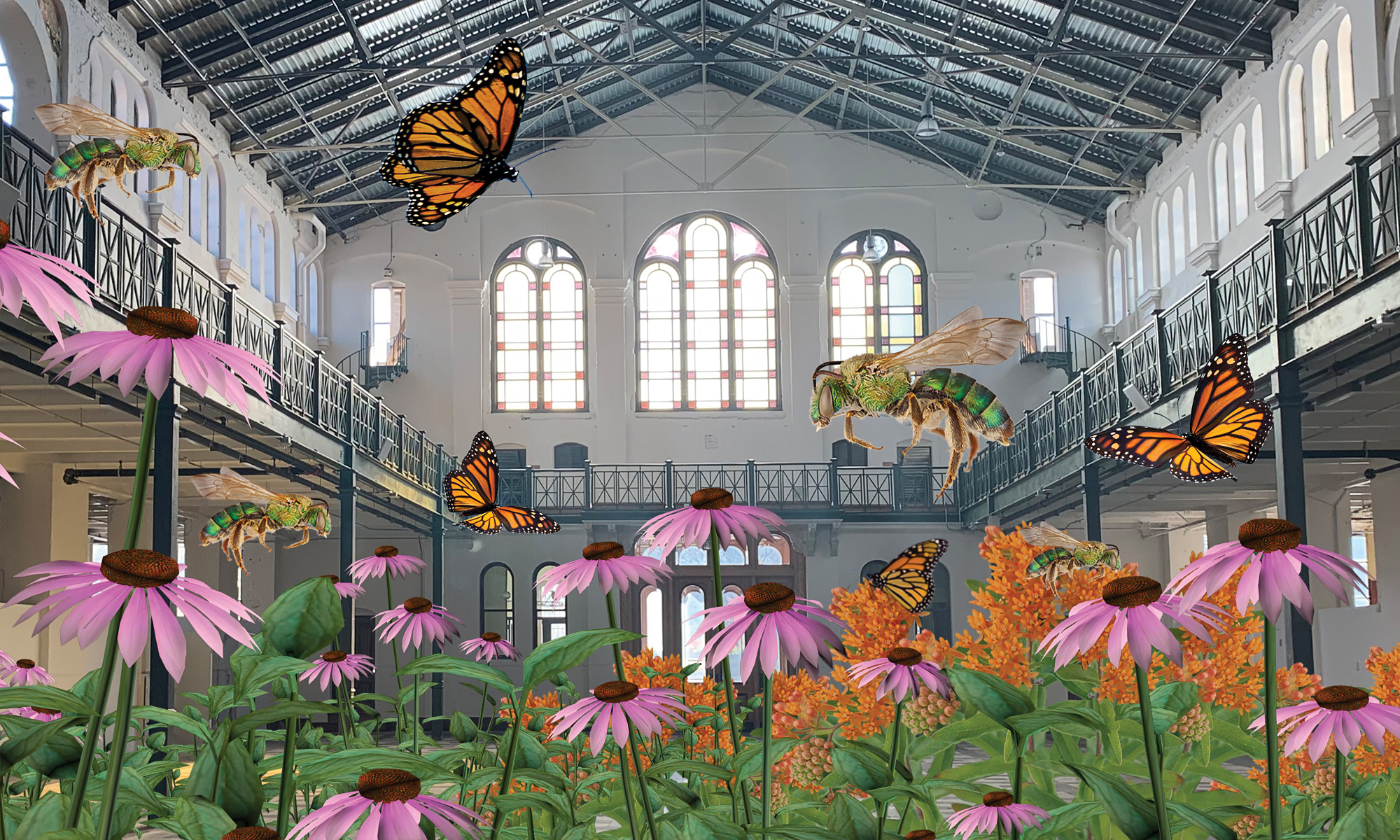 Photo: Tamiko Thiel
For its 175th anniversary, the Smithsonian Institution commissioned ReWildAR as part of its FUTURES exhibit, which encouraged artists to “imagine the future you want, not the future you fear.” Thiel created an AR garden inside the museum that reflected the native ecosystem of Washington, D.C. “I asked the Smithsonian Gardens people to give me an idea of what native and iconic plants for the Washington, D.C., area would be able to survive climate change,” she says. They explained that the ability of plants to thrive largely depends on the continued presence of their pollinators. “One can’t survive without the other,” she says. The result was a sprawling virtual garden of dogwood and the short-haired dogwood mining bee, columbines and the white-lined sphinx moth, and echinacea and the metallic green sweat bee.
Unexpected Growth
Collaborator: /p
Debut: 2018, Whitney Museum of American Art, New York
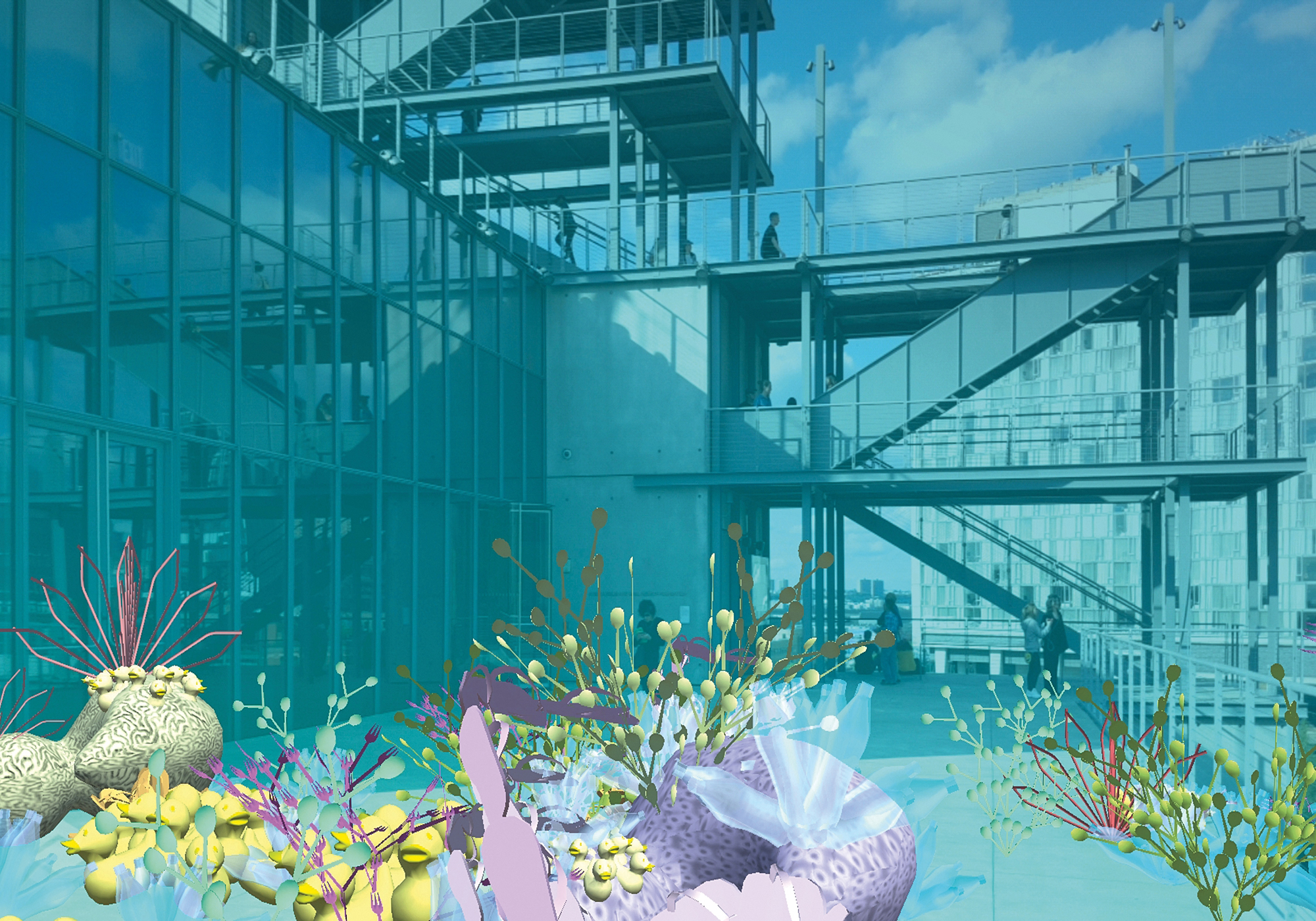 Photo: Tamiko Thiel
This AR piece was designed to take up the entire sixth-floor terrace of the Whitney. It was Thiel’s first project to include the “plastocorals” also seen in Plastocene Reef. She designed them using Lindenmayer systems, originally developed by a biologist-botanist to capture the branching, fractal-like nature of growing plants. Today, L-systems can help computers model the repetition and variation found in plants and other natural shapes. Thiel harnesses them in service of a “stealth approach” to blend their realism with unlikely objects. “It’s colorful, it’s cheerful, it’s bright,” she says. “People run over to pick up the iPad and look at it, and then they realize it’s garbage, and that they’re being surrounded by garbage. You’re doing this to creatures in the ocean and to human beings on other parts of the planet. How does it feel?”
Revolution and Return
Collaborator: /p
Debut: 2023, St. Paul’s Church, Frankfurt, Germany
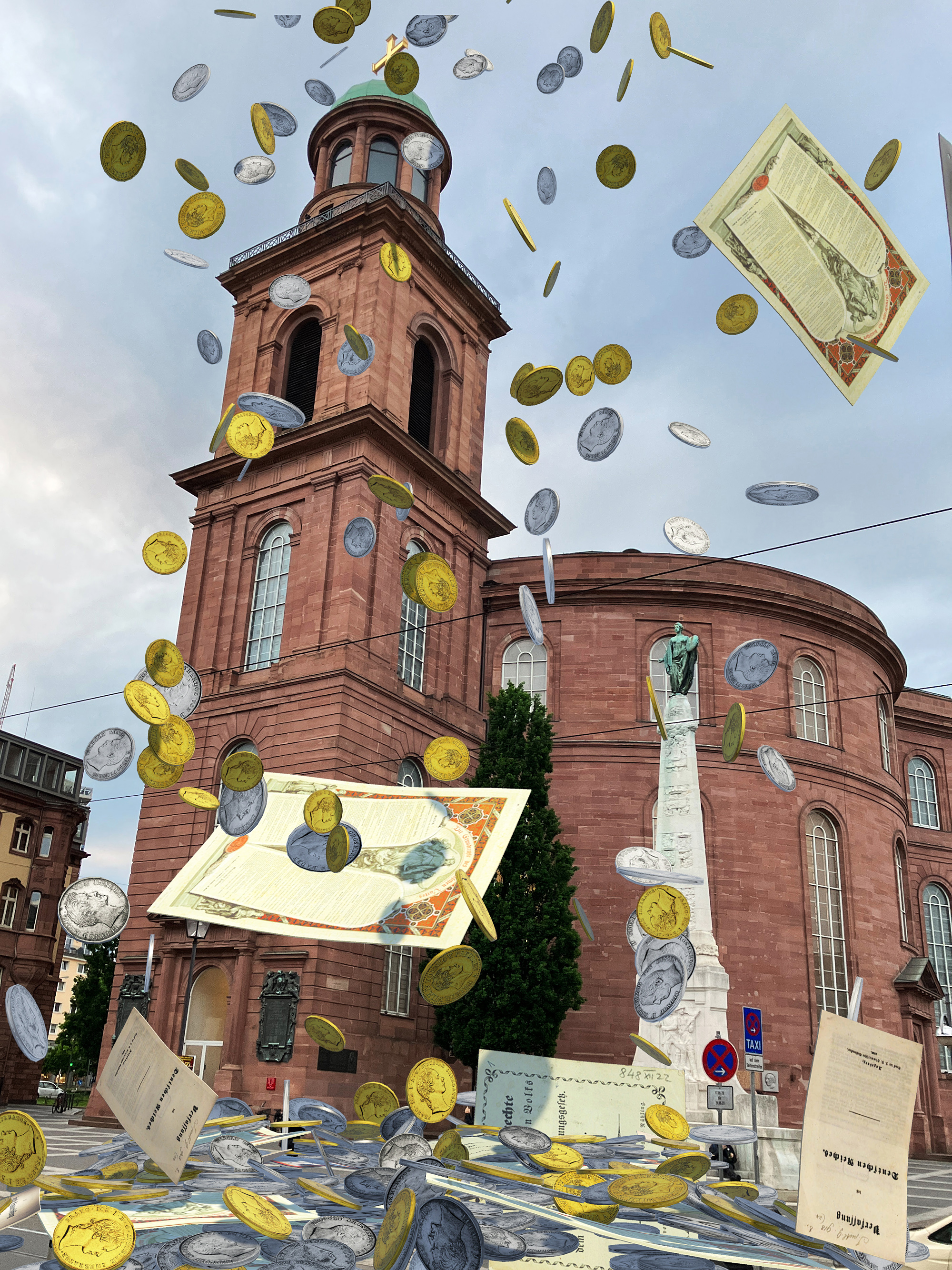 Photo: Ben Livne Weitzman/WAVA
“I often say augmented reality is the street art of the 21st century,” Thiel says. Commissioned for the 175th anniversary of Germany’s March Revolution of 1848, Revolution and Return was viewable in the public space outside St. Paul’s Church (the meeting site of Germany’s first parliament) and memorialized the series of protests calling for constitutional government in place of monarchy, as well as the suppression of those efforts. Users tap descending silver German coins, which burst optimistically into democratic documents. Then, unresponsive gold Prussian coins drop from the sky and cover the democratic documents, just as the Prussian government silenced revolutionaries.
Kali Shiloh is a staff writer at Stanford. Email her at kshiloh@stanford.edu.