William Eaton figured he’d be a banker, like his dad and uncles. But his lifelong love affair with stringed instruments would upend his more conventional career plans. While attending Arizona State University, he was on the hunt for a new guitar. He discovered the nearby Juan Roberto Guitar Works, a small shop in a Quonset hut run by guitar maker John Roberts. “John was teaching classes for people like me who come in off the street to make guitars,” he says. “This place was another world. When you saw that Quonset hut, the smell of the rosewood impregnated your entire being.” That’s where Eaton, who started playing the ukulele at 7, built his first guitar.
For a Graduate School of Business assignment, Eaton, MBA ’75, wrote a business plan for a guitar-making school. “I got this idea, but I thought, There is no way am I going to run this school,” he says. Nevertheless, he sent the plan to Roberts and Bob Venn, Roberts’ new business partner, and a trio was born. Although his co-founders have since died, 50 years later, Eaton still directs the Roberto-Venn School of Luthiery in Phoenix—believed by the Guild of American Luthiers to be the longest continuously running guitar-making school in North America.
Over the decades, 3,000 students have attended the school.
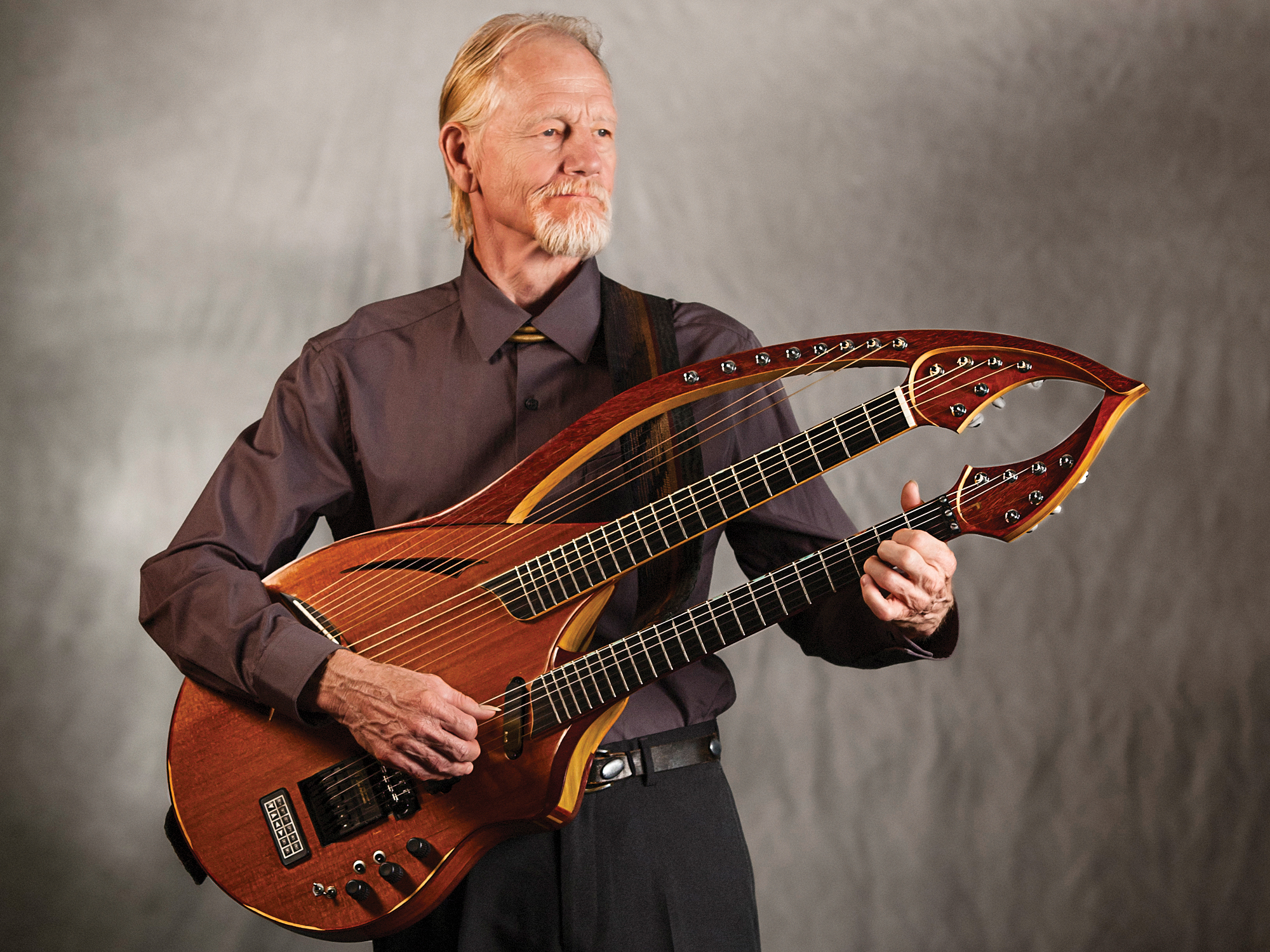
“I never would have imagined such a career,” says Eaton, who handcrafts one-of-a-kind instruments, such as his double-neck harp guitar.
Over the decades, 3,000 students have attended the school. Many have gone on to work for prominent guitar companies, including Fender, Gibson, and Taylor, or bespoke shops, such as the Santa Cruz Guitar Company. Other graduates build careers in guitar repair or start their own businesses.
Eaton, who is also a musician with four Grammy nominations (including two for Best New Age Album), has no regrets about his career pivot all those years ago. “My biggest satisfaction has been this beautiful thing—seeing how each student who comes here is transformed.”
Tracie White is a senior writer at Stanford. Email her at traciew@stanford.edu.