
Pulling drinking water from the air.
Stanford researchers have developed a durable hydrogel that can pull potable water directly from the air even in extreme conditions. Previous hydrogels did the job but degraded quickly, after roughly 30 cycles of use. The new material lasts about 190 cycles (roughly eight months of use), making the harvesting of atmospheric water more practical and economical. The researchers say the new technology could help provide safe drinking water to the one in four people globally who lack it, as well as ease pressure on water-intensive industries such as semiconductor manufacturing and data centers. Carlos Diaz-Marin, an assistant professor of energy science and engineering and co-lead author of the paper, said that the new improvements could result in water that costs about one cent per liter—roughly 1 percent the cost of bottled water. “We see a path to this technology to perhaps even being competitive with tap water,” he said.
When it comes to political advice, bots show bias.
People are turning to AI for voting advice, and AI is not neutral. Andrew Hall, ’09, a professor at the Graduate School of Business and a senior fellow at the Hoover Institution, and Sho Miyazaki, a former predoctoral research fellow at Stanford, created 36,300 synthetic voter profiles (with varying gender, region, and political views) ahead of Japan’s February Lower House election, then asked models from OpenAI, Google, and xAI to recommend a political party based on each profile. Policy positions dominated the recommendations far more than did demographic factors. And for synthetic voters with left-leaning policy views, the models disproportionately recommended the Japan Communist Party (JCP), even when other parties held similar positions on the issues tested. The chatbots relied heavily on the JCP website, which was fully accessible to AI web-search tools, whereas the major, editorially independent news outlets in Japan prevent AI crawlers from accessing their content. The findings could carry significant implications for election commissions, policymakers, and news organizations. An AI chatbot today is “operating in an information environment where the boundary between party communication and journalism is genuinely blurred,” wrote Hall and Miyazaki. “The consequences of that blurring flow directly into its recommendations.”
Come sail away.
Professor of English Adam Johnson knows how to tell a good story. He won the 2013 Pulitzer Prize for Fiction for The Orphan Master’s Son, about the life of a young man in North Korea that he based in part on his six-day trip to the country. A year later, while visiting New Zealand, he was inspired by a Māori storyteller and the art of oral storytelling. That led to his latest novel, a voyage through ancient Polynesia called The Wayfinder. “I went to these islands and I would say, ‘Do you know the story of the man with the jellyfish tattooed on his hand? Or the princess buried alive?’ ” said Johnson. It took 10 years of research—studying everything from the Tongan language to ancient navigation methods to medicinal botanicals—to write the 736-page tale. “When I wrote The Wayfinder I was thinking, You have to be true to your research. You have to be true to that storyteller I first met,” Johnson said. “And you have to try to capture a different kind of storytelling, one that’s alive.”
Picture-perfect planet.
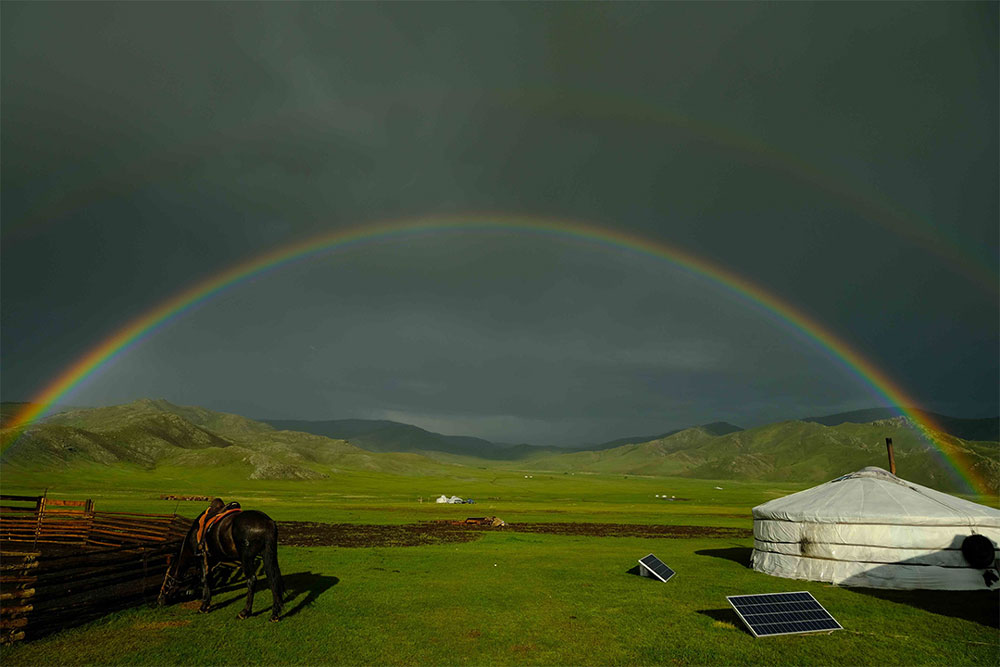 Photo: Anu Tsogtbaatar
From perfectly perched puffins to sardines swimming the seas, the winning photos from the Stanford Doerr School of Sustainability’s 2026 photo contest capture otherworldly beauty in the fantastic variety of life on Earth. Pictured above: the countryside of Selenge, Mongolia, after a hailstorm, which earned Anu Tsogtbaatar, ’27, first place in the “sustainability in focus” category.
Fishy business.
Bluefin tuna were approaching commercial collapse in the early 2000s, but they’ve made a triumphant comeback, according to new research led by Barbara Block, a professor of biology and of oceans. Researchers have spent more than 30 years tagging 1,720 bluefin tuna around the world, and Block’s team has revealed their migration patterns by mapping their movements, behaviors, and environmental preferences. Among the findings: Atlantic bluefin tuna don’t stay neatly separated into eastern and western populations, as previously thought. Many from the Mediterranean Sea, where most bluefin tuna are caught, travel to the east coast of the U.S. and Canada for the cuisine (mackerel, herring, and menhaden, which are found in relatively high numbers in U.S. and Canadian waters because—you guessed it—they’re protected), and they sometimes hang out there for years. That means quality time in literally safer waters. “The U.S. and Canadian fishers, along with North Atlantic fishers from Ireland, Norway, Sweden, and Denmark, are the ones doing most of the protecting of the Atlantic bluefin from both stocks,” Block said. Their strict catch limits appear to have helped the entire Atlantic bluefin population recover—not just the tuna born in that region.
But wait, there’s more…
Election law scholars and professors of law Pam Karlan and Nathan Persily, JD ’98, discuss the U.S. Supreme Court’s recent decision in Louisiana v. Callais and what it could mean for the future of the Voting Rights Act and minority political representation in the United States.
Stanford faculty were among the experts hired to pressure-test a new AI chatbot, only for the bot to offer detailed descriptions of how to make and release biological weapons.
Feeling lucky? According to Tina Seelig, PhD ’85, executive director of Knight-Hennessy Scholars, a few simple steps can help you create your own luck.
Josie Fabian, ’27, came to Stanford to pursue a career in aeronautics and astronautics. But after being diagnosed with acute lymphoblastic leukemia and receiving CAR T-cell therapy last year, she plans to major in bioengineering and now helps with research on the treatment that saved her life.
After Brazil banned smartphones in schools, students were more focused and got better test scores. But they also showed increased boredom and anxiety, according to new Stanford-led research.
Professor of mathematics Jonathan Luk and Princeton’s Mihalis Dafermos have shown that certain black holes challenge Einstein’s theory of general relativity. Basically, deep inside some rotating black holes, the future may not be fully determined by the past.
Note: The Loop sometimes links to articles outside of Stanford that may require a subscription to view.