9 things you (probably) didn’t know were invented at Stanford.
Today, Stanford is synonymous with companies like Google, Yahoo, and DoorDash, but long before unicorns roamed Silicon Valley, Farm folk were dreaming up inventions that transformed (and in some cases established) domains as far-ranging as nanotechnology and organ transplantation. In 1968, professor of cardiothoracic surgery Norman Shumway performed the first successful human heart transplant in the United States. Nearby that year, engineer Douglas Engelbart invented the “X-Y Position Indicator for a Display System” at the Stanford Research Institute (which was a part of the university until 1970). Today, it’s better known as a computer mouse. Read up on seven more creations that came out of Stanford—then tell us which, if any, you already knew about.
Teamwork makes the dream work.
Competition may light a fire under employees, but a new study shows that those flames can choke autonomy and lead to burnout. Researchers used surveys and experiments to probe the effects of cooperative, competitive, and independent conditions among three groups—Division I college athletes, employees from various organizations, and federal workers. Across all of the surveys and experiments, cooperative conditions fostered the greatest feelings of freedom. “Cooperation promotes psychological safety—a sense that it’s OK to take risks without the fear of being criticized,” said Valentino Chai, a doctoral student at the Graduate School of Business and co-author of the study. The resulting autonomy is linked to higher job satisfaction, greater commitment, and greater productivity. Competition, on the other hand, may generate short-term performance gains, but it pushes people to act along more rigid paths of self-interest and leads to feelings of stress. “Our findings show that employees feel suffocated by endless competition, and everyone pays a cost,” said Nir Halevy, a professor at the GSB and the senior author of the study.
Back-to-back splash.
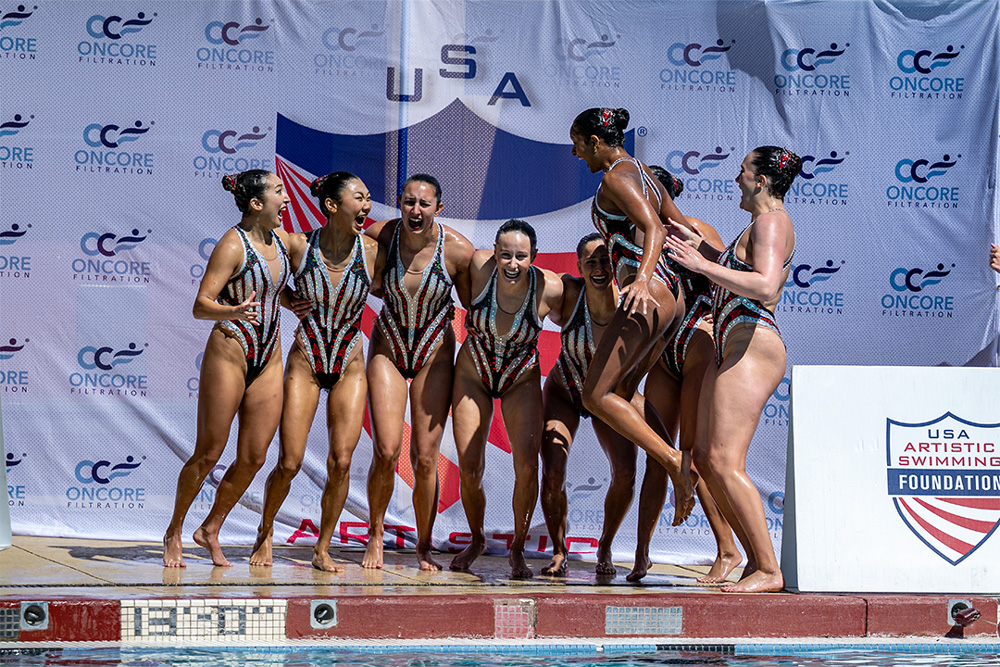 Photo: Stanford Athletics
On March 28, Stanford artistic swimming claimed its second consecutive national championship. Their wins in the trio and team events at the USA Artistic Swimming Collegiate National Championship boosted them to a total of 98 points. This is the Card’s 11th title, and its fifth earned on home turf—or should we say pool—at Avery Aquatic Center.
The machine that could revolutionize cancer therapy.
A cancer treatment called proton therapy, developed in the 1950s, enables radiation to target a tumor with minimal damage to surrounding healthy tissue. But the traditional equipment is costly and takes up the footprint of a football field—so, not exactly a feasible addition to most hospitals. But now, Stanford Medicine has collaborated with two companies to build a much smaller proton therapy machine. (It takes up about 1,200 square feet—a bit less than a volleyball court.) Last week, the Farm’s first-of-a-kind facility opened. “For our patients, the key is being able to eliminate their cancer without causing unacceptable collateral damage,” said Billy Loo, a professor of radiation oncology and co-director of particle therapy at Stanford Medicine. Proton therapy holds particular advantages for patients whose tumors are located near critical body parts such as the heart or spinal cord, and can result in fewer long-term side effects of treatment.
But wait, there’s more . . .
Sundar Pichai, MS ’95, CEO of Google and Alphabet, will be the keynote speaker at Stanford’s 135th Commencement ceremony on Sunday, June 14. Pichai joined Google in 2004 and helped lead the development of applications such as Google Chrome. “Sundar is a deeply thoughtful leader who has a vivid sense for how technology can improve society and transform individual lives,” said Stanford President Jonathan Levin, ’94. “He epitomizes what it means for a Stanford graduate to have a broad impact.”
Lerone Martin, a professor of religious studies and of African and African American Studies, will deliver the 2026 Baccalaureate address on June 13. Martin also serves as the director of Stanford's Martin Luther King, Jr. Research and Education Institute.
Redshirt freshman wrestler Aden Valencia—the No. 10 seed going into the NCAA championships last month—captured this year’s 149-pound wrestling title in overtime. He is Stanford’s third individual national champion in program history.
From food influencers to the FDA, everyone is pushing protein, but Stanford nutrition experts caution against radically increasing your intake. Most Americans already meet the recommended dietary allowance for protein. If you’re looking for a new focus, try fiber. Only about 5 percent of Americans consume enough roughage.
Speaking of protein, Burmese pythons are super into it. And their metabolism—which allows them to eat a massive meal and then not eat anything for months—has led scientists to a molecule that could curb appetite in humans.
It’s a bird, it’s a plane, it’s . . . a window washer? Spider-Man, Mr. Incredible, and other supers rappelled down the exterior of the Lucile Packard Children’s Hospital Stanford on a recent cleaning mission—squeegeeing their way into the hearts of pediatric patients and their families.
Note: The Loop sometimes links to articles outside of Stanford that may require a subscription to view.