
Insights on the war in the Middle East.
In the initial days of the Iran war, eight scholars from the Freeman Spogli Institute for International Studies (FSI) shared their insights on what might happen as time goes on and the conflict expands. Abbas Milani, director of Iranian Studies, wrote in the New York Times that an understanding of Iran’s past is crucial to anticipating its future. He sees potential for real change in the country. “The economy is a clear source of constant threat to the regime,” he wrote, “and the new secular women and men of Iran are unwilling to accept anything less than what they were initially promised before being deceived nearly half a century ago.” Michael McFaul, ’85, MA ’86, a professor of political science and a senior fellow at FSI, wrote on his Substack that a democratic Iran could be a close ally of the United States, but “the end of dictatorships rarely leads smoothly to the emergence of democracies.” Military intervention, he added, “is rarely an effective instrument for fostering democratic regime change.” And in a panel discussion hosted by the Center for International Security and Cooperation, FSI director Colin Kahl, a former U.S. undersecretary of defense for policy, warns that an extended military campaign could present challenges for the United States. “Iran has what is basically an inexhaustible supply of short-range, one-way attack drones that only cost about $35,000 apiece,” he said. “We are shooting them down with $2 million missiles. That is an exchange rate Iran will take any day of the week.”
Smells like progress.
COVID and the common cold are crafty little buggers that can mutate quickly to outwit our immune systems and our vaccines. But now, Stanford researchers have devised a nasal spray that could someday serve as a universal vaccine to protect our lungs against intruders. The spray (which currently goes by the catchy moniker GLA-3M-052-LS+OVA), has been tested in mice—meaning it has a long road to go before it might be available at your neighborhood drugstore. Still, it’s progress toward a holy grail of medicine. The vaccines we use now are antigen-specific: They mimic some aspect of a single pathogen. If the virus mutates or a new pathogen comes along, we need to alter the vaccine; that’s why the flu shot changes every year. This new vaccine imitates the signals immune cells use to communicate with one another during an infection. Those signals activate generalist immune cells to destroy a wide range of pathogens, as well as specialized cells and agents to target specific pathogens. When tested on mice, the nasal spray offered protection against not only SARS-CoV-2 but other coronaviruses, bacterial respiratory infections, and dust mite protein (a common asthma trigger). The researchers hope that within five to seven years, the spray could be approved to protect people from everything from the common cold to spring allergies. “I think what we have is a universal vaccine against diverse respiratory threats,” said professor of microbiology and immunology Bali Pulendran, the study’s senior author.
Tree huggers.
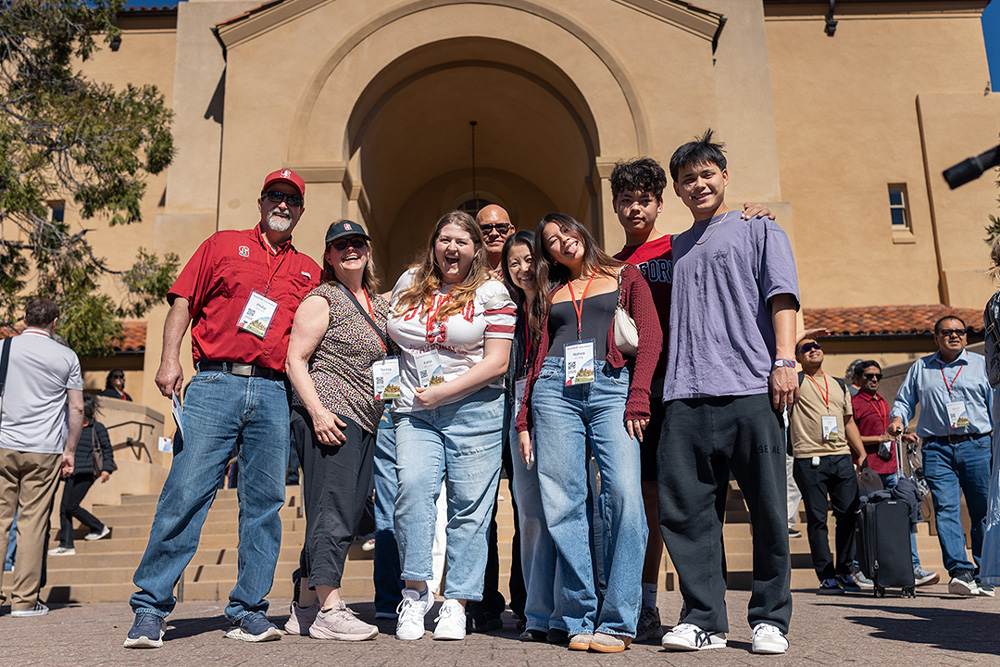 Photo: Andrew Brodhead/Stanford University
At the tail end of February, there was a lot of love on campus. That’s right: It was Family Weekend. The 5,500 loved ones who attended got to meet dorm staff, participate in faculty-led discussions, and choose from activities that included a pizza party, a walk around the Dish, and comedy night.
The price tag to end extreme poverty.
About 700 million people in the world live in extreme poverty, defined as living on less than $2.15 per person per day. How much would it cost to bring everyone up to that $2.15? The math isn’t simple—most poverty-gap estimates are based on surveys that account for only a small fraction of a nation’s population, and there are nonincome factors that contribute to wealth, such as livestock holdings. But now, building on a statistical method developed by Stanford faculty, computer science doctoral student Roshni Sahoo has created software that goes beyond household survey data and produces cost estimates for implementing a variety of policies, such as universal basic income. The result is a price tag to reducing the world’s poverty rate to 1 percent: It would cost 0.3 percent of global GDP, or about $318 billion per year. For illustration purposes, if a person making $45,000 per year donated 0.3 percent of their income to poverty alleviation, it would cost them $135. “The reaction I’ve had so far is ‘My gosh, that’s so little, I had no idea,’” says Paul Niehaus, the UC San Diego economist who initially spearheaded the research. “And maybe a little excitement and horror that that’s all it would take and we’re not doing it.”
But wait, there’s more…
Meet Sydney Barta, ’26, a five-time U.S. Paralympic Track and Field national champion and the first para athlete to run for Stanford. She’s also been named a 2026 Rhodes Scholar.
When the tech industry, theater, and foreboding collide, you get Data, the new off-Broadway play written by Matthew Libby, ’17, about employees at an AI company who are struggling with the ethical implications of their work.
Decades of research known as the “science of reading” is driving new literacy education laws in 40 states. Professor of education Rebecca Silverman offers insight into the raft of new legislation.
Jay Bhattacharya, ’89, MA ’90, MD ’97, PhD ’00, has been tapped to serve as the acting director of the Centers for Disease Control and Prevention. He will retain his post as the director of the National Institutes of Health.
One-third of stroke survivors develop aphasia, or trouble understanding and producing language. New research shows that brains with aphasia stop processing ambiguous sounds sooner than others, a finding that could influence treatment and therapy.
We’re flipping out: Watch gymnasts Anna Roberts, ’26, and Ui Soma, ’28, perform perfect vaults back-to-back.
Did you hear about the latest supernova flare? Chile’s Vera C. Rubin Observatory, jointly operated by SLAC National Accelerator Laboratory, has begun releasing near-real-time public alerts to keep the world apprised of goings-on in the universe. Software ingests and processes the information first, which is good because the raw stream would rival your family group chat; there could soon be up to 7 million alerts per night.
Note: The Loop sometimes links to articles outside of Stanford that may require a subscription to view.