Learning the ABZZZs.
Do you speak sleep? SleepFM does. The new AI model can predict a person’s risk of developing more than 100 health conditions based on physiological recordings from a single night’s sleep. The tool classified sleep stages and diagnosed sleep apnea as well as or better than state-of-the-art models used today, and it was particularly strong in its predictions of cancers, pregnancy complications, mental disorders, and circulatory conditions. Using 585,000 hours of data from sleep clinics—ranging from brain activity to leg movements—Stanford Medicine researchers had SleepFM perform standard sleep analysis tasks, such as determining the severity of a patient’s sleep apnea, before turning to the task of predicting disease risk from sleep data. “There’s a lot of other AI work that’s looking at pathology or cardiology, but relatively little looking at sleep, despite sleep being such an important part of life,” said James Zou, an associate professor of biomedical data science and co-senior author of the study. “SleepFM is essentially learning the language of sleep.”
The end of an era at the Stanford Alumni Association.
Howard Wolf, ’80, has announced that he will retire in August from his role as president of the Stanford Alumni Association. Wolf will celebrate 25 years with SAA this spring—years spent advancing the organization’s mission to reach, serve, and engage Stanford’s more than 248,000 living alumni. SAA hosts in-person and virtual events for students and alumni, including Reunion Homecoming, global alumni clubs and activities, educational travel programs, and publications like Stanford magazine and yours truly, the Loop. “Howard is a Stanford icon,” Stanford president Jonathan Levin, ’94, told Stanford Report. As the bridge between the university and alumni, Levin said, Wolf “has shared their hopes and strengthened their bonds to Stanford and to each other.”
Wolf first set foot on campus as a frosh nearly 50 years ago (the Loop originally wrote “half a century” there but thought better of it) and was a longtime alumni volunteer before joining SAA. The work of the alumni association, Wolf said, has kept him energetic and excited. “People say Stanford is the ultimate place of optimism, and it’s true. Stanford makes you believe in the future, and to be involved with that has been a blessing.” A search committee to identify Wolf’s successor will be co-chaired by Stanford Board of Trustees chair Lily Sarafan, ’03, MS ’03, and vice president for university affairs and secretary of the Board of Trustees Megan Pierson, ’82.
A snowball’s chance.
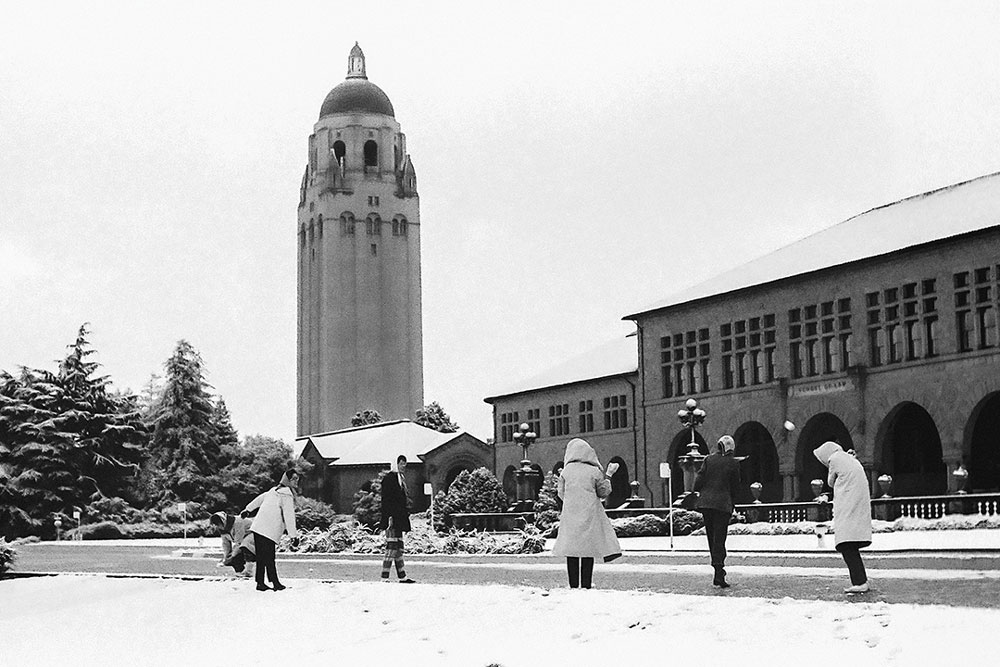 Photo: Stanford News Service
As much of the United States endures frigid storms (So sorry. Come visit!), we’re enjoying this photo taken on January 21, 1962—one of just three times in the university’s history when Jack Frost turned campus into a true winter wonderland. The most recent snowfall? Almost exactly 50 years ago—on February 5, 1976.
The biggest flex: a lifetime of health.
Failure is the new success, at least when it comes to lifting weights. According to Stanford Medicine experts, resistance training (aka strength training) is key to a healthy body at any age. And you don’t need heavy dumbbells: You just need to push to the point of failure—that moment when you know you can do only one or two more reps. That can be achieved either with heavier weights or more repetitions.
Stanford Medicine experts have compiled this and other tips to guide people toward healthier habits during three stages of life: the 20s and 30s, 40s and 50s, and 60s and 70s. Younger folks, they advise, should build the foundation for a life of good health: move more, sit less, eat well. Those in middle age should work to prevent muscle and bone loss and keep an eye on portion size as well as protein and fiber intake. And in later years, it’s important to work on balance and gait while remaining mentally engaged—learning new skills, reading, and staying socially connected. No matter your age, professor of medicine Abby King said, when it comes to getting healthy, “it’s never too late to start.”
Social (Security) moment.
In the last Loop, we asked what you thought of two economists’ plan to shore up the rapidly dwindling reserves that pay out Social Security retirement income by raising the retirement age and adjusting the progressivity of the formula. More than 50 of you responded, with notes ranging from appreciation for a partial solution and a political compromise to suggestions of how to make up the rest of the shortfall. Here’s what a few of you said.
“Their proposal is fine. But unaddressed is the obvious fact that a large cohort of affluent workers today earn way more than was the case when Social Security was invented. So the ceiling for paying anything into Social Security is too low. In fact, why is there a ceiling at all? Those making over [$184,500] are extremely able to afford to disproportionately support this program. Eliminate the ceiling, along with the other two suggestions. That combination should get us close to a fix.”
“Your proposal would unfairly penalize higher-income workers. We should be able to address the issue with reasonable adjustments to age and tax caps.”
“The OASDI rate (6.2 percent for employee and 6.2 percent for employer) should be increased to 6.4 percent paid by each; and the earnings cap on which OASDI is levied should be increased to $250K immediately and then ramped up to $400K over 10 years.”
But wait, there’s more . . .
Brigid White, a master’s student in design and a skier, wanted a place that welcomed more women into freeride skiing. She launched the Empowder Festival near Lake Tahoe last year, and the one-day clinic is back this February.
For better conversations, Christian Wheeler, a professor at the Graduate School of Business, advises you to ask follow-up questions such as, “How did that make you feel?” It signals interest in, and care about, your conversation partner, he said.
Jasmine Aikey, ’26, has won the 2025 Missouri Athletic Club Hermann Trophy, the top honor in NCAA Division I soccer. She is the sixth Cardinal woman to win the award and just the second player in history to both take home the Hermann and be named Academic All-America Team Member of the Year.
In a recent campus discussion, retired Supreme Court Justice Stephen Breyer, ’59, asked students to reflect on a question that the nation’s founders faced 250 years ago: Would a democratic republic work?
The 2026 Winter Olympics begin next week. Stanford athletes to watch include Zoe Atkin, ’26, freestyle skiing for Great Britain, Eileen Gu, ’26, freestyle skiing for China, Brandon Kim, ’28, short track speed skating for the United States, and Sammy Smith, ’28, cross-country skiing for the United States. Fun fact: Just two months ago, Smith started at defender in the 2025 College Cup final for the Stanford women’s soccer team. So, maybe the rest of us can manage to fit in some strength training.
Note: The Loop sometimes links to articles outside of Stanford that may require a subscription to view.