
Please pass the soy pulp.
In the campus lab of Vayu Hill-Maini, an assistant professor of bioengineering, agricultural byproducts such as soy pulp and oat-milk waste are being transformed into nutritious ingredients that can help address food waste and improve food system efficiency. Now, a new chef-in-residence program, led by Hill-Maini, is bringing top culinary minds to campus to help push the boundaries of culinary creativity in the name of sustainability. The program “helps us think not just about technology, but about how the perspectives in art and design can make sustainable food desirable—beautiful and delicious,” said Hill-Maini. The program’s inaugural resident is Ramón Perisé Moré, head of innovation and development at Mugaritz, a two-Michelin-star restaurant in Spain. Food is connected to our senses and emotions, Perisé explained. So when we find an unfamiliar dish before us, we sometimes reject it out of hand. “What we can do as chefs is take what’s being developed in the lab and present it in ways that feel familiar, so people are open to tasting it,” he said. “We’ve been selecting and transforming plants for thousands of years. You don’t have to be afraid of knowledge and technology—and it can even taste good.”
Good moves.
For people with movement disorders, clinicians typically use timed function tests—such as how long it takes a person to stand up from sitting—to infer disease progression and how well treatments are working. It’s simple and only requires a stopwatch, but it doesn’t catch subtler changes in a person’s condition. To get more detailed motion analysis about a person usually requires a visit to a special lab with highly trained technicians and expensive equipment. “The status quo is that very few people can have their motion measured,” said Scott Delp, a professor of bioengineering and of mechanical engineering. But in a recent study, Delp used smartphone video and OpenCap—an open-source software tool his team developed—to record 130 study participants as they performed various movements, create a 3D model, and measure 34 aspects of movement, including patterns that a stopwatch can’t capture such as stride length and range of motion. The computer model matched experienced clinicians’ ability to time movements using a stopwatch, and it far exceeded their ability to identify the two neuromuscular diseases represented in the participant group, facioscapulohumeral muscular dystrophy and myotonic dystrophy. The tool could democratize access to motion analysis, said Delp. “We think we’ll be able to detect movement disorders for free in the community.”
The Card’s next shot at keeping its streak alive.
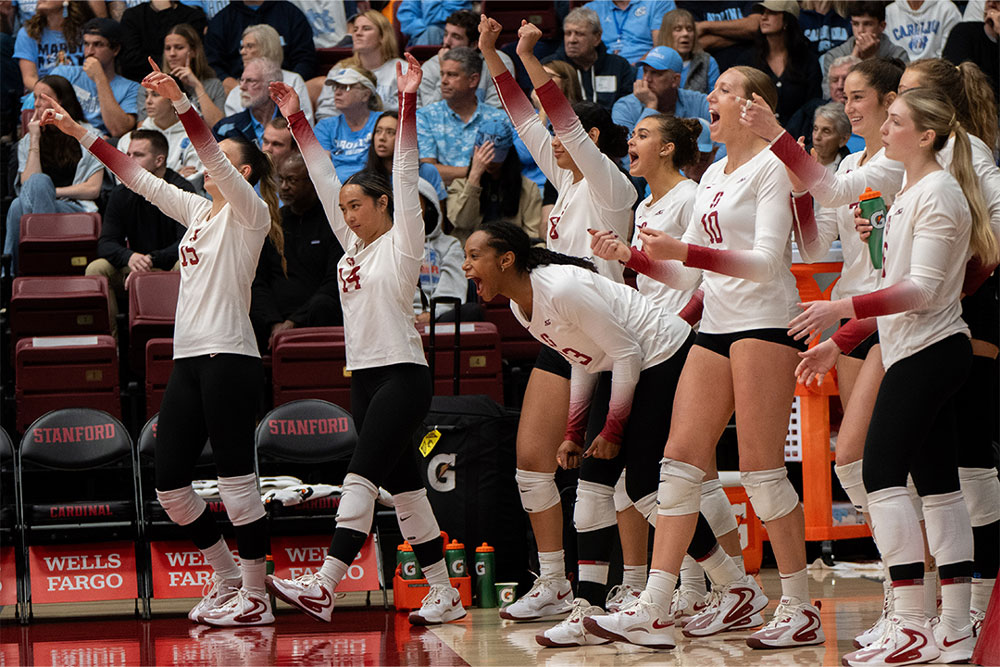 Photo: Fausto Ibarra/ISI Photos
Florida State women’s soccer defeated Stanford 1–0 in the final minutes of last night’s NCAA championship match. The Card finished the year with a 21-2-2 overall record. A win last night would have marked Stanford’s 50th consecutive academic year with at least one NCAA championship title. The next chance to hit that milestone lies with women’s volleyball, a No. 2 seed. On Friday, they’ll face third-seeded Wisconsin in the NCAA regional semifinal.
Welcome home, coach.
Tavita Pritchard, ’09, is the Card’s new head football coach. After 20 starts and 31 overall appearances as a Stanford quarterback himself, Pritchard spent more than a decade on the Stanford Football coaching staff, a period during which Stanford played in 10 consecutive bowl games. Since 2022, Pritchard has been the quarterbacks coach for the Washington Commanders. “Coach Pritchard is a culture builder, a teacher of football of the highest caliber, and a humble yet determined servant leader who is committed to the success of Stanford’s student-athletes,” said general manager Andrew Luck, ’12, MA ’23. Pritchard replaces interim coach Frank Reich, who this fall guided the Cardinal to its highest win total in five seasons.
Royal flush.
There’s a lack of loos in the United States, where you’ll find just eight public toilets per 100,000 people (well behind leader Iceland’s 56). When you can find a public toilet, it tends to stir strong feelings, and delight is not often one of them. For Fletcher Wilson, MS ’08, that presented an opportunity: to help people avoid anxiety and solve problems, and also to provide dignity. “For someone who doesn’t have access to a clean bathroom, having one is totally life-changing,” he says. He co-founded and leads Throne Labs, a start-up offering high-tech mobile toilets that compare favorably to the cost of building permanent facilities. Most users gain free entry via a QR code, and they can rate their experience afterward. If enough people report bad conditions, users making a mess of things can be banned. It rarely comes to that, Wilson told Stanford. But the possibility alone entices good behavior and results in toilets that stay tidy. Throne Labs has put more than 80 mobile restrooms in four geographic locations—greater Detroit, Los Angeles, Washington, D.C., and the Bay Area (including the Palo Alto Caltrain station).
But wait, there’s more . . .
Last week, Stanford president Jonathan Levin, ’94, spoke about the mission of universities during a New York Times DealBook Summit conversation with leaders from higher ed. “Our goal is to execute on being great places for learning,” he said, “and to have the greatest scholars in the world come and create the ideas that are going to benefit society.”
While aging generally increases the risk of cancer, a study in mice suggests that after humans turn 85, old age may inhibit tumor growth.
Just 10 percent of all cardiothoracic surgeons are female, an imbalance surveys indicate is exacerbated by inequitable pay and persistent sexual harassment. At a recent conference, 233 med students, trainees, and surgeons—including Stanford cardiothoracic surgeon and professor of medicine Leah Backhus, ’95—talked about how to change that.
Boosting your physical and mental health before a surgery, or prehab, has been recommended for years. Now, research shows that patients given personalized prehab coaching had fewer postoperative complications compared with those in standard programs.
The Stanford Accelerator for Learning, with support from Google.org, is hosting the Create+AI Challenge, a grant contest for project teams that are using AI to augment teaching, learning, or career opportunities. Anyone with a Stanford affiliation can apply.
Much of the U.S. has been unseasonably cold in recent weeks, and winter doesn’t even technically begin for 12 more days. Kari Leibowitz, MA ’18, PhD ’21, went beyond the Arctic Circle to gather secrets to enjoying the freezing season. On the list: Lean into it—flannel sheets, hot cocoa, the works.
Note: The Loop sometimes links to articles outside of Stanford that may require a subscription to view.
-->