
Hey, immune system: The scientists are on to you.
Looking for safe holiday conversation topics? Look no further. Stanford researchers have cured Type 1 diabetes in mice. The disease occurs when the immune system destroys insulin-producing cells in the pancreas. In a new study, mice were given a combination blood stem cell and pancreatic islet cell transplant from an immunologically mismatched donor. Such a transplant results in the animal having a hybrid immune system—one that contains cells from the donor and the recipient. The treatment prevented or cured Type 1 diabetes in the mice, and none of the animals required post-transplant immunosuppressive drugs. Seung Kim, MD ’92, PhD ’92, a professor of developmental biology and of medicine, believes the approach could be transformative for people with Type 1 diabetes and other autoimmune diseases, as well as people who receive organ transplants.
In related kick-ass science, a new study has shown that lupus, a chronic autoimmune condition affecting up to a million Americans, is caused by the Epstein-Barr virus (EBV). Nearly all of us have been infected by EBV, which is transmitted through saliva and most often lies dormant in our cells, including in immune cells called B cells. In an infected but otherwise healthy person, fewer than 1 in 10,000 B cells are hosts to EBV—and in the past, it has been virtually impossible for scientists to find those cells and distinguish them from uninfected ones. Using a new, high-precision sequencing system, researchers not only identified the infected cells but found that in a person with lupus, the number of B cells harboring EBV is much higher. Latent EBV occasionally nudges host B cells to produce a single viral protein, EBNA2, which sets off the cascading immune response that becomes lupus. “We think it applies to 100 percent of lupus cases,” said William Robinson, MD ’95, PhD ’95, a professor of medicine and the study’s senior author. Robinson suspects that the process extends to other autoimmune diseases, such as multiple sclerosis and rheumatoid arthritis. “This is the single most impactful finding to emerge from my lab in my entire career,” he said.
The Axe is back.
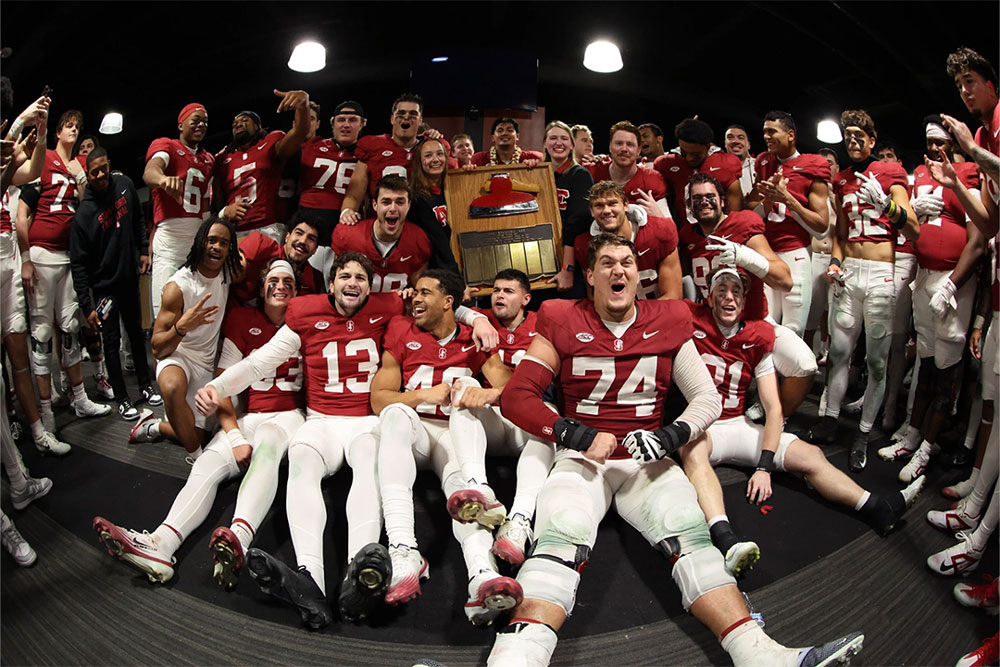 Photo: Bob Drebin/Stanford Athletics
After four years in Cal’s claws, the Axe has returned to its rightful home thanks to the Card’s 31–10 victory on the field on Saturday. The moment that went viral, however, took place on the sidelines when Stanford Football general manager Andrew Luck reacted mid-interview to a Golden Bears fumble. The 128th Big Game followed a week of legendary traditions—the beheading and Bearial of a stuffed Oski proxy, campus fountains dyed cardinal, and Gaieties—and at least one new event: Luck, ’12, MA ’23, pardoned a turkey.
The best time in your life is probably still to come.
Sure, being in one’s teens and 20s has advantages—a wide-open future, a working metabolism. But those are also the years when people show the highest rates of loneliness, depression, and anxiety. It doesn’t help that well-meaning people (say, at holiday gatherings) are constantly asserting that young adults are in their best years. According to Laura Carstensen, a professor of psychology and the director of the Stanford Center on Longevity, our emotional experiences improve as we age, peaking in our 60s and 70s. Older people generally feel more satisfied in their relationships and experience better emotional balance. “It’s different than saying, ‘I’m happier,’” Carstensen told Time. “Your emotional life becomes richer, and you’re more likely to see an old friend and smile and get a tear in your eye at the same time.” That said, while college students are lonely, research from the lab of Jamil Zaki, a professor of psychology, shows that they’re also highly empathetic and eager to help one another out, even though they underestimate those qualities in their peers.
But wait, there’s more . . .
Who are you grateful for? Glenn Kramon, ’75, a lecturer at the Graduate School of Business, wants you to write a note to someone in your life you should have thanked years ago.
If two Trees get engaged in a forest . . . it definitely makes a sound. Dahkota Brown, ’20, and Caroline Kushel, ’21, MA ’22, aka Trees 41 and 42, are set to make their relationship evergreen.
Sydney Barta and Tatiana Zhang, both ’26, are 2026 Rhodes Scholars. They’ll head to Oxford next year for graduate study in musculoskeletal sciences and Greek and/or Latin languages and literature, respectively.
How much would it cost to avoid an AI apocalypse ? According to economist Charles Jones, a professor at the GSB, mitigating the potential catastrophic risk of artificial intelligence is worth at least 1 percent of the United States GDP (about $300 billion) annually. Anyone selling a bunker? Asking for a friend.
A new ultrasound helmet may help cleanse the brain’s cerebrospinal fluid, offering a drug-free and noninvasive treatment method for aging and injured brains.
Goosebump alert: For 49 consecutive years, Stanford has brought home at least one NCAA title. Get hyped for the (fingers crossed!) 50th.