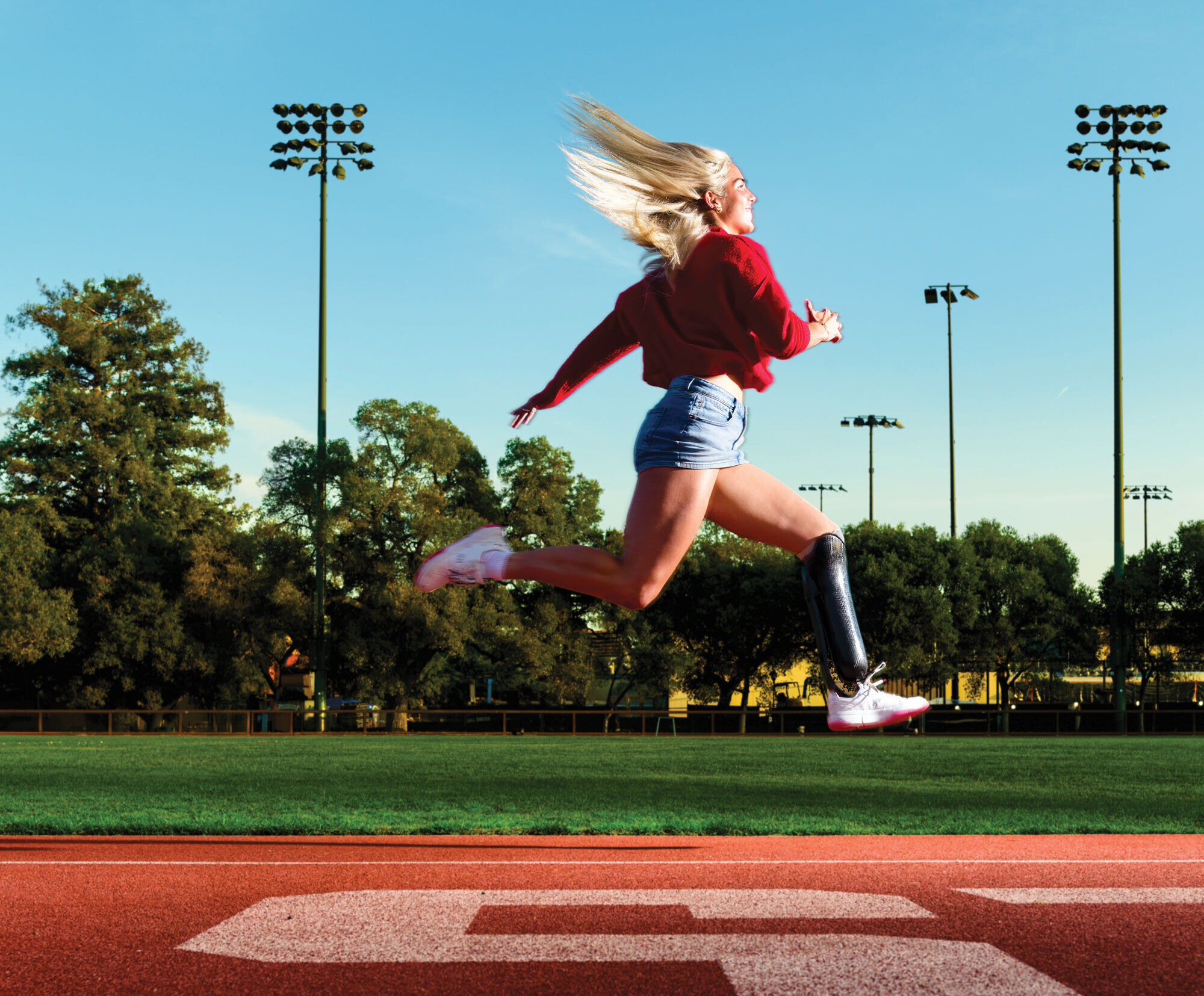
Sydney Barta is a girly girl. Just ask her and she’ll tell you.
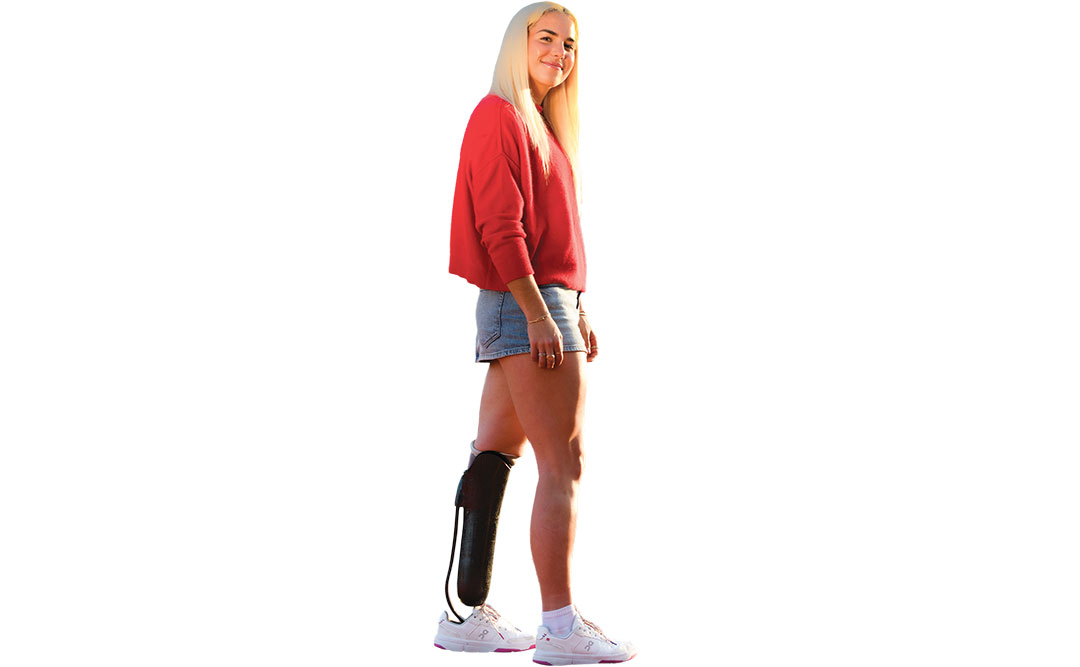
“I love pink,” she says one day in her dorm room after track practice. She’s dressed in running gear, wearing rows of gold earrings and sporting long fingernails painted white and adorned with sparkly red stars. She’s got a fluffy pink bedspread that matches the pink Ugg boots on her shoe rack. She loves shoes. Her dorm room is filled with them.
“I only have one foot, but I have so many shoes,” she says, laughing. Barta, ’26, a sprinter, recently signed an endorsement deal with the Swiss sneaker brand On. She’s got stacks of shoe boxes in her closet. She also wears heels, although she doesn’t currently have a prosthesis that fits them.
“I duct tape them on,” she says.
Barta is a five-time U.S. Paralympic Track and Field national champion and the first para athlete to run for Stanford. She’s also a Rhodes Scholar who has applied to medical school and is looking ahead to the 2028 Summer Paralympics in Los Angeles.
And she hopes to be a role model for other young girls who have undergone amputations. When she was 6, her mother climbed into her hospital bed to tell her the news of her amputation and showed her a photo of a famous para athlete running on a blade. But he was a man and didn’t look anything like her, she says.
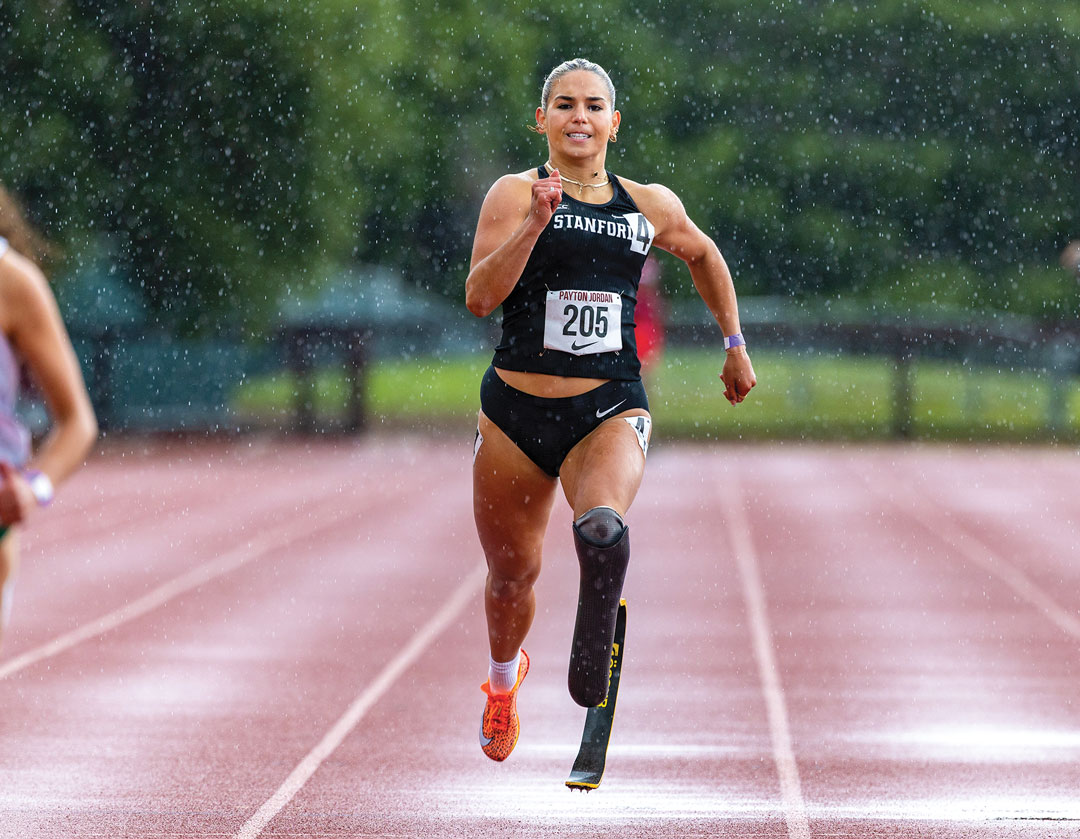 Photo: John Lozano/ISI Photos
“It wasn’t feminine at all, and it wasn’t me because I was a girly girl,” she says. “I was a ballerina before the accident, and I love pink. That’s the biggest thing I was upset about.
“I know that if I were a little girl going through something like that now, there would be so many people, maybe even including me, who they could pull up on a phone and be like, look at all these girls. Right?”
“When something bad happens, you have to wring every single ounce of good from it that you can.”
“The day of the accident, me and my twin brother were at a fun run. I was 6 and had just finished the race. I remember my mom looking up toward something behind me and she was really scared. I started running toward her. A big metal scaffold blew over in the wind and clipped my ankle. It could have killed me. I just feel so lucky that the only thing I lost was my leg that day.
♦
“The summer before my junior year, I was running the last race before the [Paralympic] trials. I pushed over the finish line, and I felt my foot crack. I had broken it all the way through. I thought my Paralympic dreams were over. I realized then that it was my calling to be a doctor that understands the experience of an athlete—when an injury is so devastating because it can take away the sport that you love and that your identity is built on.
♦
“When I broke my navicular bone—the [key] arch bone—in my only foot, it made me want to be a bone doctor, to do research on women and consider how hormones, stress, sleep, training levels, differences in biomechanics when you’re talking about unilateral amputees, how that all comes together to form an injury. I feel like that’s my unique mission.
♦
“After I broke my foot, I thought I was done with track. I was really reinvigorated by the prospect of becoming a doctor. I thought, It’s bad right now, but in September I’ll go back to school. I’ll still be able to have all the opportunities, just maybe not with track.
♦
“I got a call from Coach [J.J.] Clark, the head coach of Stanford track, and he’s like, ‘I put you on the team.’ I was freaking out, I was so excited. But that just goes to show, right? Like, you never know.”
Tracie White is a senior writer at Stanford. Email her at traciew@stanford.edu.