
Flipping amazing.
When Asher Hong, ’26, dismounted from the rings at the NCAA 2026 men’s gymnastics championships, he secured the continuation of a remarkable streak: Stanford has now won at least one NCAA team title every year for 50 years . The streak, which includes 126 wins by 19 Stanford teams, is the longest in NCAA history. The next longest streak, held by Kenyon College, was 31 years long, only included three sports, and ended in 2010. The University of North Carolina at Chapel Hill holds the next longest active streak—seven years. There are still a few team championships to go in the academic year, but men’s gymnastics has saved the streak, and that deserves some backflips . . . or, you know, applause, so we don’t hurt ourselves.
Tech support.
Dull, dirty, and dangerous. For decades, the “Three D’s” were viewed as the ideal types of jobs for robots. But the future of robotics is looking softer, safer, and more domestic, thanks to Stanford researchers, who are building them ahead of a looming shift in society: By 2030, there will be more Americans over 65 than under 18. It’s a generational imbalance that will test caregiving resources. “When we talk about domestic robotics, we really talk about robots to support aging and disabilities,” said Steve Cousins, PhD ’97, executive director of the Stanford Robotics Center. From a robotic guide dog to inflatable “vine robots” inside clothing that help the wearer get dressed, researchers are designing technology that can offer a gentle helping hand and greater independence. With some 46 percent of Americans aged 75 and older reporting having a disability, and the eldest Baby Boomers turning 80, “caregiving is the critical societal problem robotics has to solve,” Cousins said.
That winning feeling.
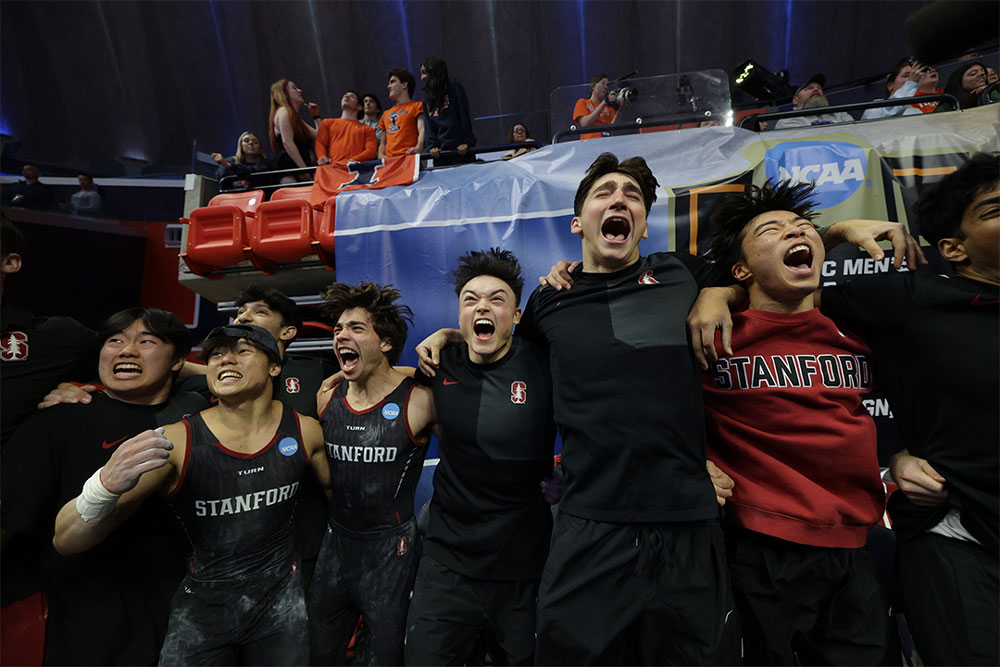 Photo: Michael Hickey/Stanford Athletics
Cry happy tears with the team.
New buzz about mosquito detection.
As climate change drives dengue-carrying mosquitoes into new territories, researchers have devised a way to hunt down the suckers before they hatch. Working with drone pilots in Makassar, Indonesia, researchers captured high-resolution images of a 4-kilometer section of the city, then trained two AI systems to identify the locations, shapes, and distribution of a common and problematic mosquito breeding site: discarded vehicle tires. They’re basically dream nurseries for skeeters, hiding shady pools of standing water that are perfect for their eggs. In a dense city like Makassar, tires lurk out of sight on roofs, under vegetation, or in other places invisible to people doing ground surveys. The AI systems found twice as many tires as human analysts reviewing the same imagery. “We are at a turning point,” said Joelle Rosser, MS ’21, an assistant professor of medicine. The recent advances in remote sensing and AI “have allowed us to completely reimagine how we study interactions between the environment and humans and how we respond to a rapidly changing environment.”
But wait, there’s more . . .
There was a Cardinal glow around the Boston Marathon this year. In the women’s division, Jess Tonn McClain, ’14, MA ’15, was 5th overall and the top American finisher, setting an American course record with a time of 2:20:49. Charles Hicks, ’23, was 7th in the men’s division and the second American finisher. And Sara Bei Hall, ’05, placed first in the master’s division in 2:31:55.
Researchers have discovered that chronic and acute pain are driven by separate brain circuits, suggesting targeted therapies could treat chronic pain without silencing the acute pain that signals danger.
How realistic is the HBO medical drama The Pitt? According to professor of emergency medicine Matthew Strehlow, extremely so in its portrayal of the urgent, rapid pace of an ER; less so in conveying the importance of nonphysician team members—and the amount of time ER docs spend on computers. (Quick flex: Joe Sachs, MD ’85, MA ’87, is an executive producer.)
Doctoral student Hanna Folsz, MA ’22, explains how Hungary’s Tisza Party triumphed over Orbán.
More than 100 former NASA astronauts of all political stripes have formed Astronauts for America—led by a group that includes four-time astronaut Steve Smith, ’81, MS ’82, MBA ’87—to promote understanding of constitutional principles, score political candidates, and meet with policymakers to share their concerns about the state of democracy in the United States.
Stanford sailing went 21-1 across two days of competition at the ICSA Women's Team Race National Championship to take home the title for a third-straight year.
It took Alice Rowe, ’29, just 30 minutes and 39 seconds to become the country’s fastest jigsaw puzzler at this year’s USA Jigsaw Nationals. The first-year student joins a posse of puzzlers posse of puzzlers with roots on the Farm.
Note: The Loop sometimes links to articles outside of Stanford that may require a subscription to view.