Lowell Wilson hadn’t made varsity yet—in the 1960s, freshmen still played on their own team—but the lineman was a likely star in the making. In the 1962 “Little Big Game,” he’d recorded the most tackles in Stanford’s 3–0 win over Cal’s frosh, and expectations were high. But in five years of high school and college football, Wilson had never done a drill like the one he lined up for at that Friday spring practice in May 1963—and he was, according to later correspondence, apprehensive to take his turn.
Each of the linemen was to tackle a sand-filled dummy hanging from a metal chain. It weighed, according to one teammate, hundreds of pounds, and after one player drove into it, the bag would swing back toward the next. “My turn came and I went straight for the dummy and it went straight for me,” Wilson said in a later letter. The players were supposed to hit the bag with their shoulder. Wilson hit it with the crown of his helmet and collapsed. When he regained consciousness, he was on a hospital table, surrounded by surgeons who had just performed a tracheotomy to put him on a respirator. He was paralyzed from the neck down.
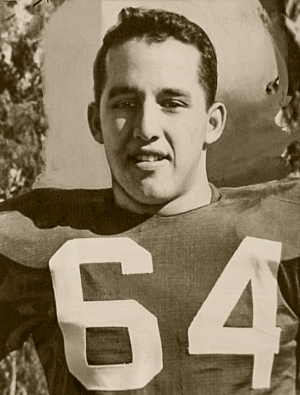 FOOTBALL ON THE FARM: Wilson in his Stanford jersey during his freshman year. (Photo: Courtesy the Wilson family)
Chuck Kleymeyer, ’66, recalls the intensity of visiting his classmate in the hospital. He had just gotten to know Wilson on a spring break service trip to the Round Valley Indian Reservation in Mendocino County, north of the Bay Area. While the otherwise preppy Stanford students in skinny pants struggled to find social footing with reservation residents, Kleymeyer says, Wilson, who was part Native Hawaiian, had an easy rapport built on jokes and his own Indigenous background. “He just easily went back and forth. It was as if he belonged in both groups,” Kleymeyer says. “Lowell would look at you. He’d listen to you. He’d pay attention to you. Not everybody does that.” When Kleymeyer visited him in intensive care, Wilson’s head was fixed in place, the respirator limiting his responses to clicking his tongue on his teeth. “It was a one-way conversation,” Kleymeyer says.
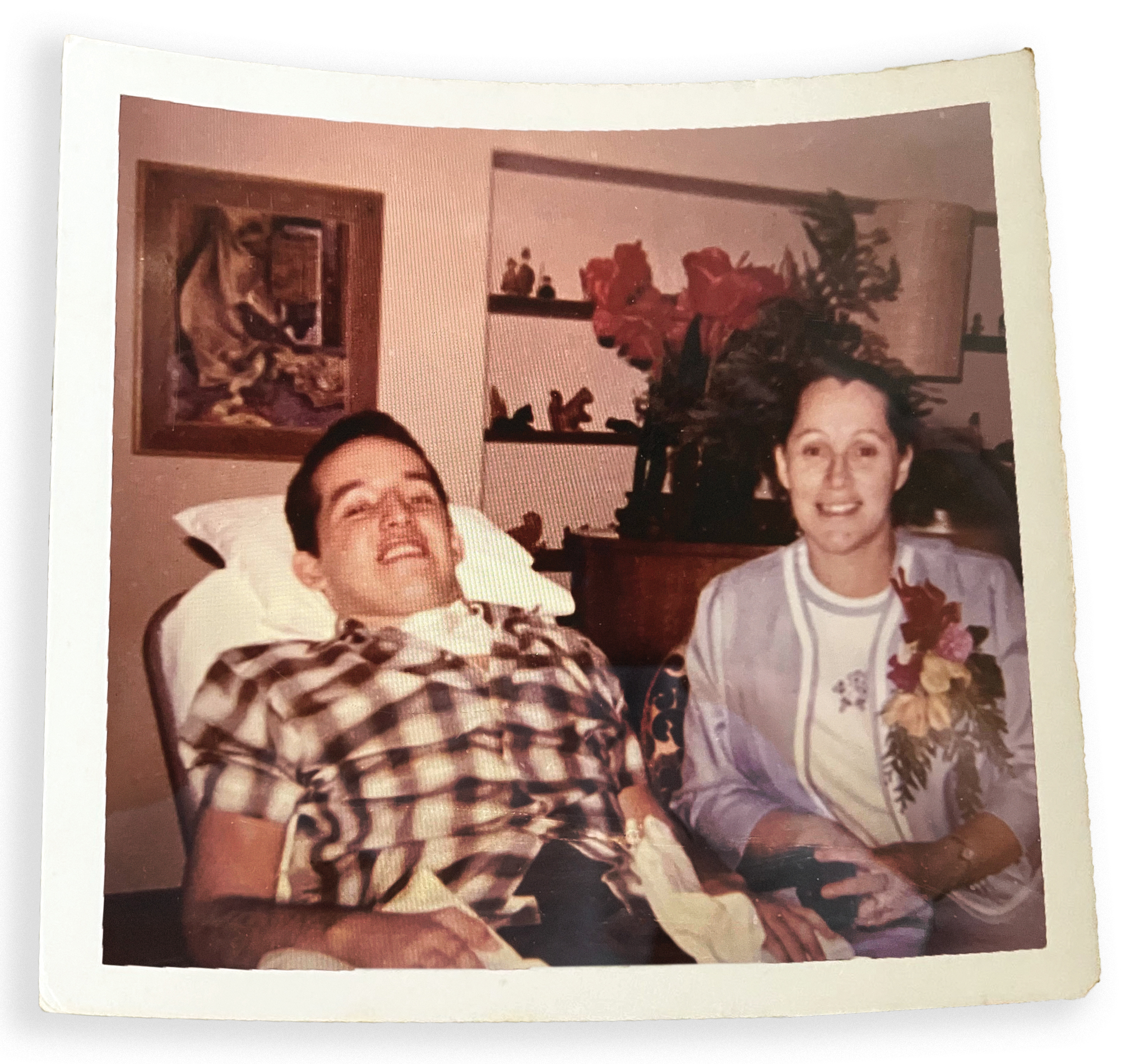 FAMILY GATHERING: Wilson and his mother spent Christmas Day 1963 with the Bunker family. (Photo: Jane Bunker)
More than 60 years after answering the emergency call from Stanford, Lowell’s older sister, Shirlene, still finds her voice catching when she talks about her brother. He’d been a star in so many ways: a champion debater, an all-state football guard, a school-best chess player, a Sunday school teacher, a student journalist, and a voracious reader. “He was like a library himself.” He attended Stanford on a scholarship, choosing it over Harvard for its relative proximity to their home on Oahu, she says. At Stanford, he studied Russian to prepare for his planned career in international law and diplomacy. “He said when he walked into a room with the Russians, he wanted to know exactly what they were saying—he loved anything that was challenging,” Shirlene Wilson says. “This was an extremely unhappy and very sad circumstance, what happened to my brother.”
The accident shocked the team. “You could break your arm, break your nose, tear up a knee,” says classmate Craig Ritchey, ’66, a defensive back and kick returner. “But that someone in the prime of his life could be in an instant rendered quadriplegic—that was a big, big shock to all of us. It was just heart-wrenching.” Coaches responded with an added emphasis on safety, says Joe Neal, ’65, MD ’70, who had participated in the drill. The swinging dummy had been new to them all that day. It was never used again.
‘If I never make a recovery, I will have to make the best use of what I have. Future prospects are that of a counselor of some sort, or a novelist.’
Wilson’s parents flew to Stanford immediately following the accident but soon had to return to Hawaii to tend to their two younger children as well as their jobs—his dad, August, was a civilian shipfitter at Pearl Harbor; his mom, Annie, worked in the Hawaii State Tax Office. They were encouraged to sue by a celebrity lawyer, Shirlene Wilson says, and correspondence shows Stanford girding for a lawsuit. But Annie was a devout Christian who believed in God’s will and in forgiveness, Shirlene Wilson says. “God is love,” from 1 John, was her comfort. In 1967, she and August welcomed head coach John Ralston during his trip to Hawaii to coach the Hula Bowl.
Stanford was covering the costs of Wilson’s medical care, and by October 1963, he was stable enough that the university offered to provide him with safe transport back to Hawaii on an Air Force medical plane. But Wilson believed he would receive better care at Stanford, his sister says, where he began to wean from the respirator, surprising doctors by getting off it completely in the spring. He was also receiving social support from classmate Jane Bunker, ’66, MA ’80, PhD ’85.
Bunker had had only passing encounters with Wilson before his injury. But her father, John Bunker, the founder of the medical school’s department of anesthesia, was involved in his care, and he asked her if she’d like to visit him as many students were doing. Bunker agreed. As time went on, she became one of the only students coming regularly. “In the very beginning when I started going, it felt really scary,” she says. “After a while it felt like home because that’s where I went every day.”
Bunker would read Wilson his mail, write letters for him, help the nurses, and feed him. Wilson loved spareribs from Stickney’s Hick’ry House, across El Camino Real from campus, and Bunker would hold them up so he could chew on them. “Being with him always made me feel happy,” she says.
In a letter from November 1963 to Daniel Akaka, later a U.S. Senator from Hawaii, thanking him for organizing a benefit football game, Wilson described life after the “freak accident” with matter-of-fact candor. He took about 22 pills a day, had lost about 60 pounds, and was missing island foods like mea ono puaa, poi, and saimin. “This past half-year I have been in the same bed, and in the same ward,” he wrote. “I am beginning my seventh month and am sure to set a record that no one will equal for quite a while.” He looked to the future with “mixed feelings.” “If I never make a recovery, I will have to make the best use of what I have,” he wrote. “Future prospects are that of a counselor of some sort, or a novelist.”
He would leave the hospital for the first time since his accident on Christmas Day 1963. Dr. Bunker arranged ambulance transport to bring Wilson and his mother to the Bunker family home. Photos from the day show Wilson’s smile. “That’s really one of my highlights,” Jane Bunker says. “And I think it was one of his highlights too.”
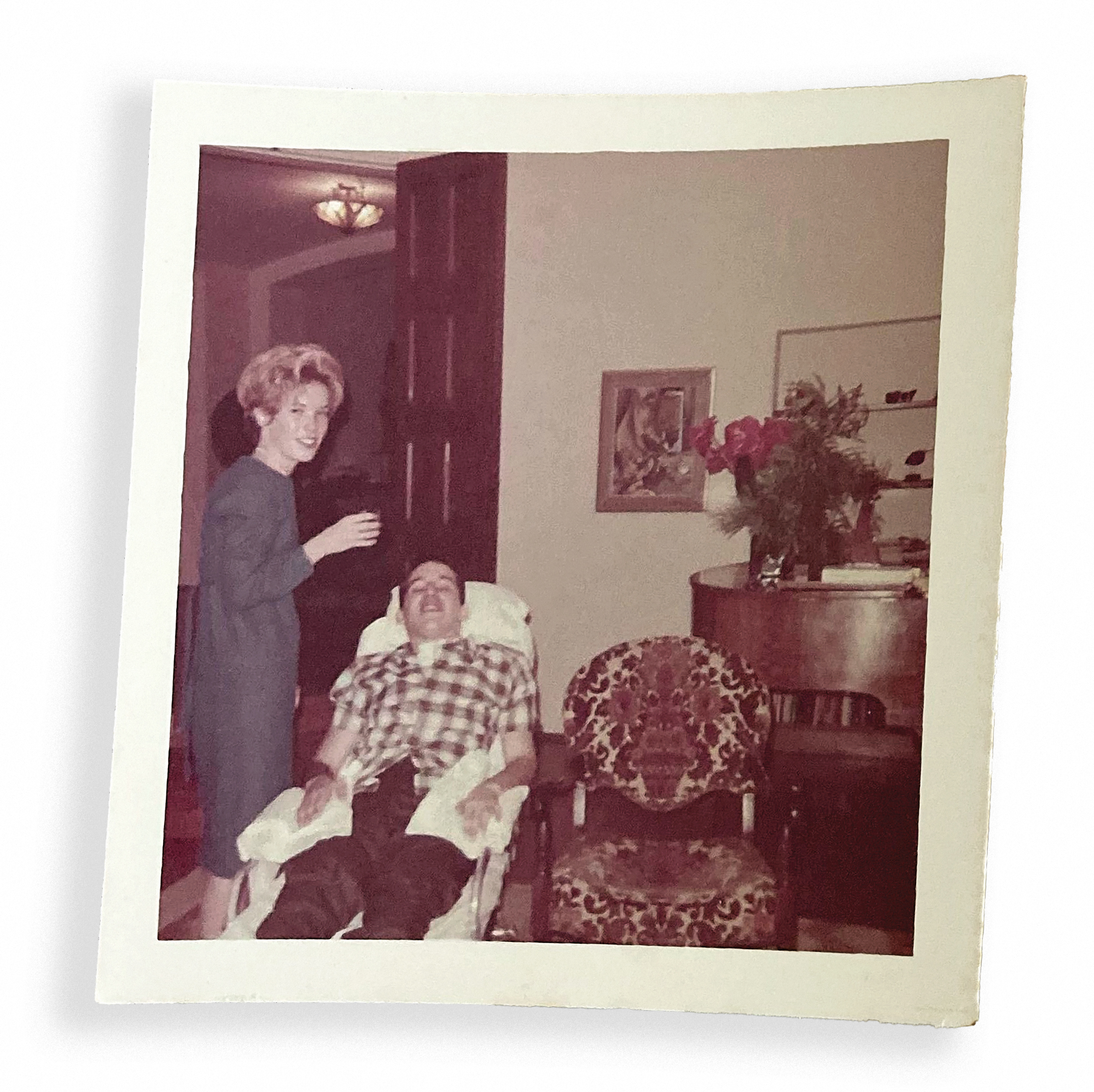 HAPPY MOMENT: Jane Bunker, left, remembers sharing Christmas with Wilson as a highlight. (Photo: Courtesy Shirlene Wilson)
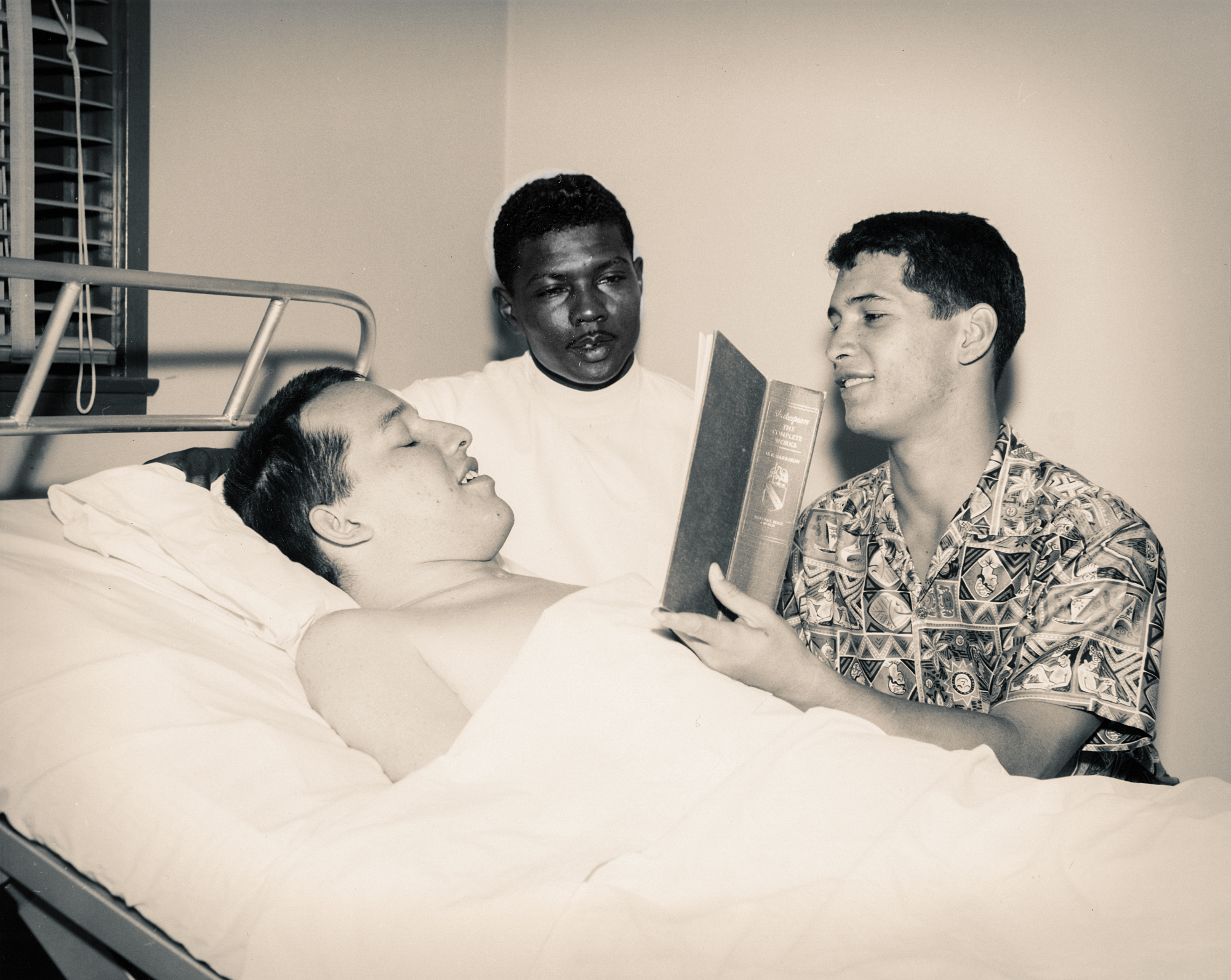
By spring 1964, Wilson’s condition had stabilized to the point he could move out of the hospital into university housing with 24-hour care. A story in the San Francisco Examiner on June 23, 1964, announced that Wilson was one of 3,600 students taking summer school at Stanford. An accompanying photo showed his visiting younger brother, Daryl, holding up Shakespeare: The Complete Works for him to read. “Paralysis No Bar to Study for Wilson,” the paper declared. “Wilson, who must use a rocking bed to make breathing easier, plans to take a course in Shakespeare. He has learned to type with a rubber-tipped stick, and by rolling his head he can operate a page-turner or switch a tape recorder on and off.”
The breezy tone belied enduring challenges. Bunker had recently left for a family vacation in Cape Cod before heading to Stanford in France. “I do remember him calling me and asking me to come back,” she says. “And that was awful because I couldn’t.” Wilson was struggling with the settling reality that his condition was not going to improve further, his sister says. In his final month, he had refused to use the rocking bed that aided his breathing. Still, his brother Daryl recalls leaving him in good spirits when he returned to Hawaii in July.
But shortly after Daryl’s departure, Wilson was admitted to the hospital with “mental confusion.” He died two weeks after his 20th birthday, the death termed “sudden and unexpected.” An autopsy was inconclusive, but the role of the accident was plain.
It’s a loss Kleymeyer often thinks about. The only Stanford student-athlete to die as a result of an accident on the playing field should be remembered, he says. Jane Bunker never forgot him. She was an art major at Stanford and later a painter. But her time with Wilson sparked an awareness that she was nurtured by service, and ultimately she became a therapist, providing mental health services in poor communities of color. She now uses her art to fund numerous scholarships for Black students in Florida, where she lives. “Lowell showed me how important it was for me to be in some sort of a work focus where I was caring for other people,” she says. “It wasn’t just some little time in my life. It was pivotal.”
For years, Wilson’s death was a taboo topic within the family, Shirlene Wilson says. “When my dad was around, we could not talk about Lowell.” Her dad put all his awards, photos, and mementos into a Chinese chest and kept it closed. Bolstered by faith, her mother was more open, she says.
Successive generations have honored his legacy. Not long ago, Daryl Wilson commemorated his granddaughter’s graduation from high school with a family trip to his brother’s grave, which is beside his parents’ on Oahu. She had done a report on her great-uncle as part of her studies. Photographs show purple and white leis laid near his marker, its inscription worn but readable: God is love.
Sam Scott is a senior writer at Stanford. Email him at sscott3@stanford.edu.