
For Henry Segal, ’26, the writing was on the wall. Soon after arriving at Stanford, he found himself routinely drawn to the sundry small plaques he spotted around campus. While enjoying the quiet ambience of a study room bearing the name of someone or other, he would think, The least I could do is read who this is named after. By the end of his frosh year, he’d read just about every plaque on the Farm and created a map of his favorites, from the pair of plaques in Memorial Court honoring the first Stanford community members to die in World War I to a marker for an avant-garde bike rack outside Cantor Arts Center indicating it was designed by David Byrne, lead singer of the ’80s rock band Talking Heads. Each inscription Segal encountered offered a window into what had come before his time on campus—“the soul of the school,” he says. “It’s almost like a civic duty to just know about your environment.”
That sense of obligation and fascination with bits of the past is characteristic among members of the Stanford Historical Society (SHS)—a brigade of history buffs who last year voted in Segal as the organization’s youngest current board member. Established by a small group of faculty and campus loyalists 50 years ago, SHS now comprises 800 members and 200 volunteers who give their time to discovering and preserving the history of the university. From lectures to tours and from oral histories to a triannual magazine called Sandstone & Tile, SHS strives to explore, document, and celebrate every nook and cranny of the Farm. And that means every nook and cranny. It was SHS member Donald Price, ’53, MBA ’58, for example, who researched the history of a pair of 4-foot, cast-iron griffins (or winged lions—the jury is still out on that) acquired by the university in 1931 and eventually relegated to a storage facility. Price’s work led to the beasts’ 2018 recovery and new posting outside of the Stanford Mausoleum. And it was Sol Martinez, ’22, a student intern sponsored by SHS and the Centers for Equity, Community, and Leadership, who in 2021 combed through the papers of professor emeritus of history John Johnson—who helped build the field of Latin American history—and discovered his unpublished manuscript Foreign Images of the U.S.: 1860-1992: A Cartoon History, an examination of political cartoons about the United States. That work, hidden in plain sight since Johnson’s death in 2004, is now available in Stanford’s archives.
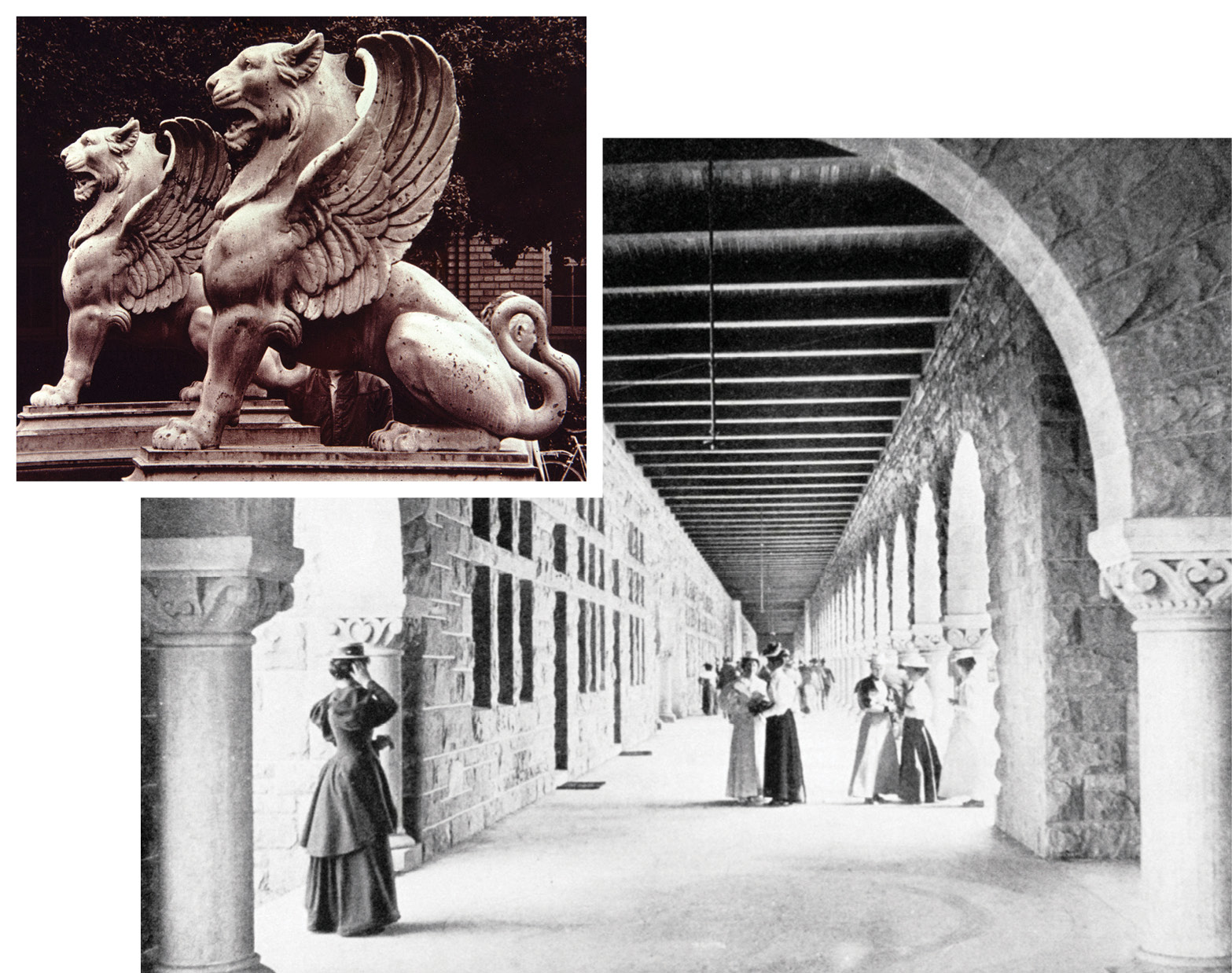 Courtesy Special Collections & University Archives/Stanford Libraries (2)
The particularized work of SHS often serves as a trove for anyone writing about the university (dozens of Stanford stories include attributions to SHS). And it can complement work done by Stanford University Libraries, helping to build the historical record for researchers on campus and beyond, says university archivist Josh Schneider. He points to SHS’s Beyers Prize for Excellence in Historical Writing, which awards $1,000 to up to two students per year for original research and writing. “They’re often reinterpreting Stanford history through a more contemporary lens,” he says, “and often the writing is fantastic and ends up being published.”
Still, the compulsion to delve into such fragments of history is . . . niche. “I don’t expect a historical society to be a mass popular society—it’s for nerdy people,” says Larry Horton, ’62, MA ’66, the SHS board president and a former Stanford administrator. But the mission of SHS is vital to a society built on knowledge passed down through generations, he says. “It’s hard to enjoy the current reality if you don’t know what came before.”
And much of what came before is still up for discovery. “History at Stanford is a contact sport,” says Segal. Whether scouring archival footage or tracking down sources, Segal often finds himself unearthing unwritten campus stories. Last year, Sairus Patel, ’91, editor of the Trees of Stanford website, tipped him off to an obscure brass plaque—installed as a prank—under a silk tree on campus. “There’s nothing about this on the internet,” says Segal. He spent 10 weeks investigating its backstory and ultimately created a Stanford Storytelling podcast episode about it. Those deep dives are one of the reasons Segal invites friends to attend SHS meetings and discover pieces of the past for themselves. Here, he says, “you’re doing history rather than studying history. It’s really exciting.”
In celebration of the 50th anniversary of SHS, test your knowledge of Farm history with trivia inspired by one of the society’s 30 published books and monographs, A Chronology of Stanford University and its Founders.
|
|
|
When a conversation at work is going well, Natalie Marine-Street doesn’t talk much. Hired in 2015 as the first full-time staffer of the Stanford Historical Society’s oral history program, Marine-Street, MA ’14, PhD ’16, is the engine behind the sometimes hours-long interviews of Stanford community members. “Your job as an interviewer is to turn your interviewee into a storyteller,” says Marine-Street. Since its inception in 1978, the oral history program has recorded and transcribed 1,468 interviews, most of them available online. Its interviewers have worked to capture the experiences—professional but also sometimes deeply personal—of Stanford’s luminaries. You can hear, in the subjects’ own words, about former university president John Hennessy’s childhood in a large, Irish Catholic family; Hoover Institution director and professor of political science Condoleezza Rice’s role as a White House Soviet specialist in the George H.W. Bush administration; and the early work of professor of mechanical engineering David Kelley, MS ’78, who earned $2 an hour demolishing building interiors with the Intergalactic Destruction Company prior to founding the design consulting firm Ideo. There are also hundreds of interviews with lesser-known figures: staff who restored the Arizona Cactus Garden; teachers of Shakespeare and of bioengineering; and a former Lagunita Court resident who recalls her undergrad days—everything from designing her dorm’s T-shirt to witnessing the Challenger explosion. “Over the years, we’ve really tried to think about, What are the many different histories of Stanford?” says Marine-Street. She conducts or oversees about 100 interviews annually—40 with faculty and staff, 40 with alumni, and a couple dozen based on suggestions or theme projects. Those have included three dozen anti–Vietnam War activists; panels of pioneering female faculty members; and five deans of Humanities and Sciences representing 40 years of leadership. Many such projects are conceived in collaboration: Several years ago, an alum suggested Marine-Street capture the evolving experience of Stanford community members with disabilities. There are now 27 such interviews available online. Illustration: Bitter/iStock/Getty Images |

Kali Shiloh is a staff writer at Stanford. Email her at kshiloh@stanford.edu.