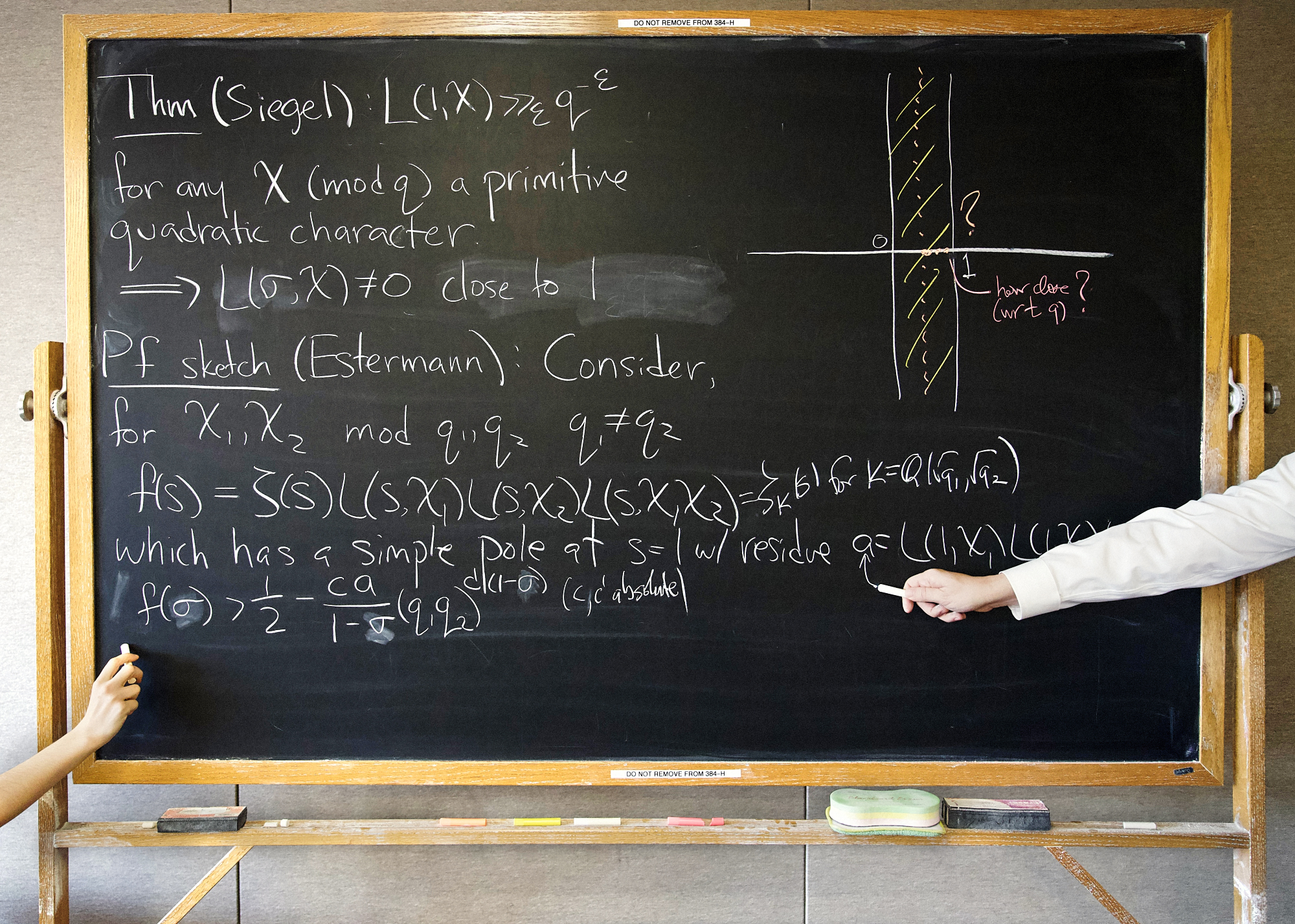
On a campus colonized by novelty, the math department is a stronghold of ancient tech. Over the past two decades, Brian Conrad, a professor of mathematics, has watched classroom chalkboards give way to whiteboards and, more recently, laptop projectors. But in the northwest corner of the Quad, nearly all the faculty prefer good ol’ porcelain enamel. “I like to say it’s us and small children,” says Conrad, though he adds that theoretical physicists, some chemists, and statisticians also dabble in calcium carbonate.
While whiteboards are sometimes considered easier to read from a distance and eliminate the dust factor (at the cost of marker fumes), chalkboards have their edges. Chalk—preferably the venerated Hagoromo Fulltouch—washes off hands and boards with plain water and eliminates the frustration of marker roulette. “I was once assigned to a room with a whiteboard,” says Conrad. “There were 12 markers in the room, the first 11 of which were dead.”
‘There were 12 markers in the room, the first 11 of which were dead.’
Perhaps the biggest advantage of writing with a stick of powdered rock is that it takes time. “There was one problem with all my COVID lectures,” says professor of mathematics Jonathan Luk, who used an iPad to teach remotely during the pandemic. “They were much faster.” Despite their best efforts, math professors tend to blaze through theorems when not slowed by friction. For Luk, prepared slides come with similar drawbacks. “You already see the full sentence,” he says. “I think it’s often useful to see the full thinking process for the other person to digest.” Using chalk as opposed to a whiteboard marker or iPad pencil, Luk says, benefits instructor as much as it does student. “It helps me not to go too fast and to think carefully, both in my computations and in instruction.”
Stanford’s math classrooms brim with chalkboards: green, brown, black; rolling, sliding, stationary. Those rooms are up for renovation this summer, and new boards are part of the deal. “We are likely looking for black CeramicSteel boards, which are the highest quality available,” says Helen Chu, the assistant vice provost for learning spaces and support. That’s an improvement over the brittle, slate chalkboards of the past, she says. In that way, the Math Corner will be positively futuristic.
Kali Shiloh is a staff writer at Stanford. Email her at kshiloh@stanford.edu.