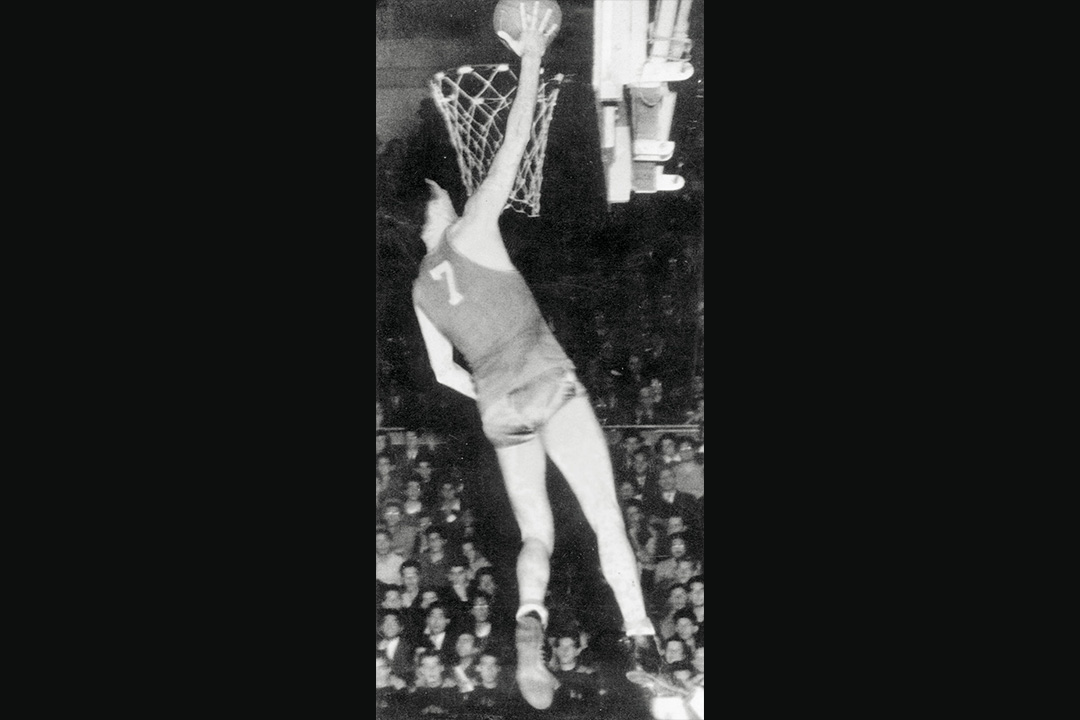
Surely the first century of ground-breaking invention at Stanford must have included an athletic innovation or two. Or, at least, that’s what I thought until the facts turned pesky.
West Coast offense? It’s a long story, but if you mean the Bill Walsh short passing game, he developed that as the offensive coordinator for the Cincinnati Bengals, several years before he became Cardinal head coach. Starting blocks? Those were dreamt up at the University of Iowa (or maybe in Australia), although Stanford track coach Dink Templeton, Class of 1921, JD ’24, did court intercollegiate controversy by having his athletes use them for their hands. (It didn’t catch on.) Jump shot? Basketball star Hank Luisetti, ’38, is sometimes credited with inventing it, but if he indeed had a true jumper—and he has been quoted saying otherwise—he was preceded by others in the early 1930s. It turns out that Luisetti, though, really did create something new at Stanford (details withheld here for the sake of suspense).
Stanford has a proud history of innovation, and we had to get picky.
As I combed archives and publications, I bid a reluctant goodbye to many near-misses among the Eureka moments—things that were invented by Stanford’s relentlessly innovative scholars and alumni, but not while they were here. For example: Bradford Parkinson, PhD ’66, and his colleagues developed GPS under the auspices of the Department of Defense after he graduated and before he returned as a professor of aeronautics and astronautics. Graduate School of Business professor emeritus William Sharpe was still on the University of Washington faculty when he published the Capital Asset Pricing Model, which explains the relationship between the risk of an investment and its expected return. And while engineer William Fair and mathematician Earl Isaac worked together at the Stanford Research Institute (SRI), they co-founded the Fair Isaac Corporation to launch their brainchild, the FICO score, known in the vernacular as your credit score. (Incidentally, we could have done a whole story on inventions that emerged from SRI while it was still part of the university. Among them: the location of Disneyland—an analysis resulted in the recommendation of Anaheim, Calif.—and those squarish microencoded numbers on the bottom of checks, which revolutionized banking.)
Which is to say that Stanford has a proud history of innovation, and we had to get picky. The nine inventions we ultimately chose to showcase were all born on the Farm. As is almost invariably true, most were based on the work of others who came before, and some were collaborations between Stanford scholars and other researchers. But in each case, at least one key inventor worked or studied here at the time of creation. Taken together, these innovations represent a collection of tools and devices that fundamentally changed how we treat disease, use computers, even make music.
I wonder what we’ll think of next.
Kathy Zonana, ’93, JD ’96, is the editor of Stanford. Email her at kathyz@stanford.edu.