Checklist
The Spring cover story showcased nine inventions you may not have known about from the Farm’s first century, including the computer mouse.
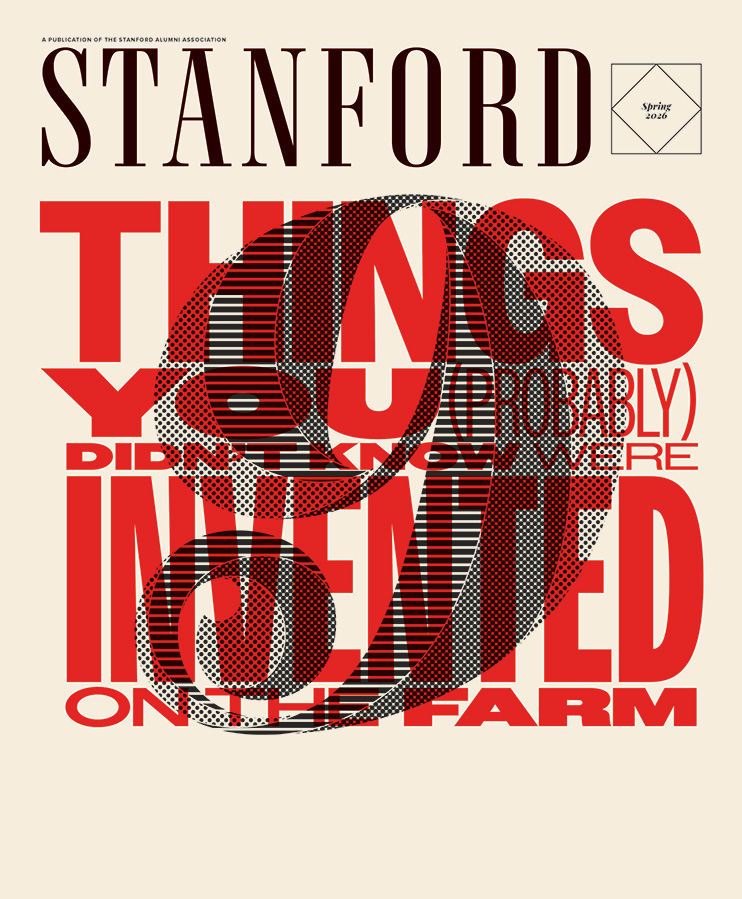 Illustration: Luke Lucas
You correctly highlighted Stanford Research Institute engineer Doug Engelbart, but omitted the contribution of Bill English, MS ’62. Bill built the first computer mouse and was the technical lead in setting up the mother of all demos, which showed not only what could be done with a graphical display on a single computer but also the value of the ability to communicate directly over a network, from one computer to another.
Joe Becker, PhD ’72
Palo Alto, California
Dr. Norm Shumway performed a coarctation repair on my infant-sized aorta at Stanford Hospital when I was less than a year old. It was probably a routine surgery for him at that point in his career (1987) but a truly life-changing one for me. He passed away when I was an undergraduate, which I found out because I happened to walk by Memorial Church during his memorial service. The only thing to do was skip my afternoon class and step into the church.
Tara Laidlaw, ’08
Talent, Oregon
The article covers a slew of male inventors but not one woman. I’m not sure what message is conveyed by this choice. If it was impossible to find women from 50 or 100 years ago, you might explain their absence in your article rather than leave a glaring silence that you invite readers to fill.
Merete Rietveld, ’00, MA ’01
Los Angeles, California
Who Knew?In the Spring issue, we asked you which of the nine inventions you already knew came from the Farm. Here’s how you did. 64%The human heart transplant (1968) 57%The computer mouse (1968) 52%The architecture of the internet (1974) 31%Recombinant DNA (1971-74) 24%The klystron (1937) 19%Modern basketball (1936) 10%Digital FM synthesis (1967) 7%The fluorescence-activated cell sorter (1969) 5%The fluorescence-activated cell sorter (1969) 14%Didn’t know any |
A Fitting Tribute
The Spring issue included a story about student-athlete Lowell Wilson, who died in 1964 as the result of an accident on the football field.
My husband, Martin Lee, ’66, teared up when I read this article to him. Despite having a memory impaired by Alzheimer’s, Marty remembered Lowell Wilson as a “great guy” and recalled visiting him at the hospital after the accident. Wilson’s accomplishments, aspirations, and courage in response to tragic loss and adversity certainly make him worthy of remembrance. I am grateful for the opportunity you provided to learn about this admirable young man.
Nancy Lambert
Durham, New Hampshire