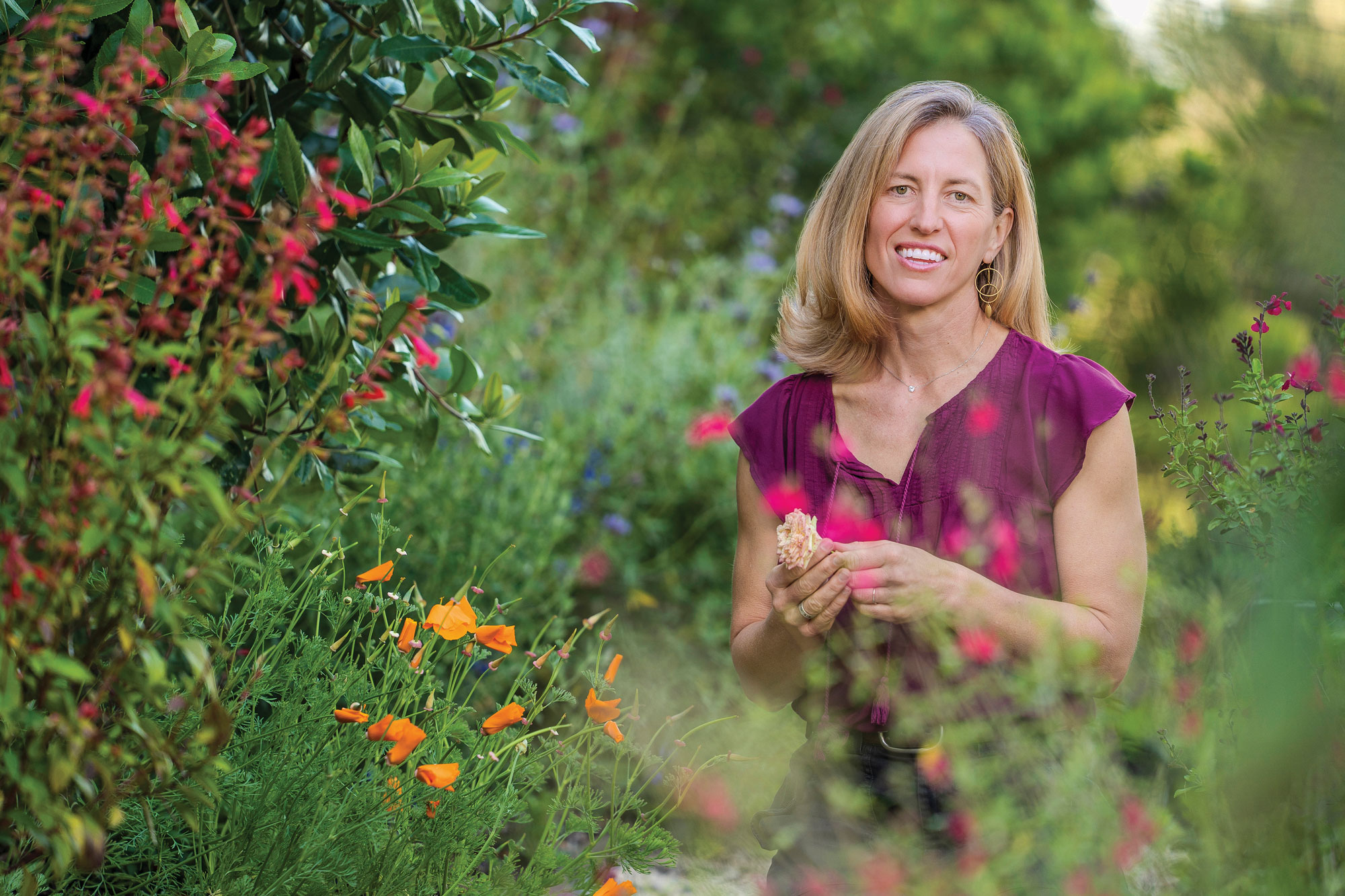
Overhead, underfoot, and on our dinner plates, plants surround our lives, though few of us see them the way Elizabeth Sattely does. The associate professor of chemical engineering has a lifelong love of plants rooted in her mother’s gardening. Sattely moved around as a child, and she remembers her mom’s green thumb transforming yard after yard. “She had this way of creating magic with plants,” Sattely says. But it was years later, as a doctoral student in organic chemistry at Boston College, that Sattely developed the appreciation for the hidden powers of plants that is central to her research at Stanford. At the time, Sattely was spending long nights over beakers and flasks, heating, filtering, and mixing “nasty” chemicals to make tiny amounts of complex products from scratch. She loved the challenge, but she became fascinated to think that many of the molecules she was toiling to assemble in the lab could be found in nature, where plants made them seemingly out of thin air. It was the dawning of a perspective she distills to a sentence: Plants are the world’s best chemists.
That prowess allows them to overcome their more obvious physical limits. Fixed in place, plants can neither flee predation nor seek out sustenance, and their roots—what Sattely dubs their “inside-out intestines”—lay exposed to whatever bacteria or fungi may lurk in the soil. Yet they account for 80 percent of Earth’s biomass, including some of the planet’s largest and longest-living organisms. Their dominance is thanks in no small part to the extraordinary ability to turn sunshine and carbon dioxide into arsenals of chemicals that bend the environment to their needs. Want to repel an insect, fight fungi, or recruit beneficial bugs? Plants make molecules for that.
Sattely has dedicated much of her career to discerning how this ability can help feed and heal humanity. Her recent research has implications for everything from how we think about food allergies to how we make cancer medicine. “She’s an amazing thinker. She really is looking for important problems,” says Mary Beth Mudgett, a Stanford biology professor whose collaborations with Sattely uncovered a chemical in plants that can vaccinate crops such as tomatoes and peppers against bacterial speck, a common disease impacting fruit quality and yield. Sattely, she says, is a rare blend of old-school chemist, cutting-edge molecular biologist, and restless innovator eager to apply her expertise to new challenges. “I think she’s truly one of a kind.”
Decoding a Killer
Sattely brings next-generation genetic tools to her quest, but the instinct to tap plants for their chemicals is, of course, an old one. Aspirin, one of the world’s most-used medicines, first came to us from the bark of willow trees. In 1960, the National Cancer Institute, a division of the National Institutes of Health, systemized the turn toward plants on a scale never seen before. Over the ensuing two decades, scientists tested some 35,000 plants in hopes of finding new weapons in the fight against cancer. None proved more important than a stand of Pacific yews in Washington’s Gifford Pinchot National Forest whose bark was sampled on a hot August day in 1962.
Yews have ancient association with long life (their own) and quick death (anyone consuming them). The hags incanting “double, double toil and trouble” in Shakespeare’s Macbeth aren’t trying to please the palate when they throw “slips of yew” into their cauldron with eye of newt. But the advent of chemotherapy in the 1940s gave new medicinal value to such poison if it could be appropriately targeted. In the late 1960s, lab tests revealed the Pacific yew’s bark had a killer bite against cancer cells. Scientists dubbed the active compound paclitaxel—a leading chemotherapy more commonly known by the brand name Taxol that is used to treat ovarian, breast, lung, and other cancers.
There was a problem, however. Producing enough Taxol to treat a single patient could require felling multiple slow-growing trees. Scientists later learned to make the drug from a precursor compound called baccatin III, which could be gleaned from the needles of a cousin species, the English yew. Other researchers—including Stanford chemistry professor Paul Wender—puzzled out how to make Taxol entirely in the lab, but fully synthetic options required dozens of steps and proved too pricey for widespread adoption. Taxol production has remained connected to slow-growing yews, a contributor to its high cost. Recent figures put the going rate for a kilogram of Taxol at more than $20,000.
For molecular scientists like Sattely, another option beckoned. What if you could find the genes that yew trees use to make Taxol, then transfer them to faster-growing organisms more amenable to husbandry to let them do the work? The idea has loomed as a holy grail in the world of synthetic biology, where organisms are engineered to attain new abilities, Sattely says. A dozen genes in the Taxol-creation process had been identified, but a series of daunting problems had stalled progress for decades. Yews have approximately 50,000 genes, more than double what humans have, and they are far less understood. In some organisms, genes that work together cluster near each other. In plants, those pathways are often scattered across the genome in what can seem like impenetrable chaos.
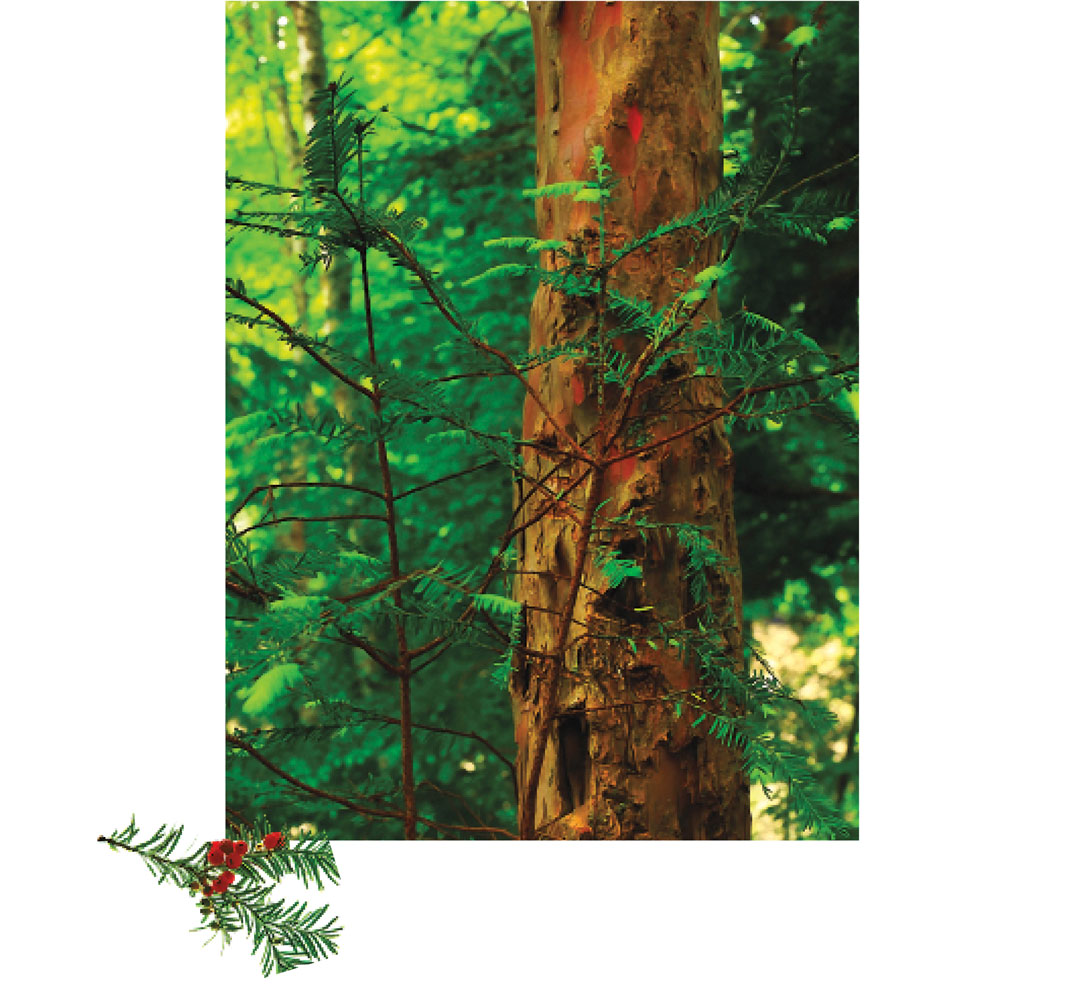
Yews have ancient association with long life (their own) and quick death (anyone consuming them).
“For a long time, it was near impossible to find all of the genes responsible for a molecule as complicated as Taxol,” says Sarah O’Connor, director of the department of natural product biosynthesis at the Max Planck Institute for Chemical Ecology in Jena, Germany. But around 2010, the advent of powerful and rapid sequencing tools gave scientists new ways to explore plant genomes, a development that jolted the once sleepy world of plant chemistry, she says. Sattely has been in the vanguard translating those advances into new discoveries. “I would say Beth has been one of the people who really cracked this open,” O’Connor says. “She has been one of the key people who developed the methods, set the standards, and really led the field.”
Several years before taking on Taxol, Sattely used RNA sequencing to track down six of the 10 genes that an endangered Himalayan herb called the mayapple uses to produce the basis for another chemotherapy—etoposide. She and grad student Warren Lau, MS ’12, PhD ’17, then successfully transferred the relevant genes into a fast-growing relative of tobacco, surprising even Sattely, who wasn’t sure you could throw so many genes into a new plant and have the engineered result thrive. The findings were published in 2015 in Science, where an accompanying news piece ran with the headline: “Genetic engineering turns a common plant into a cancer fighter.” “That was our sort of proof of concept that you could go into a plant like the Wild West and pick apart how it makes a molecule that is useful in the clinic,” she says.
In 2018, Sattely’s lab began working to fill gaps in the longer genetic pathway behind Taxol. Yews, of course, don’t produce the drug in order to fight human cancer. They use it as a defense against colonizing fungi and other threats. To prompt this defensive reaction, the team agitated thousands of cells from yew needles with bacteria, salts, fungi, and other stressors, then extracted their nuclei and sequenced their RNA to see what genes had activated in the response. In essence, the strategy was to provoke the cells into revealing their secrets. “What we really needed to do was flip a ton of switches and see which lights turned on and off together,” says Conor McClune, the postdoc in Sattely’s lab who led the project.
Still, at one point, the trail seemed hopelessly lost. “Maybe the tree just makes a crazy number of molecules, and you can’t engineer any one of the pathways,” Sattely recalls thinking. But she’s learned to have faith that there’s a logic to metabolism—no matter how disorderly it may appear. She and McClune persisted and found the gene behind an overlooked enzyme that was key to unlocking the process. “Once we found that, it all kind of came together and started to work,” she says.
Ultimately, the team identified the eight missing genes needed to make baccatin III, the precursor to Taxol, and then transferred those genes into the same type of tobacco relative used in the mayapple experiments. The altered plants produced baccatin III at a concentration higher than found in English yew needles. “The findings are a major leap forward in efforts to secure a reliable supply of paclitaxel,” a reviewer wrote in Nature, where the team published its results last year. Almost simultaneously, a team at the University of Copenhagen identified two more genes that, combined with the work of the Sattely lab, may provide a path to harvest Taxol without a yew in sight. A Science account of the experiments ran under the headline: “Newly discovered plant genes could slash cost of making key cancer drug.” The Sattely lab is working on transferring the genes into yeast, which can be easily grown in lab vats commonly used to produce pharmaceuticals. “Of all the things we have done in the lab, it probably has the most translational importance,” Sattely says. “It would be a huge benefit to have a bioprocess that uses enzymes—instead of synthetic chemistry and isolation from Taxus plant tissue—to produce that molecule.”
The Path to Plant Chemistry
Like her mother, a retired nurse, Sattely is a constant gardener, one who is apt to return from the local nursery with greenery “coming out of every window” of her minivan, says her husband, Stanford bioengineering professor Michael Fischbach. “It’s a large vehicle, but not large enough. If you came to see our place, a reasonable question would be: Who’s in charge here? The people or the plants?” Gardening seems to match Sattely’s disposition. She speaks with an unassuming poise, and it’s no stretch to imagine her tranquilly tending her California natives or retiring a lab plant to a new life in her backyard. “I find a lot of joy in it,” she says.
But the turns and leaps of her career hint at a less obvious side to her personality. When she was growing up, her dad, who worked in jobs ranging from computer programming to construction, used to lead her on impromptu excursions with a tinge of danger, like exploring mineshafts or walking up the middle of a deepening river. Once, when a hurricane hit their hometown in New Jersey, he rallied her to come out into the storm. “My dad had no regard for safety,” she says. “He was like, ‘Let’s see what it’s like to be in the middle of a hurricane.’ ” Whether it’s inherited or not, Sattely has her own affinity for taking chances, a quiet derring-do that has shaped her path almost as much as her love of plants. “I do enjoy taking some risks. I like novelty, and I like feeling discomfort, and I like going with my gut on things.”
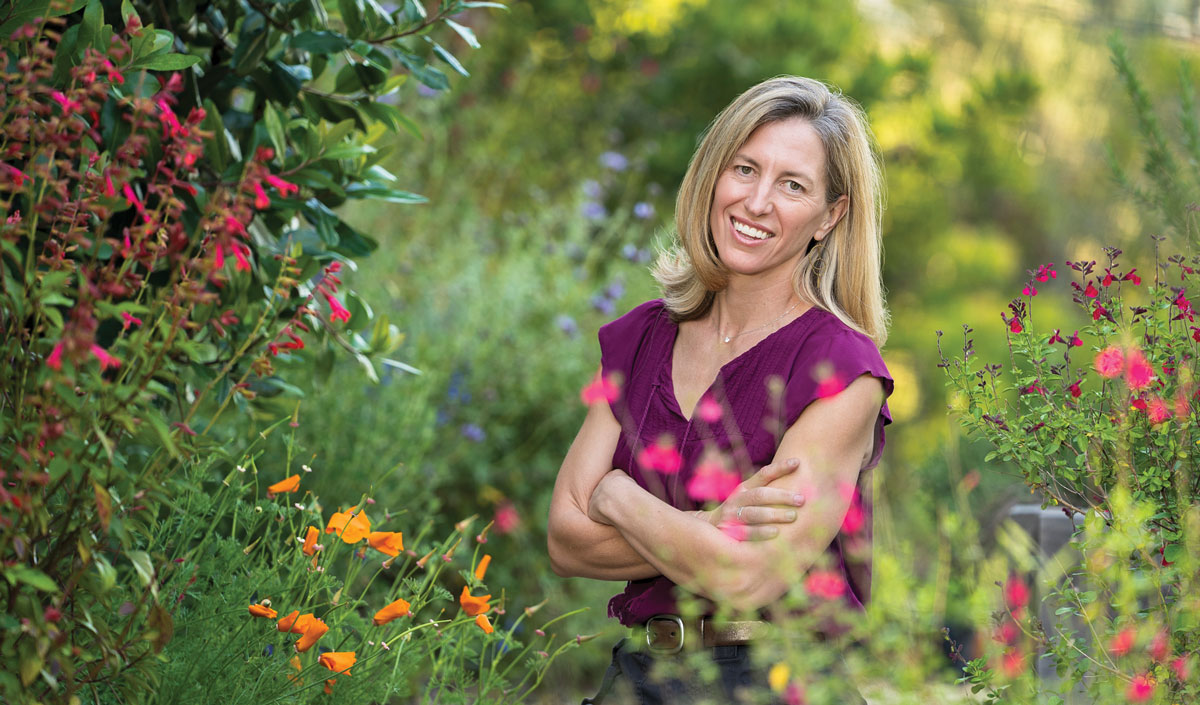
‘I do enjoy taking some risks. I like novelty, and I like feeling discomfort, and I like going with my gut on things.’
For many rising academics, a postdoctoral position is a chance to add to the momentum gathered during a PhD program while moving in a similar direction. But after earning her doctorate from Boston College in 2007, Sattely turned from the temperature-controlled world of synthetic chemistry to the aqueous swirl of biochemistry in living systems. She was lucky, she says, to land a position with the late Chris Walsh, an internationally renowned enzymologist at Harvard Medicine, despite barely knowing her basic amino acids. Her work in Walsh’s lab focused on bacteria. When it came time to embark on her own research career, she veered again. She received funding that allowed researchers to work outside their expertise, and she dove into plant chemistry. “It just felt like this was an area that was rich with applications,” she says. “We need plants for food, we use them for medicine, we rely on them in so many different ways. It would be a cool way for me to use my skills in an area that I find fascinating.”
From a distance those might seem like minor lane changes. They are, in fact, a pair of sharp pivots that would test many elite researchers, says Chaitan Khosla, a Stanford professor of chemistry and of chemical engineering, as well as the director of Stanford’s Innovative Medicines Accelerator. “That requires guts,” he says. Sattely nevertheless found traction quickly. Her mayapple paper, which Khosla considers particularly impressive for an early-career researcher, came less than five years after she arrived at Stanford in 2011, as did several other notable papers, including one on how plants metabolize pollution. The breadth of her background, and her nimbleness on new terrain, gives her a powerful way to connect different types of chemistry and biology, Khosla says. Just over a dozen years ago, Khosla founded the Chemistry, Engineering and Medicine for Human Health Institute (now known as Sarafan ChEM-H), hoping, he says, to attract researchers to Stanford whose “imagination, intellectual restlessness, and sheer ability allow them to jump across a variety of chasms that surround molecular science, especially in the direction of health care.” Sattely fits that vision to a T. “Basically, Beth personifies ChEM-H more than anybody else I know.”
Food for Thought
Sattely remains committed to understanding plants as the world’s ultimate “chemical factories,” but she will also gravitate to new areas if she thinks she can have an impact. “She’s always willing to move into totally new fields if that’s where the interesting questions are,” says her friend and collaborator Polly Fordyce, PhD ’07, an associate professor of genetics and bioengineering. “She’s pretty fearless scientifically.”
The result is that her lab—currently 14 people strong—publishes on topics far beyond her well-publicized cancer-related studies. Her group has identified genes in rice that produce compounds called momilactones, which inhibit competing plants from growing nearby. By transferring those genes to other plants, Sattely hopes to produce crops that act as their own weedkillers, a possible response to the global rise in herbicide resistance. They have uncovered the genetic paths that metabolites in edible plants use to medicinal effect, including the way broccoli and cabbage interact with bacteria in the intestines to create compounds that protect against cancer. And they’ve done work aiming to wean farmers off the fossil-fuel-based fertilizers that help feed the world at the cost of tremendous greenhouse gas emissions and energy use. A Bay Area-based start-up called Switch Bioworks, which Tim Schnabel, ’15, MS ’17, PhD ’21, spun out from his research in Sattely’s lab, produces a microbial powder that can be added to seeds. As the microbes grow, they naturally produce the nitrogen that crops need to flourish. “An ounce of powder can replace tons of fertilizer,” Schnabel, the company’s CEO, says.
More recently, Sattely’s lab has ventured into the interface between plants and our immune system. In March, the group published a paper looking at the flip side of food allergies: food tolerance. Traditionally, people assumed that tolerating food was a nonevent, simply the absence of an allergic response, Sattely says. Scientists now consider it an active process, in which immune cells size up food before giving the thumbs-up. Sattely’s study, published in Science Immunology, identified protein fragments from plants such as corn, soy, and wheat that stimulate this copacetic response. The findings could help advance therapies for disarming food allergies.
“She takes one idea from one area and draws a connection to another idea in a completely different area,” says Catherine Liou, PhD ’22, a postdoc in the lab. “She doesn’t just jump and leave what she used to work on. She keeps those old skills with her as she’s moving into a completely new area.”
Growth Goals
Sometimes, when people learn she’s a Stanford professor, they remark how smart she must be, Sattely says. She disagrees. She says she is lucky. Neither of her parents earned a four-year college degree (they got GEDs, and her mom added an associate’s degree in nursing), and nobody she knew growing up had been to grad school. But her mom worked hard to find her mentors. “I’m the same smart like everybody else, just all the stars aligned, and I got to be here.” That sense of serendipity feeds her sense of duty to make the most of her opportunity for the public good. “I have a strong feeling that universities should be doing more,” she says. “It’s a privilege to be here and we need to be doing more for the world.”
That instinct is behind her latest effort. Much of her work touches upon areas related to diet and food production, and she’s concerned by what she sees. Global agriculture is a huge consumer of energy and water and a major source of carbon emissions. Meanwhile, people in rich countries are succumbing to illnesses like heart disease that are exacerbated by poor diet, while people in poorer areas struggle with malnutrition. Those are major problems beyond the ability of any one lab or professor to address, and Sattely returned from a yearlong sabbatical in the fall with a plan for a campuswide food initiative that would bring Stanford researchers into collaborations to look for solutions. Currently, she and three other researchers meet regularly to think more exactly about how they can define problems so researchers across Stanford can marshal resources to focus on them. “We have all these people that don’t have food, then we have people who are eating the wrong kinds of food,” she says. “It’s costing us a huge amount of money, we’re destroying the planet as we’re producing this food, and we’re just going to sit there and, like, let it happen?”
If solving that sounds ambitious, some who know her best would agree. “She is questioning the way a giant portion of our society functions,” Fischbach says. “Having the audacity to think that you could improve the way we make and grow and consume food is just totally absurd. And so that’s why it’s perfect for her.” Because, like plants themselves, Sattely has hidden powers to make things happen.
Sam Scott is a senior writer at Stanford. Email him at sscott3@stanford.edu.
Tree images, from top: Craig Chanowski/Getty Images; Isabell Schatz/Istock/Getty Images Plus