One night in late April, I was in my local grocery store looking for frozen edamame. As I passed the rows of lightly fogged glass doors, I happened upon a shelf filled with boxes of frozen burritos brightly wrapped in red, yellow, and green. I caught my breath and began to sob right there in the aisle.
Just the week before, I had learned of the passing of my best friend, the poet Kevin Lee Bennett.
Some of you may remember Kevin, ’90, from this magazine’s July 2021 cover story, “A Friendship Mission.” That article captured the disappearance and recovery of my childhood speed-skating competitor, then partner in antics at Stanford, the eccentric genius from Midland, Mich., Kevin Bennett, winner of a 1991 Academy of American Poets University and College Poetry Prize. The narrative then skipped to 2005, when Kevin disappeared from his home in New Orleans shortly after Hurricane Katrina and went missing for more than 13 years before a local photographer named Cheryl Gerber decided to ask a question of a homeless man she’d seen on and off for more than a decade. That chance conversation with Kevin spurred her to piece together clues that led her to me, igniting an improbable chain of events that reunited us after more than a decade apart.
But that story ends exactly where the one I want to tell begins.
Kevin’s rediscovery and “rescue” was never the ending. It was day one of something else, a journey together into something beyond friendship that put me into roles and responsibilities that I never expected but that ended abruptly with his passing on April 22. He was found on his couch during a wellness check initiated by a neighbor, wearing the new jeans I had just ordered.
Two weeks earlier, my phone had rung.
“John!” he announced, with unmistakable excitement. “I got the groceries! Thank you! But . . . 40 burritos! Not 12 . . . 40! How did you manage it?”
Over seven years, Kevin and I had developed a rhythm. Every couple of weeks he would call with his list. Walmart for food deliveries. Amazon for clothes or household necessities. His tastes evolved over the years—initially tuna, mayo, and bread, later olives, hummus, charcuterie—but one constant remained: Tina’s Red Hot Beef Burritos—his caviar because, like caviar, they were scarce. Walmart limited deliveries to only 12 burritos per order, so Kevin rationed them carefully until the dwindling supply became the signal that it was time to call.
‘His last known words were to a neighbor headed to church on a Sunday morning: “That dress suits you—it matches your eyes.”’
This time, I had discovered an obscure option on the website that allowed me to order two 14-pack boxes in addition to the usual 12 singles.
“I have a freezer full of burritos!” he laughed. It may have been the happiest I had heard him in a while. Then, as he always did, he settled into the familiar script I had heard hundreds of times.
“John, thank you for everything you do for me. I am so happy. I love living here. I love my writer’s apartment. I am a writer. I am writing. I love you, John. You are my best friend.”
Seven years earlier, when we had finally found each other again in the middle of a New Orleans street, those had been almost his first words.
“I love you, John. You are my best friend.”
The beginning and the ending were identical. The coda was complete.
But everything important happened in between.
People sometimes imagine caregiving as dramatic acts of sacrifice. In reality, it is astonishingly ordinary. It is replacing burned-out light bulbs. Vacuuming. Changing bed linens. Taking out the trash. Ordering groceries. Finding jeans that fit. Sitting for three hours at the DMV trying unsuccessfully to obtain a Real ID. Making sure your friend locks the apartment door behind you before you head to the airport. Remembering which coffee shops he likes and avoiding the ones that treated him poorly while he was “living outside.” Learning the inventory of his freezer. Learning that silence is not emptiness.
When Kevin moved into his little apartment in the French Quarter in May 2019, it became his sanctuary. Exposed brick. Green shutters. Gas lamps flickering outside. Second-line parades—the traditional New Orleans street processions that originated with funerals—drifting past the windows. A laptop open almost constantly, words appearing slowly, patiently, stubbornly.
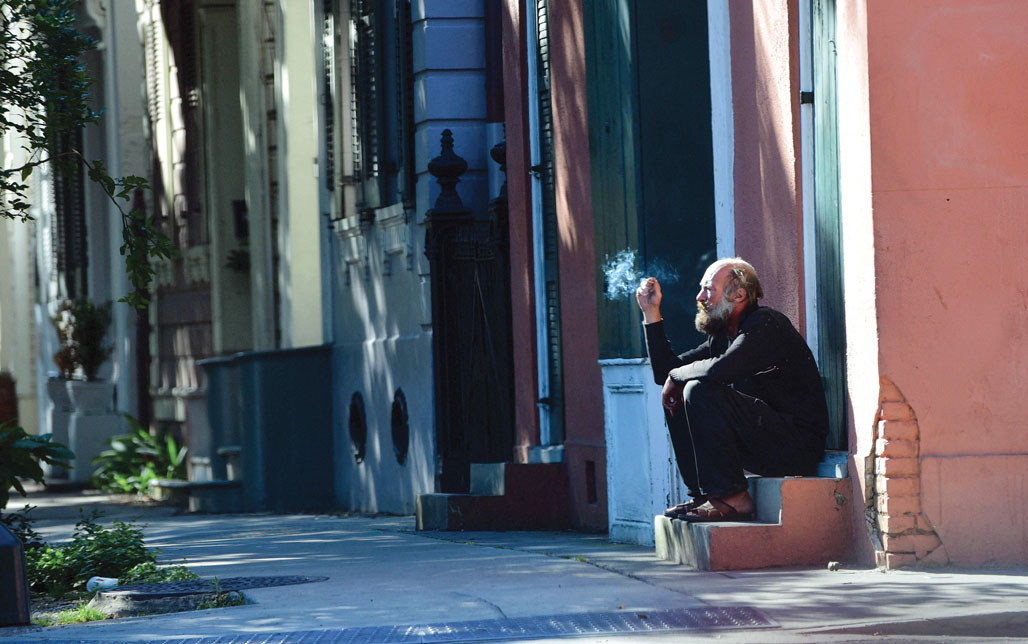 THE THINKER: Bennett often assumed the pose of Rodin's sculpture, which was originally titled "The Poet."
I flew in from Illinois every six to eight weeks at first, then a few times a year. Each visit carried the same quiet blend of friendship and maintenance. It became a fixture of my life: a purpose that didn’t really expose itself until Kevin was gone. Selfishly, I guess, I felt needed. I became his legal, financial, and medical guardian, according to some complicated paperwork. A cohort of friends and I raised money to make sure Kevin never had to live outside again, and for seven years, every call and visit was filled with joy. “I’m so happy here, John! I am a writer and I am writing.” When the Stanford literary journal Mantis published a collection of his poems in 2022, he was beyond the moon. “I am published, John! My work is published!”
When I would visit, we would eat oysters at the French Market. Have coffee at CC’s before walking to the river. Ride the streetcar through the Garden District. Splurge on steak at Galatoire’s with Cheryl and her husband, Mark.
Then we’d come back and clean the sink. To be fair, much more of this fell to Cheryl—the real heroine who was always ready to visit, clean, or take Kevin to Taco Tuesday. A complete stranger who embraced a schizophrenic homeless man and provided endless love and care.
That said, Kevin was actually remarkably neat. He made his bed every morning. But there were difficult stretches when daily tasks became overwhelming, and his community had to organize to problem solve. A broken door, a squatter attempting to take over his couch, flooding from the apartment above. Sudden dizzy spells, a fall where he cut his head, new medications.
Early on, I pushed hard for him to stop smoking. He loved me enough to try. He wore nicotine patches and reduced his smoking to a pack a day or less. However, when the occasional dark times came, he inevitably returned to his habit. Two packs. Three packs a day. He was well known by the neighbors for sitting outside, savoring his smoke in solitude. Always polite, usually reserved, but with the occasional unexpected compliment. His last known words were to a neighbor headed to church on a Sunday morning: “That dress suits you—it matches your eyes.”
Eventually, I stopped trying to get him to quit. The goal was never to manufacture the version of Kevin I wanted. The goal was to help Kevin live the fullest version of the life he wanted. He was happy, he was writing, and autonomy mattered. I let it go.
Conversations with Kevin also required patience unlike any I had known. Sometimes we would walk together for 20 minutes saying almost nothing. At first, I found the silence uncomfortable. Later I understood it. He was processing a thought. But not a mundane thought, something significant, complicated, sublime:
“John, did you know Goethe and Kierkegaard viewed God in completely different and yet somehow similar ways?”
What followed could be 20 uninterrupted minutes of literary criticism, theology, philosophy, and poetry woven together by one of the most extraordinary minds I have ever known. Sometimes I struggled to keep up. Sometimes I was completely lost. I never interrupted. It felt like watching fireworks split through a fog.
Other times, even the simplest question—“Do you want to head back?”—could overwhelm him. He would lower his head onto his hands, his familiar Thinker pose, like Rodin’s sculpture on the Stanford campus. (Note: The Thinker was originally designated “the poet.”)
Over the years, I learned something about caregiving that never appears in manuals. Sometimes you lean in. Sometimes you wait. Sometimes you listen. Sometimes you gently push. Knowing which was which was my job.
There is another misconception about friendship after someone has endured profound hardship. People imagine the dramatic reunion is the miracle.
‘People imagine the dramatic reunion is the miracle. It isn’t. The miracle is Tuesday.’
It isn’t. The miracle is Tuesday. The phone call. The grocery order. The coffee with just a touch of chocolate: “That’s amazing!” The routines—always a walk to the river to “our bench” to finish our coffees. The trust that quietly accumulates over thousands of ordinary moments until someone can honestly say, “John, I am happy.”
Kevin said those words constantly. Not because every day was easy. Not because his life suddenly became perfect. Because happiness had become possible again.
When Kevin died, his laptop was open. A book of poetry rested nearby—written, as it turns out, by Sebastian, a formerly homeless man Kevin had mentored in his early days of living outside. Outside, the gas lamps glowed over the streets Kevin loved.
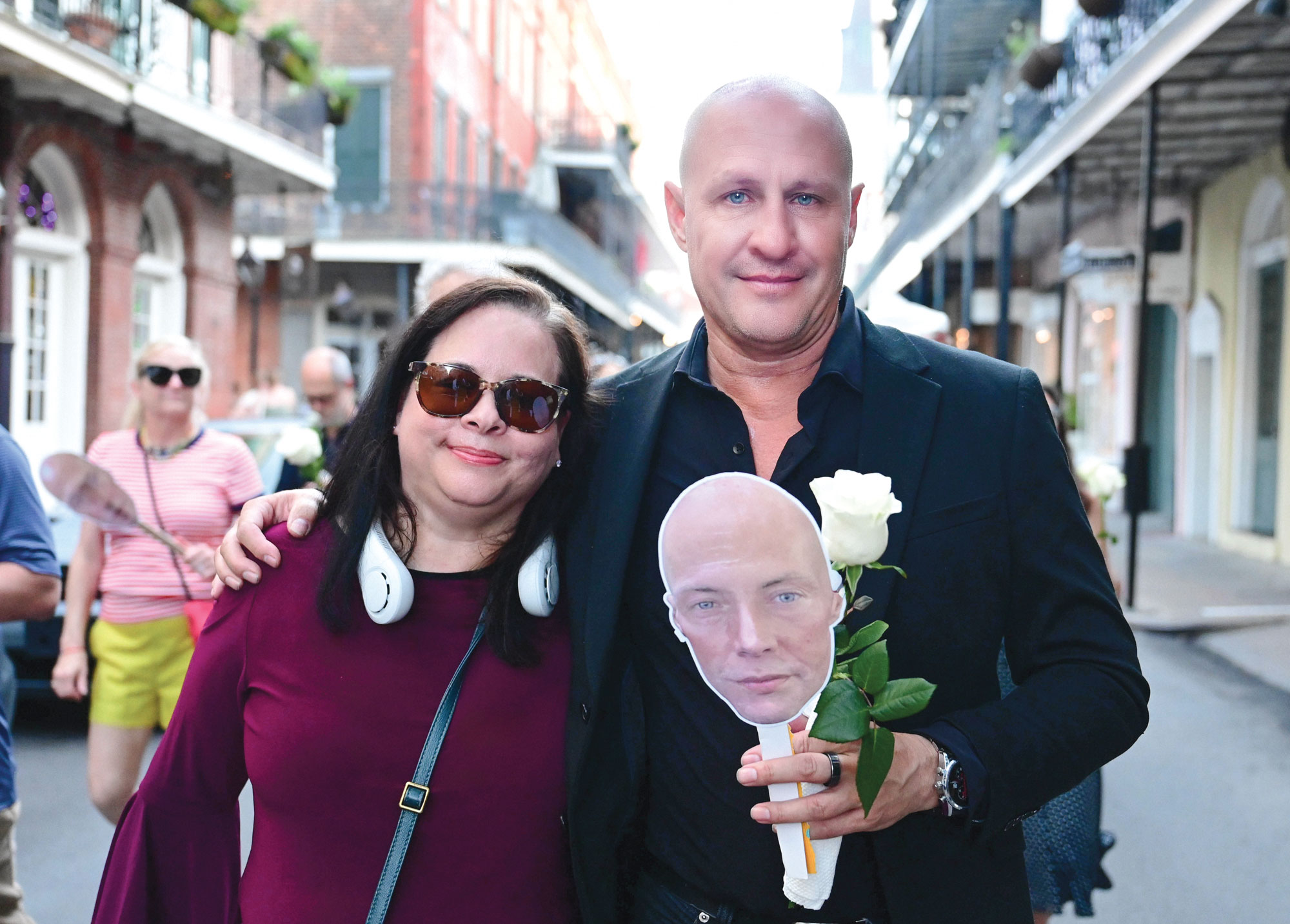
We marked Kevin’s passing with a second-line parade through his city and a vigil outside his apartment. Friends came from all over to celebrate his impact, including Sebastian, his wife, and their young child.
It is difficult not to replay the visits I didn’t make. The trips I postponed. The times I said, “I’ll come soon,” and then months would go by.
Grief always edits the past in cruel ways. Fortunately, friends have reminded me of something I sometimes forget. The point was never perfection. The point was presence.
We—Cheryl and Mark Gerber, the late Perry Friedman, ’91, MS ’91, and his wife, Robyn, Pauline Steinhoffer, ’91, Kim Kamin, ’93, and dozens of friends and strangers who contributed to a GoFundMe seven years ago—did something profoundly simple.
We gave the poet a home. We gave him coffee with friends. We gave him a place to write. A place to live inside. A place to be happy.
And lots and lots of burritos.
John Coyle, ’90, is a writer and speaker on the neuroscience and psychology of time perception. Email him at stanford.magazine@stanford.edu.