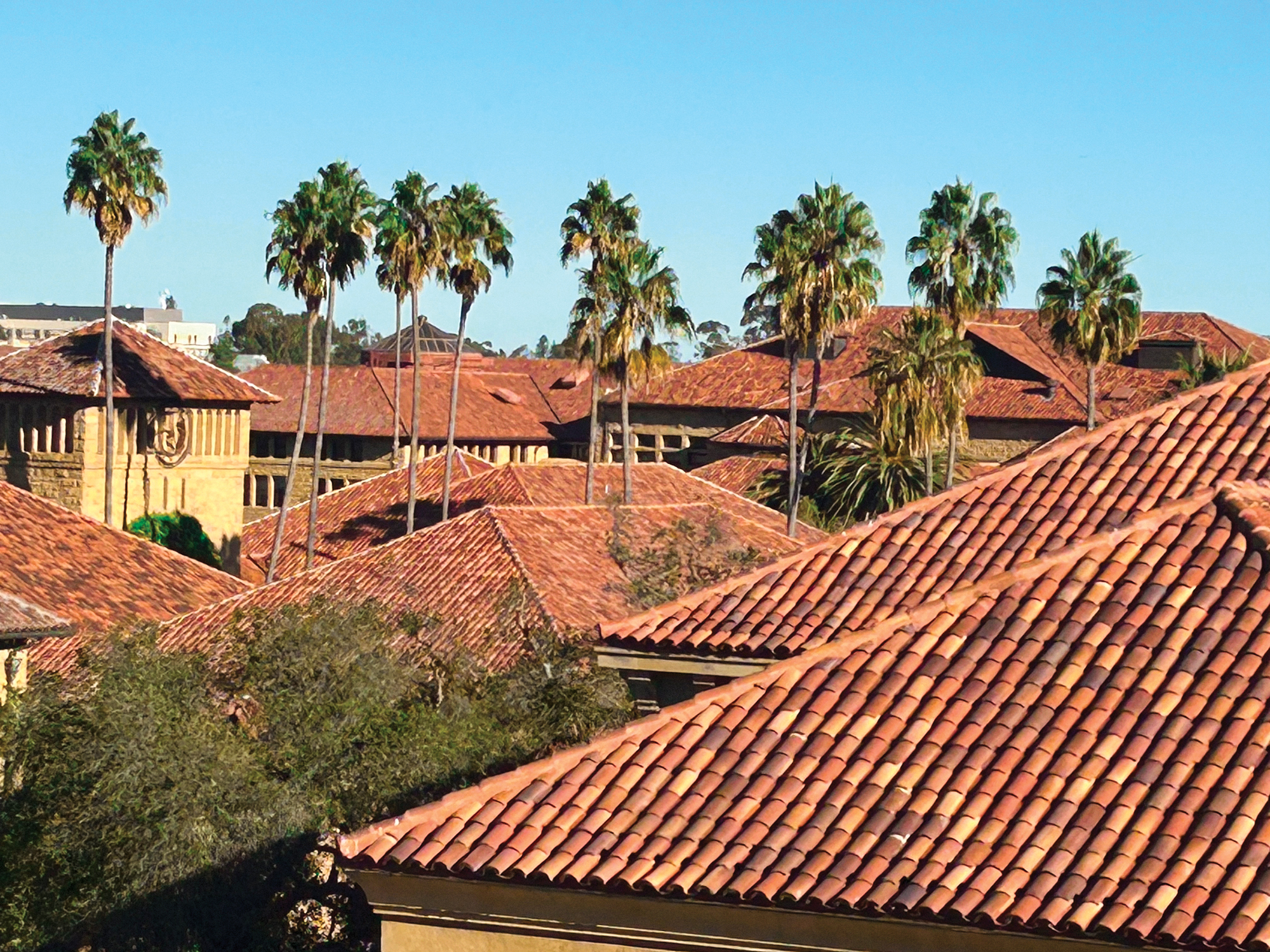
“The yellow sandstone arches and cloisters, the red-tiled roofs against the azure sky, make a picture that can never be forgotten,” David Starr Jordan, Stanford’s first president, wrote in an oft-cited 1913 letter. The roofs he revered cover some 75 percent of the buildings on campus and, according to university architect and executive director of campus planning and design David Lenox, have been “referenced and reinterpreted” in other features of Stanford’s contemporary architecture.
The story of the red tiles begins with a friendship—that of Jane Stanford and Sarah Gladding, whose husband, Charles Gladding, co-founded Gladding, McBean & Co. The company originally made sewer pipes and located itself in Lincoln, Calif., a Placer County town near a rich clay deposit from which the company was soon making other terracotta architectural products in an earthy red. Sapna Marfatia, MLA ’18, campus preservation architect and director of architecture, planning and design, recalls the lore that one day, Jane proposed an idea to her friend: What if Stanford used the company’s products for its roofing?
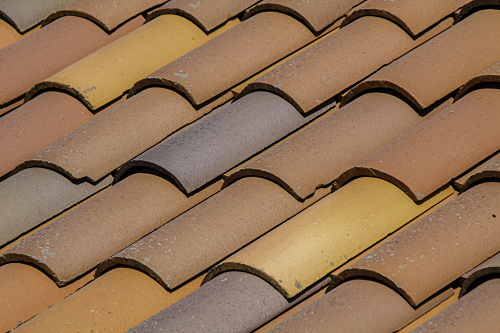 BEARING CARE: The terracotta tiles require careful and minimal washing. (Photo: Robert David Siegel, ’76, MA ’77, MD ’90)
Gladding, McBean sent its first shipment of specified roofing tiles to Stanford in 1891. Thus began the university’s 136-year relationship with the company, now a division of Pacific Coast Building Products, which has supplied Stanford with most of its celebrated red tiles.
The perfect composition
Gladding, McBean has a signature Stanford blend: 50 percent red blend, 45 percent purplish-brown (Gladding, McBean’s #8 color mix), and 5 percent orangish-yellow (its “Franciscan” blend).
Variations on a theme
Most buildings are crowned in the original barrel-shaped tiles, while Memorial Church’s unusual shape calls for specially molded tiles, and Hoover Tower is topped with flat, scale-like pieces.
A roofing reprise
Though tiles are easily replicated, Stanford also reuses them. “It’s very easy to pick up tiles from one building that is being demolished and put them on a newly constructed building,” says Marfatia. In 2024 alone, the division of Land, Buildings & Real Estate (LBRE) salvaged 141 tons—roughly 24,000 square feet—of clay tiles, some of which were then used to cover the Graduate School of Education building.
The repeat
Maintenance is simple. The terracotta tiles require careful and minimal washing to avoid harming the membrane beneath them, so after decades of dirt piles on, a cleaning crew deploys a power-washer—but on the gentlest setting possible. The process focuses on removing dirt, carbon staining from the air, and lichen, restoring the tiles to what architects and caretakers have come to know as a “Stanford standard.”
Georgia Allen, ’28, is a former editorial intern at STANFORD. Email her at stanford.magazine@stanford.edu.