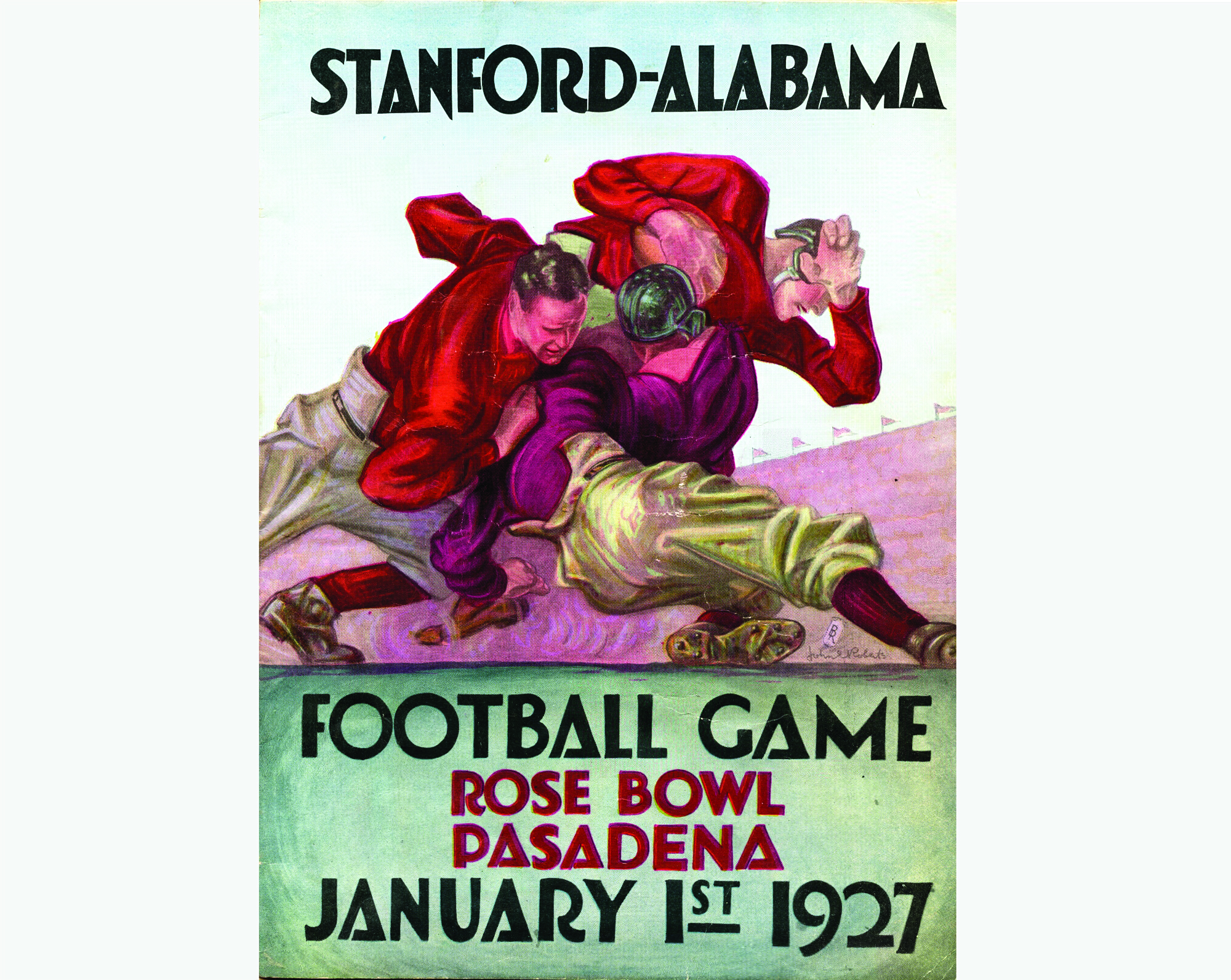
One hundred years ago, Stanford football finished its season in a national spectacle that kicked off the modern era of sports media. But the season began in bizarre fashion. Head coach Glenn “Pop” Warner was as legendary for his innovations as for his wins. He’s credited with everything from popularizing huddles to championing the spiral punt. But in 1926, Warner arranged something that wouldn’t prove nearly so popular—an opening-day doubleheader.
Stanford started the season on September 25 with a 12:30 p.m. kickoff against Fresno State—a 44-7 romp—followed two hours later by a 13-6 victory over lightly regarded Caltech. Fatigue, perhaps, made the second game closer than expected, but Warner had accomplished his goal—to evaluate as many players as quickly as possible—while still racking up a pair of wins.
Except for a 13-12 nail-biter over USC, the team would hardly be tested again. Its 41-6 dismantling of Cal was Stanford’s biggest victory yet in Big Game history, and the team’s 10-0 record gave Stanford its first outright Pacific Coast Championship. (It had shared the title two years earlier.) For the second time in three years, Stanford was headed to the Rose Bowl, this time to face undefeated Alabama.
Demand for tickets was so high that organizers added 4,500 temporary seats to the stadium, resulting in a record attendance figure of 57,417. An even greater audience listened at home. NBC made history by airing the game across the country—the first coast-to-coast radio broadcast of an American sporting event and the start of the sports mass-media era.
True to form, Warner himself was looking for something new.
True to form, Warner himself was looking for something new. He found it in what the press called “silk pants”—made of synthetic airplane cloth—that glistened in the sun, weighed just half a pound, and were more supple than traditional heavy canvas.
They wouldn’t be enough. On game day, Stanford dominated play but could only muster a single touchdown. In the game’s waning minutes, Stanford was forced to kick. Its punter—Frankie Wilton, ’29, MA ’35—reportedly lined up too close to the line of scrimmage. His kick was blocked, and the ball rebounded deep into Stanford territory. Alabama scored just before the final whistle. The game ended 7-7. For Stanford fans, the third and final tie in Rose Bowl history (even though overtime wasn’t adopted until the 1990s) felt like a loss.
There were happier postscripts. Stanford was declared national champion by the Dickinson System, college football’s first widely accepted ranking system. Along with the 1940 title, it is one of Stanford’s two football national championships. And in the following year’s Rose Bowl, Wilton found redemption, scooping up a fumble and falling into the end zone for the winning touchdown to give Stanford its first Rose Bowl victory.
Warner would keep scheduling doubleheader season openers until 1928, when a loss to the Young Men’s Institute, a Catholic fraternal organization of no sporting repute, took the gloss off the ritual. Not every innovation can be as influential as the huddle.
Sam Scott is a senior writer at Stanford. Email him at sscott3@stanford.edu.