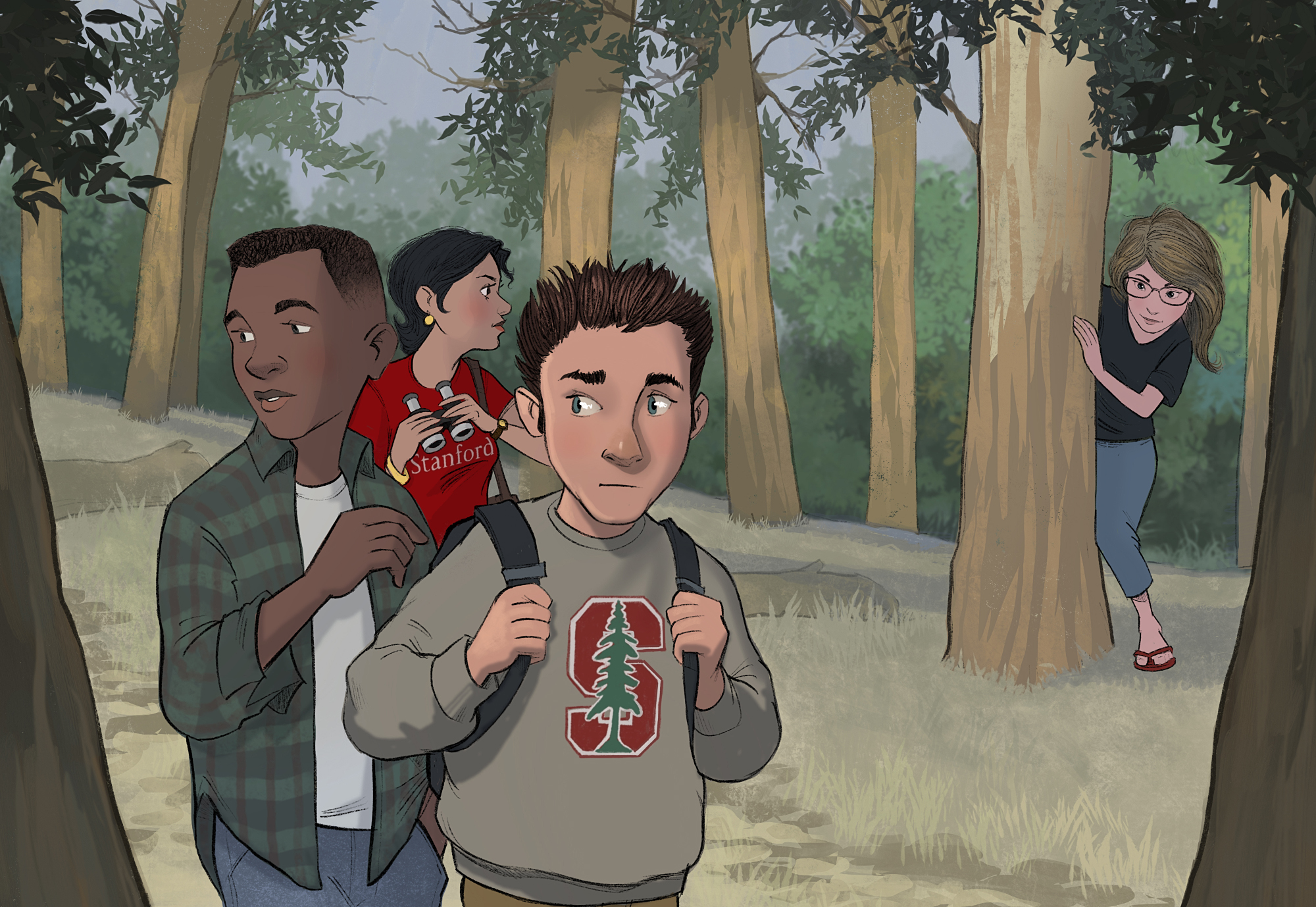
Growing up, I was a people pleaser. My family moved often, so I learned to do almost anything to make and keep friends. (Example: agreeing to be someone’s “dog” for show-and-tell in the fourth grade.) At some point, I read self-improvement pioneer Dale Carnegie’s How to Win Friends and Influence People and took to heart Part 2, Principle 2: Smile. From then on, I smiled relentlessly, even when—especially when—hurt, sad, or scared. Perhaps that’s why, as a freshman in Lagunita, I surprised myself and my friends by signing up for Assassin, a game played across the dormitory complex that transformed obliging students into determined stalkers.
I was issued a standard Nerf gun and the name of my first “victim.” The rules were simple: Eliminate your target, then take over that player’s mark. There could be no witnesses. And there were safe zones, such as dorm rooms and bathrooms. The last person standing won the game.
My first few kills were uncomplicated—at that point, many players were not invested, and they took unnecessary risks like walking around unaccompanied. But as days passed and the number of players dwindled, few could be found without a bodyguard. Taking out targets required increasing amounts of patience, stealth, and the very thing I worked so hard to avoid: the possible wrath of friends and neighbors.
Unexpectedly, I found people respecting me as a worthy opponent.
I went all in. Whereas before, I would avoid an alleyway or a shadow cast by a giant eucalyptus tree, these became places for me to hide as I tracked my victim. I found myself welcoming the arrival of dusk, so I could crouch unseen, Nerf gun in hand. Once, I stood for hours in a tiny broom closet across the hall from my target’s room. I heard him approach his door and say, “Thanks, I’m safe now; you can go.” Seconds later, I sprang from my hiding place and delivered a fatal shot. Unexpectedly, I found people respecting me as a worthy opponent.
Of course, during Assassin, I was not only a predator, I was also prey. When the guy who lived across the hall from me became my assassin, I felt the only choice I had was between the game and my sanity. So, one morning, with only a few players left, I walked across the hall and surrendered.
My undergraduate education provided many gifts, but the most important was probably courage. Courage has helped me leave a PhD program despite dire warnings from my thesis adviser, resign from my first job without another lined up, and trust my own instincts about child-rearing over the well-meaning advice of others. Moving away from what feels wrong and toward what feels right often requires displeasing others and facing the unknown. It hasn’t led to fame and fortune, but—maybe better—to a life that’s truly, uniquely my own.
I’d like to say I’m no longer a people pleaser, but that wouldn’t be true. Almost 40 years later, I still smile all the time, even when—especially when—hurt, sad, or scared. But after playing Assassin, my victims didn’t see me the same way. More importantly, neither did I.
Melissa Hurley, ’91, is a medical writer in San Francisco. Email her at stanford.magazine@stanford.edu.