
A healing touch.
It first happened almost by accident in a lab tank. A healthy piece of coral fell onto a bleached one, and right where they made contact, the sick piece began to recover. “Never seen anything like that,” thought Stephen Palumbi, a professor of oceans and of biology. When oceans PhD student Danny Collins came to Palumbi hoping to harness the physical sensitivity of corals to help them heal, the memory flooded back. Now, Collins is the lead author of a study showing that bringing healthy coral in contact with a bleached (sick but not dead) clone causes algae—which give corals their color—to rush from the healthy coral into the sick one. The bleached fragments fully recovered in seven weeks. Because the fragments must be genetic clones, the technique won’t necessarily scale in the wild, but the discovery of the algal flow still holds potential in coral restoration. The researchers plan to explore delivery of algae to bleached corals in ways that don’t require continuous contact. Retrieving algae from healthy corals before a punishing heat wave hits, then delivering them to bleached corals, may be one way to accelerate recovery.
We’re gonna need a bigger tooth fairy.
When Brigid Lynch, a geomorphologist working on a project in the Midpeninsula Regional Open Space District (MidPen), happened upon an unusual rock about the size of a toaster oven, she took a picture but didn’t think much of it. But later, when she ran that picture through Google’s reverse image search, she was stunned: “This is absolutely a Pacific mastodon molar,” she recalled thinking. (Not up on your Ice Age mammals? This “new” elephant-like creature was officially recognized as separate from the American mastodon in 2019.) MidPen has donated the tooth to Stanford, where the libraries’ digitization services lab has created a 3D scan of the fossil. “Fossils are our only opportunity to see into past biodiversity,” said Christine Garcia, curator and manager of Stanford’s geoscience specimen collection. The tooth is being preserved for carbon dating and further study.
Together again.
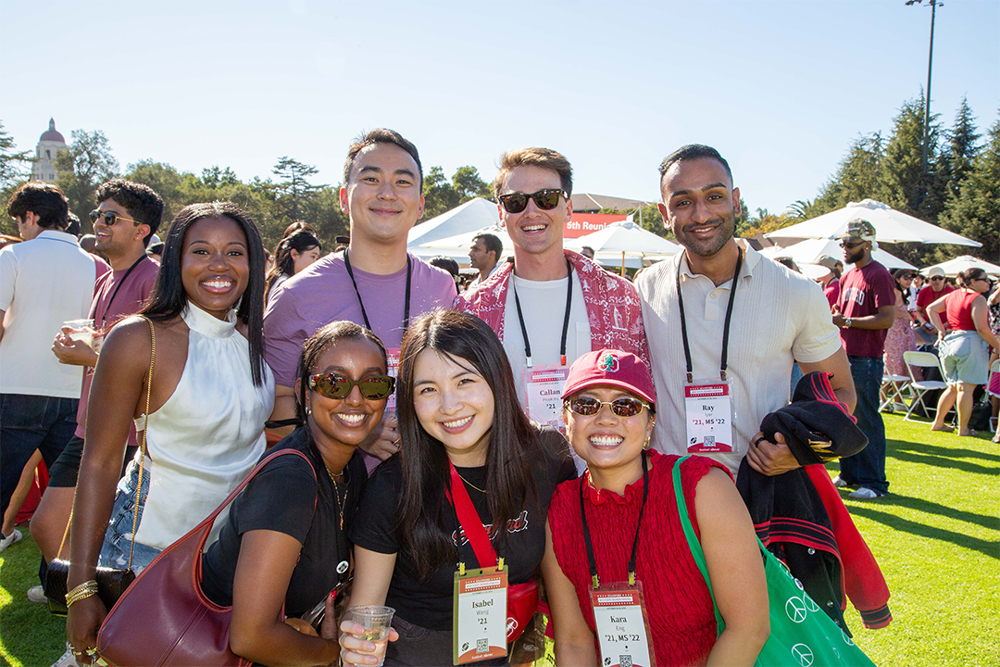 Photo: H. Taghap
More than 8,500 alumni and their guests reconnected at Reunion Homecoming this month. Alumni from classes ending in 1 and 6 attended class parties, learned from Stanford faculty, fountain hopped for old time’s sake, and witnessed the Card’s 34-7 victory over Elon University.
Getting a leg up on lymphedema.
An estimated 10 million people in the United States live with lymphedema—a condition in which excess lymph fluid accumulates in a patient’s limbs rather than draining through the lymphatic system into the bloodstream. In addition to pain, lymphedema can cause thickened skin of the affected limb as well as extra fat and scar tissue buildup. There’s no approved medication, and current interventions—such as physical therapy and use of compression machines—are time intensive, expensive, and only modestly effective. Stanley Rockson, a professor of medicine, discovered years ago that a group of inflammatory molecules known as the 5-LO pathway underlies the disease. Now, Rockson and his team have completed a clinical trial of the drug acebilustat, which halts production of a key protein in the 5-LO pathway. Participants, all with lower-limb lymphedema, lost an average of one liter of volume from their affected legs. Their skin thickness and scarring also eased, and they reported better quality of life. The next step would be a phase 3 clinical trial to gain FDA approval. “We hope that, ultimately, effective pharmacologic therapy could supplant physical self-care,” said Rockson.
But wait, there’s more…
After a colleague’s sudden cardiac death, Stanford researchers compiled years’ worth of data from his smartwatch, smart ring, and exercise bike into one of the most extensive individual profiles ever gathered from health tracking devices. Their findings suggest that wearables could provide early warning of cardiac trouble.
What kind of citizen are you? A quiz developed by Hoover Institution scholars can help you consider your civic values free from political labels.
Research shows that our ancestors likely shared similar, diverse gut microbiomes developed over thousands of years. We in the industrialized world have erased much of that diversity in just a few generations.
If you or your ancestor remembers the campus library floods of ’98, you know El Niño means business. With a potentially historic rainy season looming, three decades of university planning and infrastructure upgrades are ready to be put to the test.
Dan Grunfeld, ’06, MBA ’17, a former Cardinal basketball team captain and two-time Academic All-American who helped lead Stanford to three NCAA tournaments, will return to the Farm as the general manager and an assistant coach of men’s basketball.
“[W]ho will sit with whom in what kind of coalition government, under what conditions, and under whose leadership?” writes Amichai Magen, JSM ’03, a senior researcher at Stanford’s Freeman Spogli Institute. He outlines five scenarios for today’s election in Israel.
Once the cartilage in our joints is gone, it has little capacity to regrow—for now. Stanford researchers are working to rebuild cartilage using, for example, hydrogel scaffolds and an enzyme-blocking experimental drug.
Ghostly séances in the Stanford mansion? It’s true—Jane Stanford dabbled in spiritualism. Before you head out on the trick-or-treat trail, read the 2000 Stanford magazine story.
Note: The Loop sometimes links to articles outside of Stanford that may require a subscription to view.