
Two Nobel Prizes.
Yesterday, Robert Hall, a senior fellow emeritus at the Hoover Institution and a professor emeritus of economics, won the Nobel Memorial Prize in Economic Sciences for his contributions to the “microeconomic foundations of macroeconomic stabilisation.” He shares the prize with Columbia University economist Michael Woodford. Their models start from how households and businesses make decisions rather than from statistical links among big-picture variables such as inflation, production, and consumption. Because people and businesses are future-looking, they show, central banks can influence the economy by communicating their policy plans. Hall’s work “has profoundly shaped our understanding of economic growth, employment, and the forces that drive the American economy,” said Hoover Institution director and professor of political science Condoleezza Rice. “He has been instrumental in the way policy leaders think about the free market economy.”
Said Hall: “Stanford’s economics department and the Hoover Institution gave me a dream job: the freedom and time to do the research I wanted to do. The taxpayers of California gave me an excellent education in the public schools and at Berkeley, and the federal government paid for my graduate education at MIT. I hope they will regard this as a satisfactory return on their investment.”
One week earlier, Karl Deisseroth, PhD ’98, MD ’00, a professor of bioengineering and of psychiatry and behavioral sciences, missed a call that came at 12:27 a.m. Pacific Time. Moments later, when the Nobel committee called his wife, professor of neurology Michelle Monje, MD ’04, PhD ’04, she did pick up. (Power couples—they’re just like the rest of us.) Deisseroth had won the Nobel Prize in Physiology or Medicine.
Deisseroth shares the award with German scientists Peter Hegemann and Georg Nagel, whose discovery of a light-sensitive algal protein laid the groundwork for optogenetics, Deisseroth’s pioneering technique for inserting light-sensitive microbial proteins into living brain cells. The process makes it possible to turn selected cells on and off with light, creating new possibilities for understanding and treating neurological and psychiatric disorders. “Once you know the cells that are important in a symptom or in correcting a symptom, then you can design any method you like to target their activity,” Deisseroth said. Monje, Deisseroth, and their three youngest children celebrated with group hugs and squeals. “We all knew he deserved this, and he’s deserved it for a while,” said their son Alexander, a Stanford freshman. “We’re insanely proud of him.”
Foundry School starts its engines.
How do things become things, at scale? That’s the deceptively simple question behind Foundry School, an initiative launched by the U.S. Department of State to rebuild American manufacturing capacity by bringing together universities, policymakers, and leaders of sophisticated factories. Its goal, said university president Jonathan Levin, ’94, is to “ensure that the next generation of American students has the knowledge from across disciplines to lead the future of U.S. manufacturing.” Stanford is leading the academic programming for Foundry School, which consists of two phases: The first seven sessions—on topics such as factory design, materials and supply chains, and workforce development—will be hosted by seven universities in critical American manufacturing regions, from Arizona to Pennsylvania. The second phase will be taught at Stanford during winter quarter. Students will learn from manufacturing leaders and work on a real-world challenge in complementary seminar and lab courses. “We want students to . . . learn how to make decisions when the technology, economics, workforce, supply chain, energy, and policy constraints all collide,” said Joseph DeSimone, a professor of chemical engineering and the Foundry School’s Stanford faculty lead.
The art ranger.
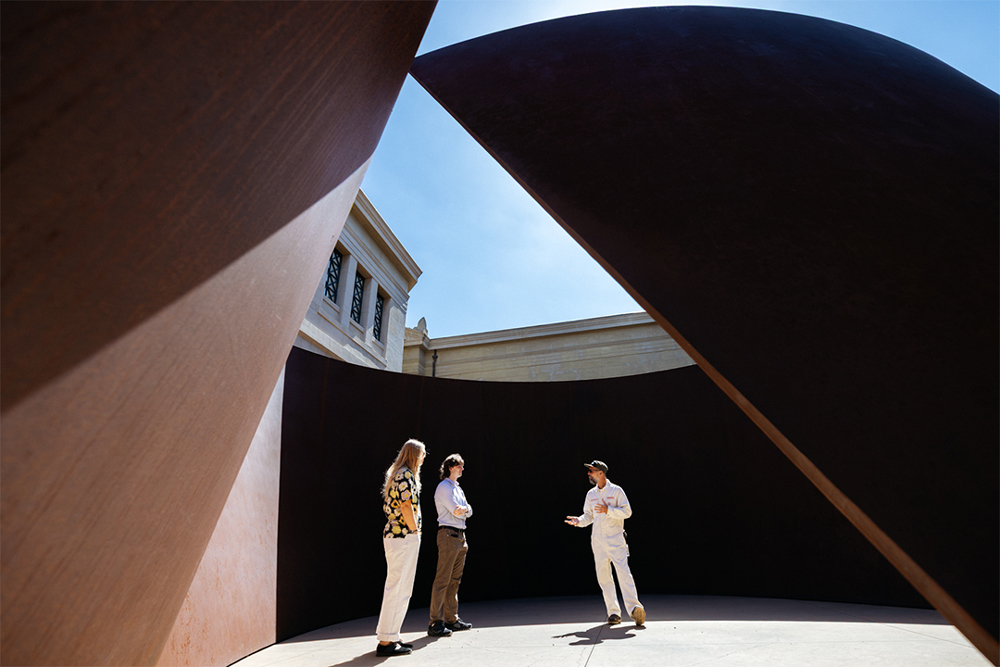 Photo: Andrew Brodhead/University Communications
Mark Shunney is in the business of painting, sealing, waxing, and oiling. As Stanford’s public art program manager, he oversees the preservation of more than 80 publicly accessible works on campus. That means doing everything from applying a glossy ceramic coating to Cantor’s OY/YO sculpture to powerwashing Sequence (above), a 235-ton steel sculpture. Shunney sees himself as an art “ranger”—a title that “has a certain beautiful symbolism,” he said. “It’s code for safety and care and conservation.”
Party in the front, business in the back.
For centuries, scientists have believed that the brain evolved as a single organ, but new research shows that the ol’ noodle is actually two distinct organs that evolved independently over hundreds of millions of years. “We’ve shown for the first time that the front of the brain arises from a totally different progenitor cell than the back of the brain,” said Kyle Loh, PhD ’16, an associate professor of developmental biology. Evolution took two existing neural systems and pushed them together spatially, he told Stanford Medicine. “Having the brain as one organ would probably be more efficient, but we rely on this primordial way to make the brain as two separate pieces.” The hindbrain—or brain stem—controls automatic functions like heartbeat and breathing. The forebrain is all about higher-level thinking—consciousness, abstract reasoning, your ability to email the Loop and say how much you love it. Scientists have long struggled to generate human hindbrain neurons in the lab, hindering research into disorders like ALS and spinal muscular atrophy. But armed with their two-brain discovery, researchers have successfully used stem cells to create functional hindbrain motor neurons, which could improve our understanding of brain stem disorders as well as conditions like obesity, since the hindbrain helps regulate hunger. (Bonus fact: Jellyfish, which diverged from humans more than 600 million years ago, have two nervous systems at different ends of their body. So, things could have been weirder. Much weirder.)
But wait, there’s more…
Song Lin, a professor of chemistry, has been awarded a 2026 MacArthur Fellowship for his work using electricity to simplify complex chemical reactions, ultimately offering more efficient, sustainable ways to synthetically create drugs.
Astronaut and geologist Jessica Watkins, ’10, is in the early days of a six-month stint on the International Space Station, this time as commander of NASA’s SpaceX Crew-13 mission. On her first visit, in 2022, she phoned the Farm from space.
California requires schools to phase out ultraprocessed foods by 2035, but researchers say budget constraints, limited staff, and other factors could make that challenging.
Identical twins Travan and Travis Jasper, both ’91, grew up in Richmond, Va., without running water or enough to eat. Now physicians, they’ve returned home to work as co-directors of the local emergency room.
After analyzing wearable device data from women over more than 42,000 menstrual cycles spanning 1.2 million days, researchers have found that sleep habits are linked with cycle regularity and that the phases of a woman’s menstrual cycle can correspond to differences in key vital signs such as heart rate and breathing rate.
The topic is bonds—U.S. bonds. They’ve made headlines as yields reach rates not seen since two thousand double-oh-seven. Here’s how to make sense of it.
Joint replacement surgery is better and more popular than ever. With polyethylene-lined joints that resist wear (plus advances in robotics and surgical approaches), today’s artificial joints can last for the rest of recipients’ lives rather than wearing out after 10 to 15 years.
Note: The Loop sometimes links to articles outside of Stanford that may require a subscription to view.