
Inside the hunt to prevent, delay, and cure Alzheimer’s disease.
It’s been 125 years since German physician Alois Alzheimer encountered his first patient with the disease that would later bear his name. Yet we are about as far away from solving Alzheimer’s—the most common type of dementia and the sixth-leading cause of death in the United States—as we were in 1901. There is still no approved therapy to prevent, halt, or cure the disease. But Stanford scientists have made breakthroughs in imaging, genetics, proteomics, and immunology that are revealing new flanks to attack. “I think we’ll get there in my lifetime, but we’re not there yet,” said Sharon Sha, a clinical professor of neurology and neurological sciences and chief of the Stanford Memory Disorders Center. Professor of neurology and neurological sciences Frank Longo, for example, has completed a phase 2A trial of the first drug to show improved brain function in Alzheimer’s patients. It’s no cure, he said, but, “if we can delay [symptom onset] by 10 years, we eliminate 90 percent of Alzheimer’s in the world.”
The gag economy.
Two New Yorker cartoonists walk into a classroom, and it’s no joke. Kendra Allenby, ’10, and Amy Kurzweil, ’09, have mastered the art of the grind—teaching, bartending, and more as they sketch their way into the pages of a magazine dubbed the Everest of the single-panel (or “gag”) cartoon world. For them and their fellow artists, being a New Yorker cartoonist isn’t just a gig; it’s an identity. But it’s increasingly difficult to make a career of it. “I often tell my students,” said Allenby, “‘if you want to do this, you have to be as creative about your career as you do about the cartoons.’” Read in Stanford magazine about their career paths, and start your own cartooning journey on October 28 with Allenby and Kurzweil in a free, Stanford Alumni Association–hosted Zoom workshop for alums, Line by Line: Inside the World of New Yorker Cartoonists.
The Class of 2030 has arrived. That’s Brannanas.
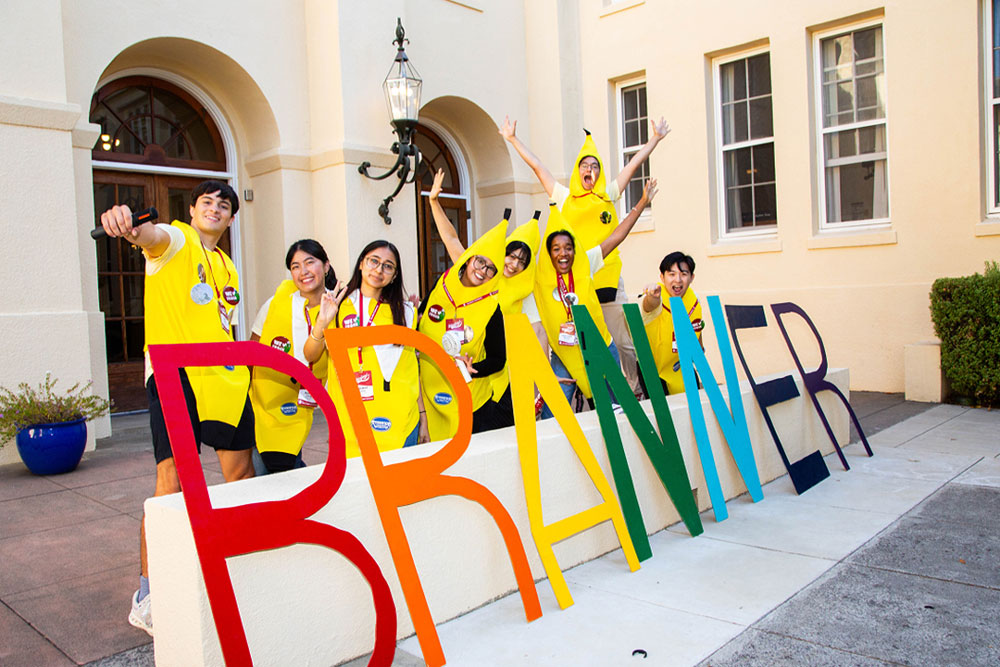 Photo: H. Taghap
The Farm is officially home to 1,950 new first-year and transfer students. At Stanford’s 136th Convocation last week, university president Jonathan Levin, ’94, acknowledged the uncertainties in the world while welcoming the new undergrads into the family. “I can’t tell you what the future will hold,” he said. “But what I can tell you with confidence is that you are in the right place.”
Dream works.
Undergoing surgery can be anxiety-provoking, but what if the anesthesia itself could ease your health care worries? Stanford researchers have found a way to induce dreaming in elective surgery patients as they emerge from anesthesia, and the results would make the Sandman do a double take. In a study of 452 patients, 69 percent recalled dreaming, and 86 percent of those dreams were positive—usually populated by friends and family, and often reimagining stressful events with more peace. The five-step protocol, which pairs propofol with EEG monitoring and quiet time as patients emerge from anesthesia, may extend beyond the operating room: Researchers see parallels to psychedelic therapies like MDMA and ketamine. “We’re deploying this as a mental health intervention that borrows deeply from psychedelic work,” said Boris Heifets, an associate professor of anesthesiology, perioperative and pain medicine. A 15-patient open-label trial for nonsurgical patients with moderate to severe PTSD wraps up in the coming months. The results will help determine if anesthesia could serve as a rapid-acting therapy for psychiatric disease.
But wait, there’s more…
Do you know when to woo? Watch as Stanford football general manager Andrew Luck, ’12, MA ’23, teaches Stanford’s newest undergrads to keep things All Right Now.
You may have spotted 14-time Emmy nominee Sterling K. Brown and his wife, actor Ryan Michelle Bathé, both ’98, on the red carpet last week, but a few months ago, the couple was under red tile roofs. They spoke with Stanford magazine about marriage, fame, and the long, winding road to both.
A Stanford study finds that when California public school districts close schools to save money, they don’t usually come out ahead. Reduced spending comes with lost revenue, resulting in no significant net improvement in overall finances.
Sleep researchers Masashi Yanagisawa of the University of Tsukuba and Emmanuel Mignot, a Stanford professor of psychiatry and behavioral sciences, will receive this year’s Albert Lasker Basic Medical Research Award for discovering a quarter-century ago that many cases of narcolepsy stem from the absence of the brain peptide orexin.
Sam Fuld, ’04, wasn’t done with Major League Baseball when he stepped off the field. Now, the former outfielder is president of business operations for the Philadelphia Phillies.
Stanford scientists have developed a compact gene-activation tool called TIGRa. It’s shorter than CRISPR-based tools (and therefore able to enter cells without issue), more versatile in the genes it can target, and more efficient at activating more than one gene at a time.
Stanford engineers found a way to make clean hydrogen roughly 10 times more efficiently—by heating the reactor from the inside instead of the outside. Surprise bonus: The process leaves behind high-quality graphite, a material used in batteries.
Note: The Loop sometimes links to articles outside of Stanford that may require a subscription to view.