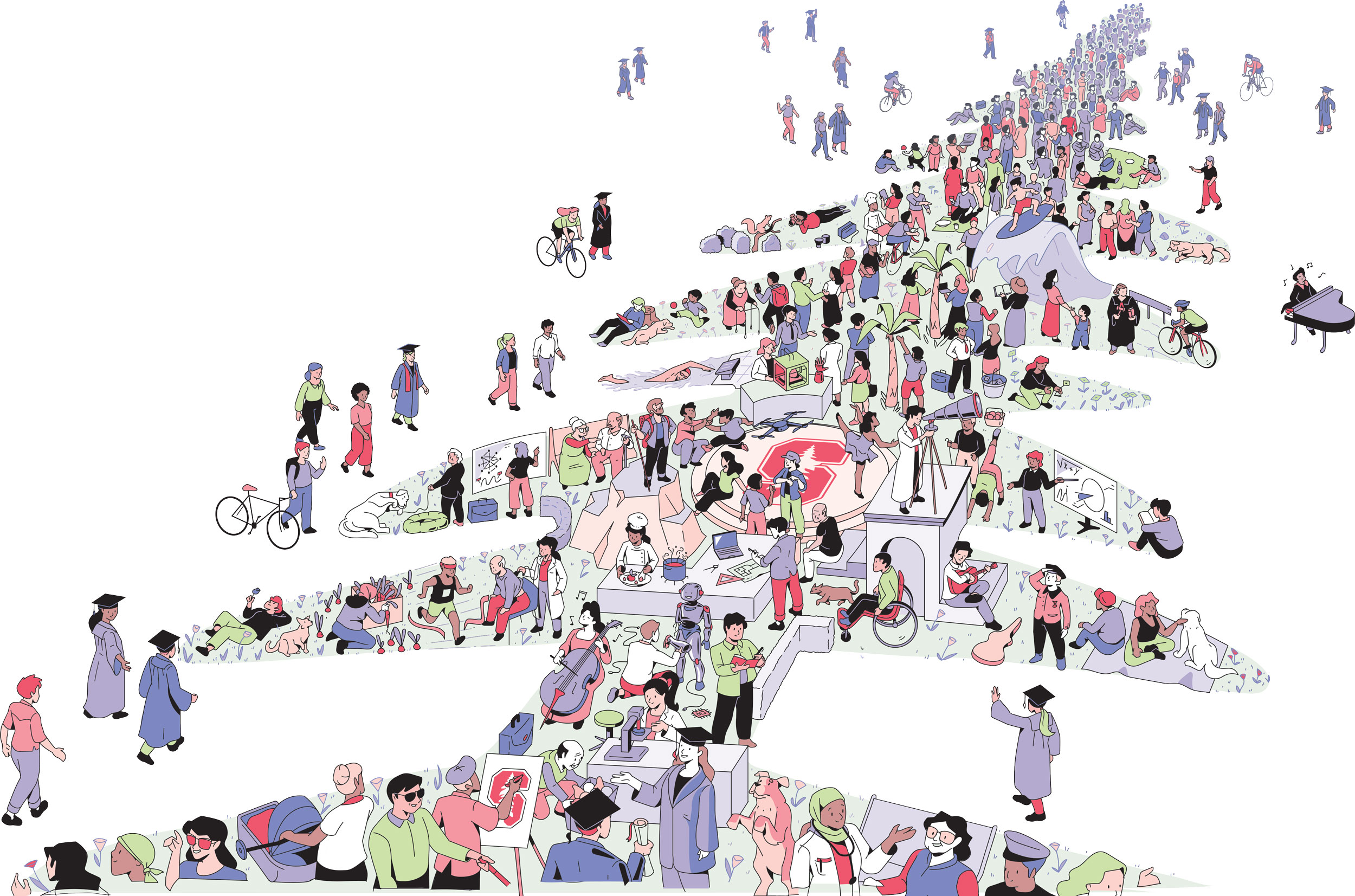
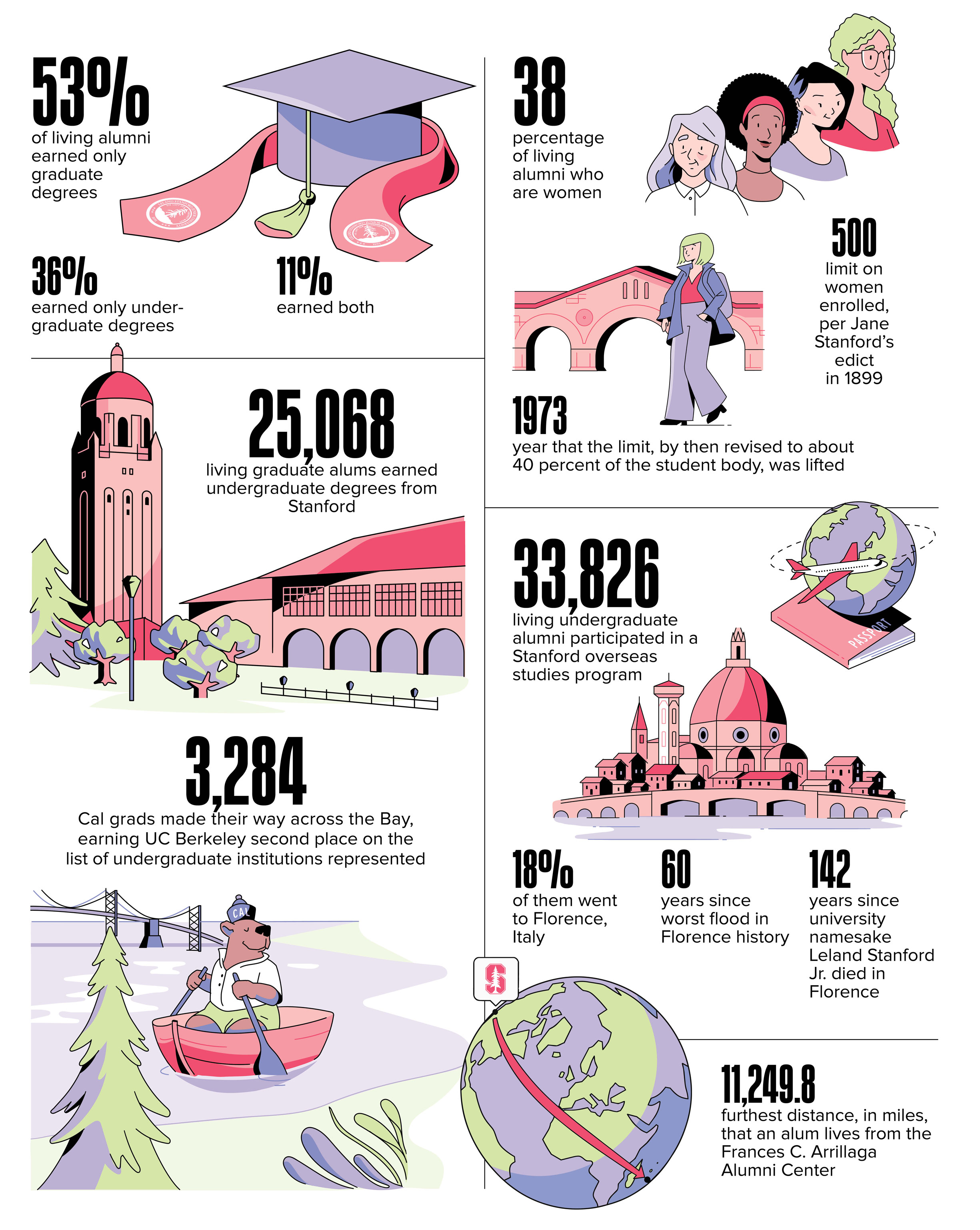
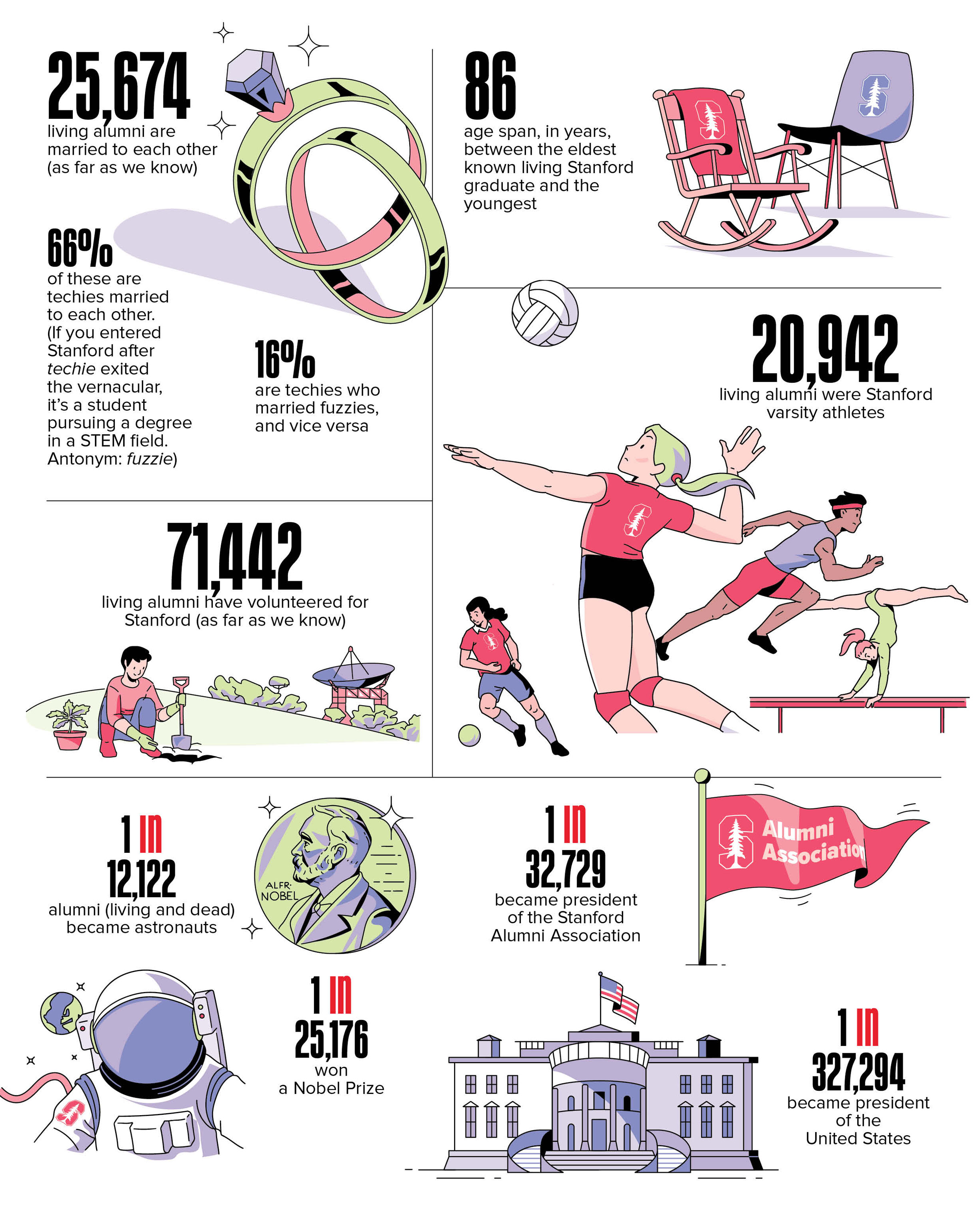
If all 251,748 Stanford alumni clasped hands and stood side by side, we could reach Leland Stanford’s mansion in Sacramento and return to his Palo Alto Stock Farm. There, the dry bed of Lake Lagunita would provide just the right amount of space for all of us to mingle at a cocktail party. And if we wanted to slip the surly bonds of Earth, we could stand head-to-foot and touch the International Space Station (where, incidentally, 14 alums have ventured).
An alum, as defined by the Board of Trustees, is anyone who attended Stanford for three quarters or more in a degree-granting program. In June, the number of living Stanford alumni cracked the quarter-million mark for the first time. So, incidentally, did the number of public EV charging ports in the United States. To get a sense of the power in our numbers, read on.
—Kathy Zonana, ’93, JD ’96
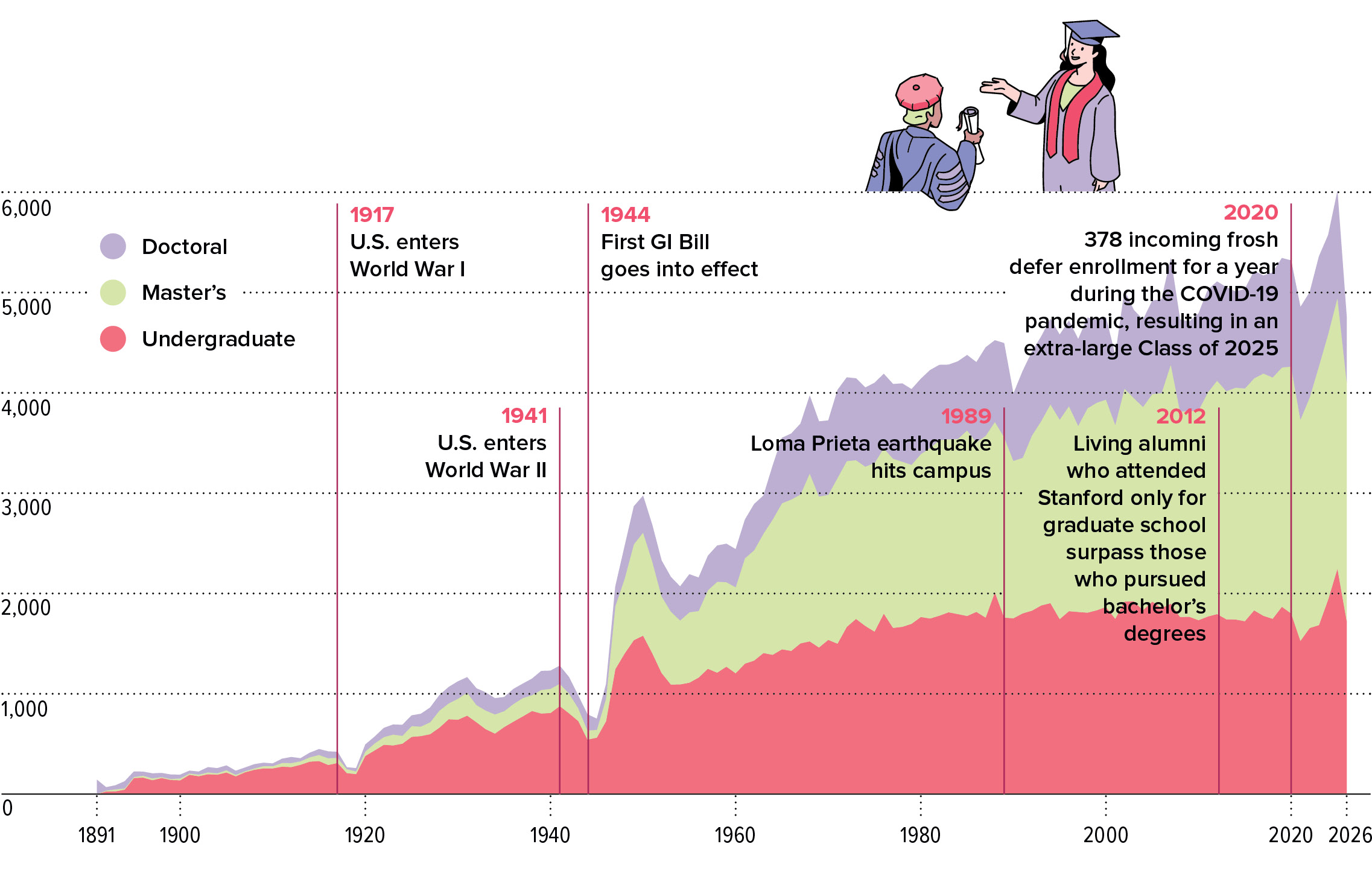
How We Grew Over Time
Degrees granted since the university’s founding, including by the later-adopted Cooper Medical College.
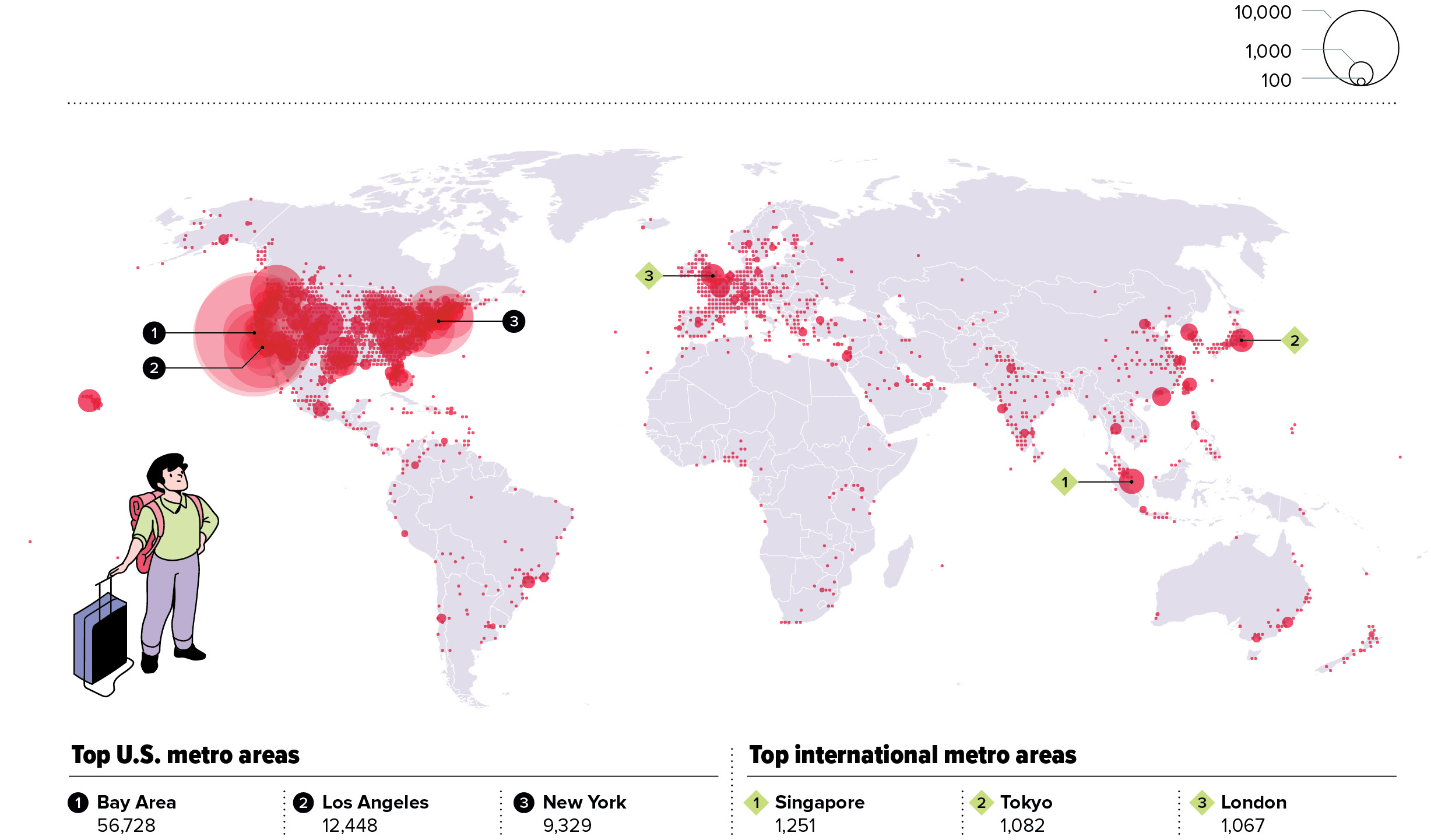
Where We Live
That’s all 50 U.S. states and 162 additional countries, if you’re counting (which we were).
|
The 250,000th BranchIn which we go out on a limb to anoint the quarter-millionth alum. |
|
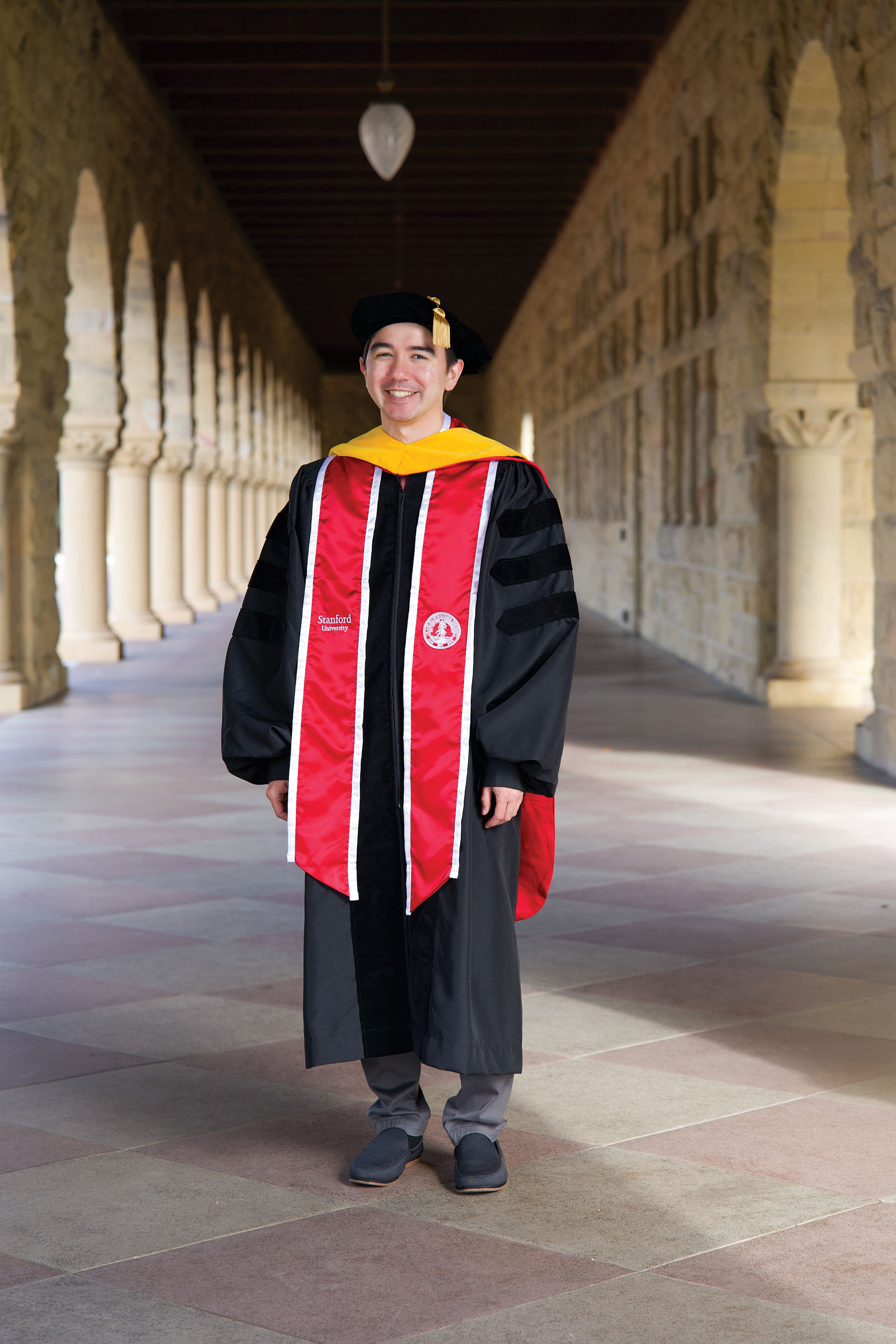
Steven Miller likes to build things. He spent most of his six years of graduate school wearing gloves and goggles—a long ponytail hanging down his back—as he built molecules under a fume hood in a chemistry lab while jotting down notes on Post-its and sticking them to the wall. Boron: 5263 mg. 60 ml THF. “I was probably in that lab 10 to 12 hours a day, six days a week,” says Miller, PhD ’26, who was a doctoral student in the lab of chemistry professor Justin Du Bois. “I piled up thousands of Post-it notes.” When Miller crossed the stage in June, he became, more or less, the 250,000th living Stanford alumnus. (A brief methodological aside: As of June 1, based on the order in which degrees are conferred, Miller was slated to become the quarter-millionth alum. But Commencement was on June 14, which left a couple of weeks in which his placement might have wiggled a little due to alumni deaths or students not actually graduating despite their declared intent. In other words, Miller is the 250,000th living alum for storytelling purposes. And now we return to those purposes.) “It’s pretty cool to know what number alumni I am,” he says about the unofficial designation. But mostly he’s excited to start a career as a medicinal chemist, using synthetic organic chemistry techniques to design and synthesize novel molecules or alter existing ones to help make medicines and other therapies. As a kid, Miller liked to build box cars and go-karts. He thought about becoming an engineer, but his dad was an engineer, and he wanted to strike out into new territory. In high school in Virginia, he discovered a knack for chemistry, and in spring of 2019 he earned a bachelor’s degree in the field from Virginia Tech University. That’s where he found his passion for organic chemistry. “I think it’s something that a lot of people dislike,” he says, laughing. But one of its subfields—synthetic organic chemistry, or the design and construction of complex carbon-based molecules—spoke to him. “What I really liked about it was when I discovered, like, oh, wow, it went back to this idea of building stuff. I was good at building molecules,” he says. For his dissertation, he designed and built fluorescent labeling tools to follow neurons in microscopy experiments. Someday, they may enable researchers to better understand a chloride ion channel implicated in epilepsy. “I get to make things,” Miller says. “And even though they’re really small—molecules may not be as satisfying to the eye as putting together something like a car—I’m using my hands to make something.” Miller also likes to use his hands in the kitchen, where he makes pot pies from scratch. He lives in Menlo Park with his girlfriend, Linn Allworth, who was his chemistry lab partner at Virginia Tech and is now a pharmacist at Stanford Medicine. After graduation, Miller joined the lab of associate professor of medicine Justin Annes. Annes specializes in the treatment of endocrine disorders such as diabetes, and Miller provides chemical support for the lab’s endocrine projects. “I’ve always loved talking to biologists,” Miller says. “I like having context for what I’m doing. It’s exciting to open this new chapter in my life.” —Tracie White |
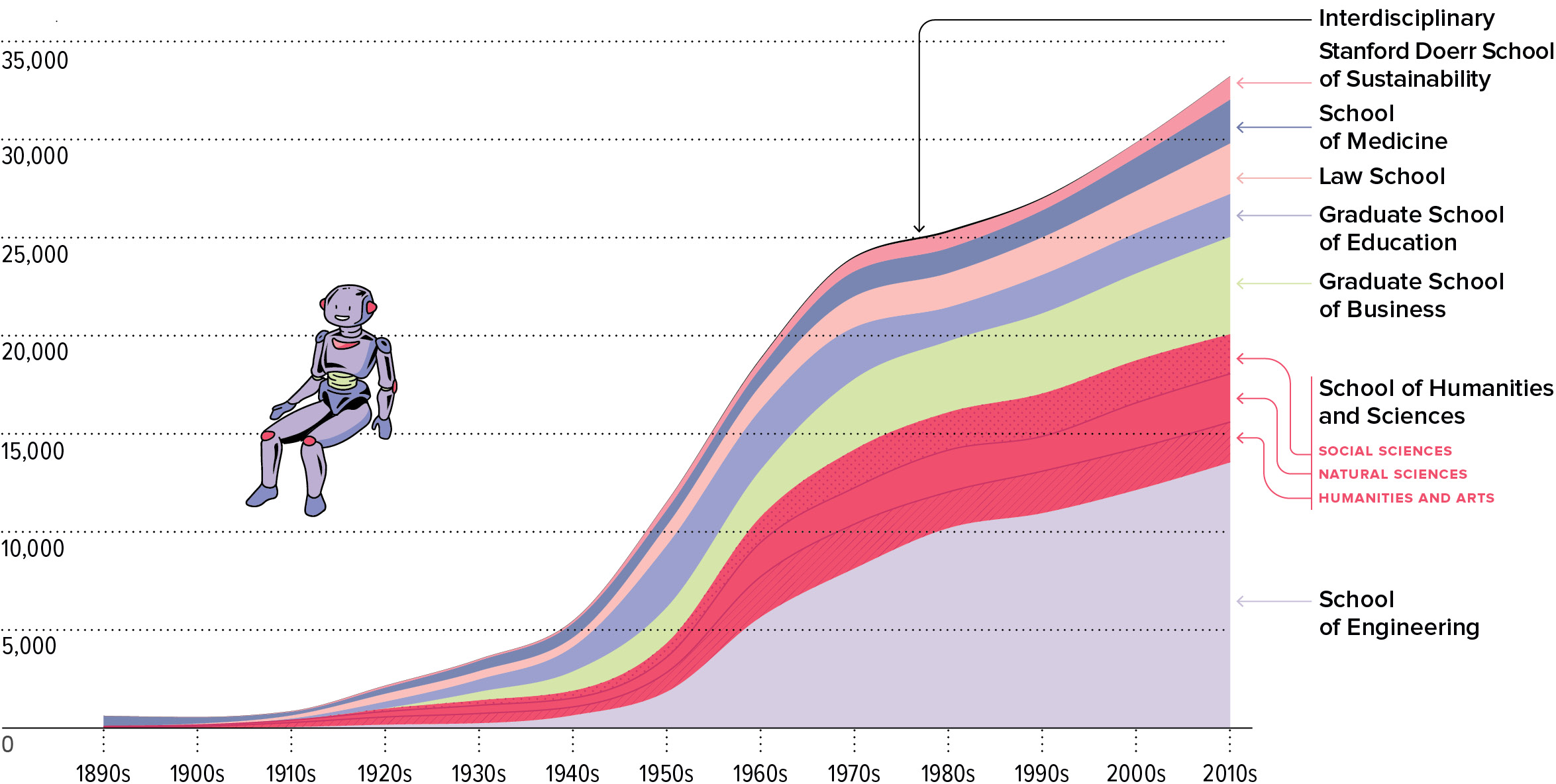
What We Learned in Grad School
Master’s and doctoral degrees granted by each of Stanford’s seven schools.
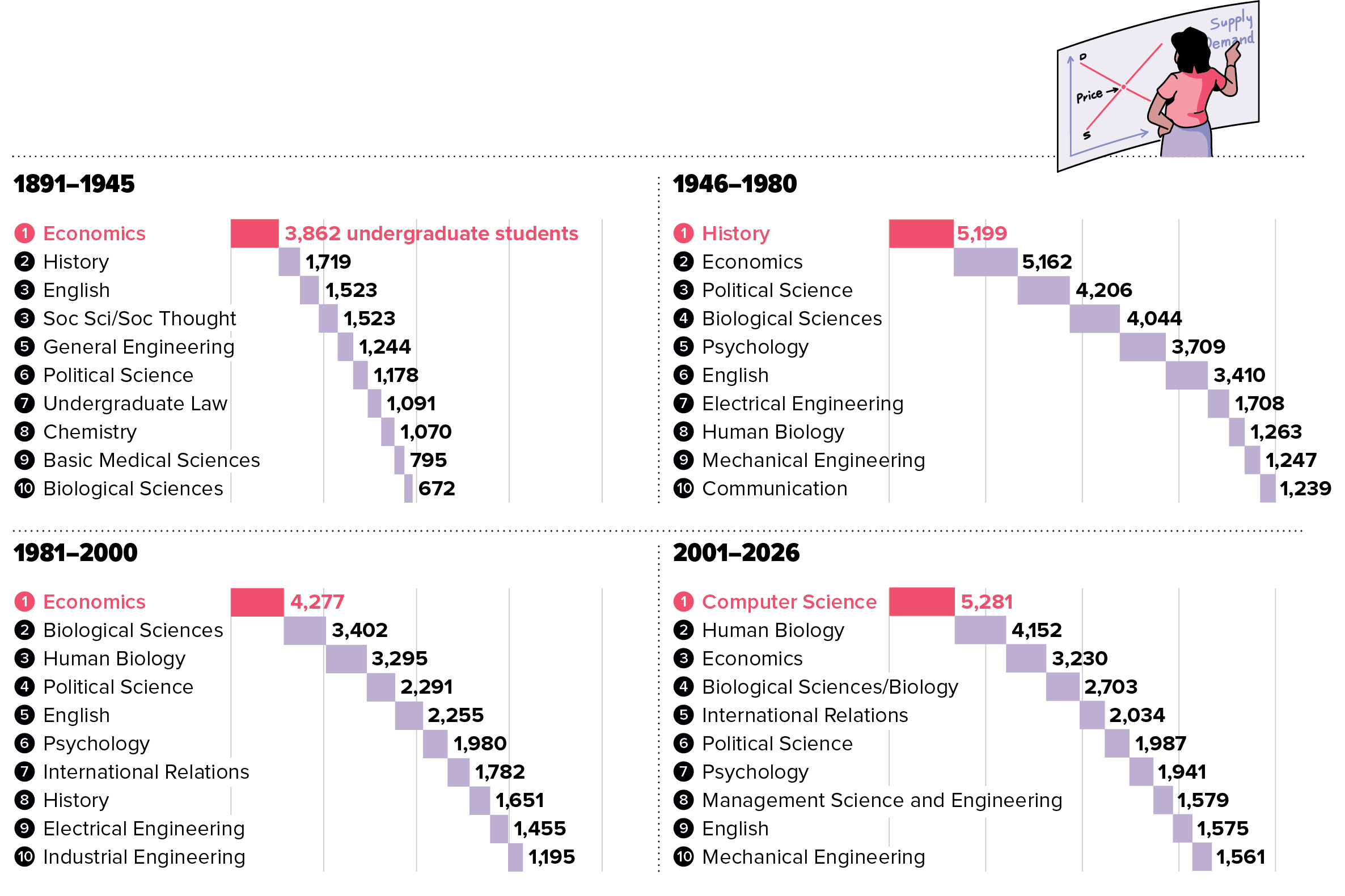
What We Learned as Undergrads
Each era’s most popular undergraduate majors.
Tree TopsWolf takes a bough and Landrey Cline replants herself. |
|
On June 15, 1892, some 27 undergraduates and nine master’s students participated in Stanford’s first Commencement. They had only been on campus since October, when the university had opened its doors. And yet, says Carolyn Manning, ’78, former vice president for alumni relations, “there was something that was going on that made people want to stay in community.” They established a half-dozen clubs, hosted get-togethers, and launched a publication that included Class Notes. They were the Stanford Alumni Association. Things have changed in almost every way. That fledgling group has grown into a throng of 251,748 living alumni. There are more than 8,000 attendees at Reunion Homecoming each fall, 1,500 annual alumni-led events, 174 clubs, 65 annual Travel/Study trips, and quarterly issues of this magazine. Still, says Manning, who worked for SAA for 44 years, “I feel like it’s some of the same DNA.”
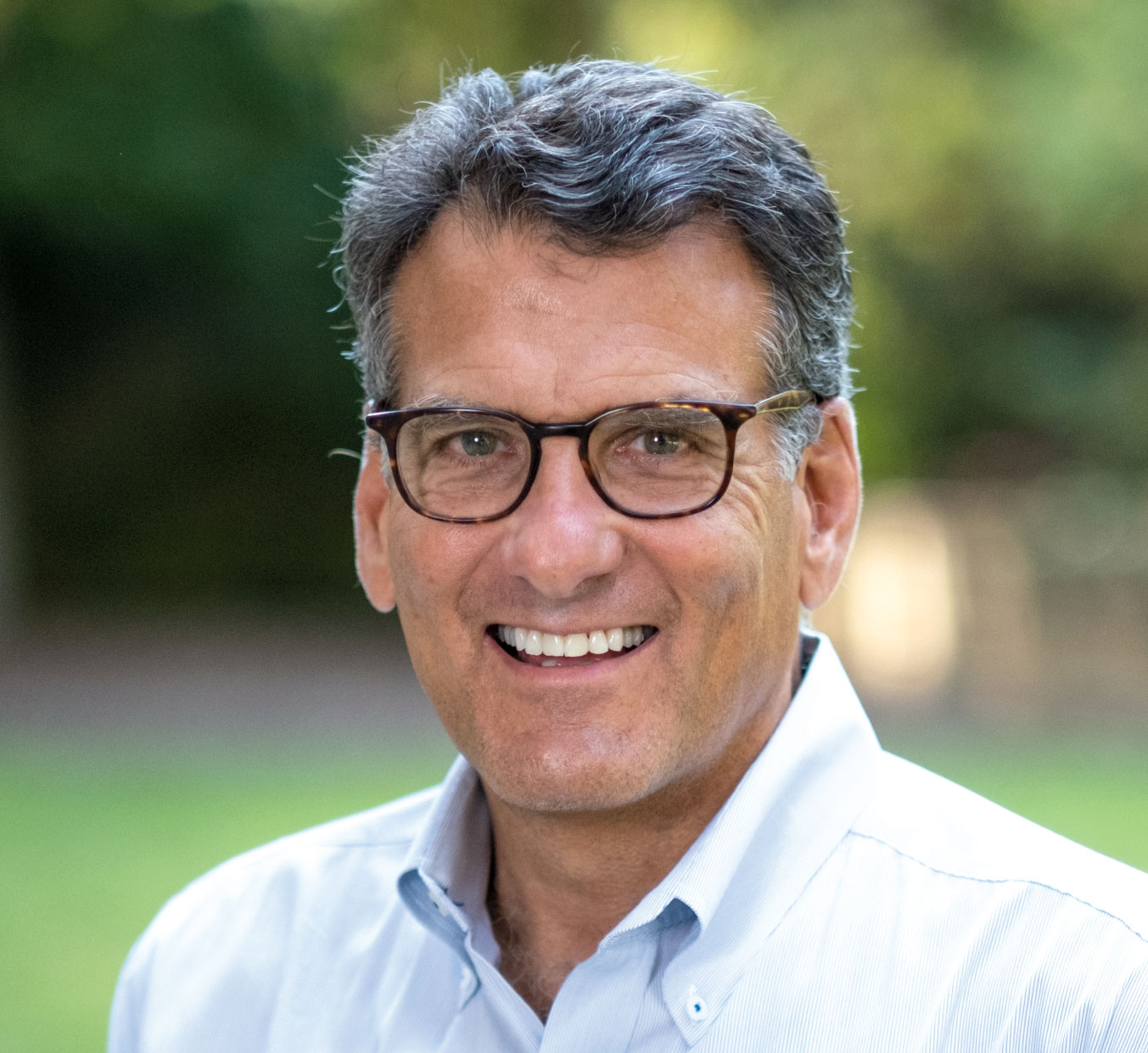
The traits that emerge from that DNA might be most visible in SAA’s leaders, starting with longevity. The position has been open just twice since 1977. The first time was in 2001, when Howard Wolf, ’80, took the helm for what he figured would be a five- to 10-year stint. Instead, he retired on September 1, after 25 years and five months in the Frances C. Arrillaga Alumni Center. “I fell in love with the job,” he says, and with “the idea that you’re a part of a place that is so special in the world, and you can have one degree of influence on the trajectory of that rocket ship. How fantastic is that?” Wolf’s tenure spanned four university presidents, a shift in public perception of higher education, and nationwide changes in college athletics. The number of living Stanford alumni increased by 50 percent and many of SAA’s offerings—from Reunion Homecoming to Senior Dinner on the Quad to online affinity groups—expanded, modernized, or transformed entirely. And for an organization founded on the gathering of people, there was no test greater than the COVID-19 pandemic. “Figuring out how we could still provide services, that was tricky,” says Manning. “He was really transparent with people about what we knew and what we didn’t know. We were very lucky to have him at the helm during that time.” Wolf directs the credit elsewhere. Each year, he says, 15,000 alumni volunteer for the university. “I think alumni are the secret sauce, in many ways, of Stanford’s success,” Wolf says. “[They] are some of the most amazing people in the world. I have a special place in my heart for our volunteers and our volunteer leaders, because they give so much of themselves to Stanford. They believe that if they volunteer for Stanford, it helps make the world a better place.”
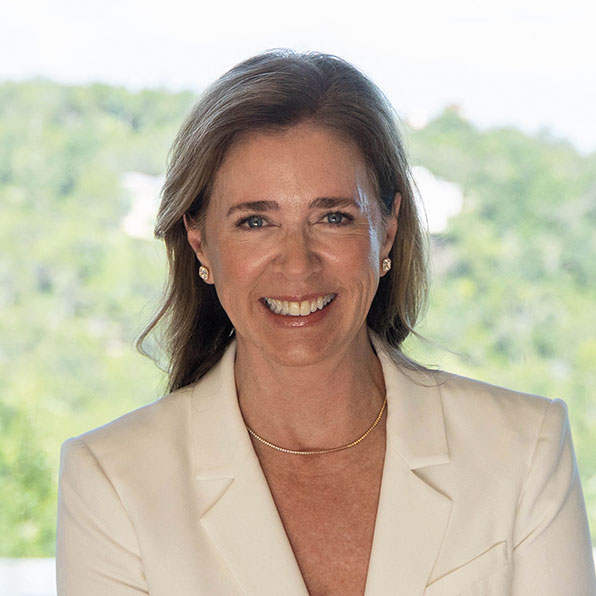
On August 31, one of those volunteers, Michelle Landrey Cline, ’93, MBA ’98, became the 10th SAA president and the university’s vice president for alumni affairs. Landrey Cline’s Stanford story began in the spring of 1989—when she was poised to decline her offer of undergraduate admission. The Beaverton, Ore., high schooler had hoped to follow in the footsteps of a neighbor she admired, Karin Fahlman Chesnutt, ’88. “I always thought she was really cool,” Landrey Cline says. “She played piano and had really cool feathered hair.” But money was tight. Landrey Cline was the youngest of five kids; their father died when she was 8. And yet, the day she decided she would turn down the Farm, her mother appeared, midday, at her school locker. “She said, ‘I think you have to go.’” Landrey Cline matriculated—and promptly became homesick. She remembers running up her mom’s long-distance phone bill to the tune of $300. “That was a lot back then,” says Landrey Cline, who worked in the Overseas Studies office throughout her undergraduate years. (Of note: Landrey Cline, Wolf, and Wolf’s predecessor, Bill Stone, ’67, MBA ’69, share the same frosh dorm: Wilbur Hall’s Madera, which is now Okada. They’re also each 13 class years apart, so Class of ’06 Okada frosh, consider yourselves notified.) But as soon as Landrey Cline decided to dive into campus life, she went straight to the deep end. By the spring of her first year, she was one of the student leaders of Admit Weekend. She became a tour guide, served as a frosh RA in Stern Hall’s Larkin, and was president of the Stanford Student Alumni Network, which introduced her to the world of alumni relations—once by putting her in the literal driver’s seat. She was asked to ferry then-university president Gerhard Casper to the class parties during Reunion Homecoming 1992. Driving up to Hoover House to retrieve him in one of SAA’s white vans, “I hit a curb,” she says. “And I’m like, I have no business driving the president of Stanford.” In her time at the Graduate School of Business, Landrey Cline was co-president of the marketing club and an orientation leader. “I loved that time,” she says. “Grad school is such a gift. When you go to high school and you go to college, these are expected things that you do. Grad school, it’s like, wow, what a luxury that I get to just learn right now.” Professionally, she has worked at Mobius Venture Capital, the Boston Consulting Group, Disney, and, from 2001 to 2005, at SAA as co-director of regional outreach and director of special projects. Most recently, she spent 15 years at the Business Talent Group, which supplies independent experts and executives on demand. In a volunteer capacity, she has chaired the Alumni Committee on Trustee Nominations, the Graduate School of Business Alumni Association Board, and the Stanford Associates Board of Governors. She has received the Stanford Medal, the Governors’ Award, and the Award of Merit in recognition of her efforts on behalf of the university. “I think everything she’s done has led her to this,” says Manning. “She brings a broad perspective to the work. Personally, I’m thrilled there’s finally a woman in the chair.” (Landrey Cline’s nine predecessors are male alumni.) “Howard has been extraordinary, both as a leader of SAA and as a personal manifestation of the Stanford spirit,” says Stanford president Jon Levin, ’94. “For 25 years, he’s written back personally to every email he’s received and connected with tens of thousands of alumni at reunions and alumni events all over the world. We found a truly worthy successor in Michelle Landrey Cline, who has an incredible passion for Stanford and energy and love of people, Stanford alumni in particular.” Over the summer, Wolf brought Landrey Cline to an event on campus, planning to introduce her around. In minutes, he says, it was clear she didn’t need a facilitator. “She’s just so affable, so gregarious, and so easy to talk to, but at the same time, super smart and super strategic.” The SAA president reports directly to Levin, and part of the role is to represent alumni to university leadership. “I really see myself as a conduit,” Landrey Cline says. “There’s a lot of wisdom in the alumni body that you want to be able to share with leadership.” Over the summer, Landrey Cline relocated to the Bay Area from Austin, Texas. “I’m really excited to come home,” she says. It’s been foreshadowed for a while now. Thirty years ago, in her GSB application essay, Landrey Cline wrote that she envisioned herself as a leader of the Stanford Alumni Association. “Whether [I’m interacting] with students, or staff, or faculty, or alumni, I get so much out of it,” she says. “So to be able to do that for my day-to-day—that fuels me.” —Summer Moore Batte, ’99 |
Data analysis by Jeremy Ware, Mark Covington, and Gina Johnson