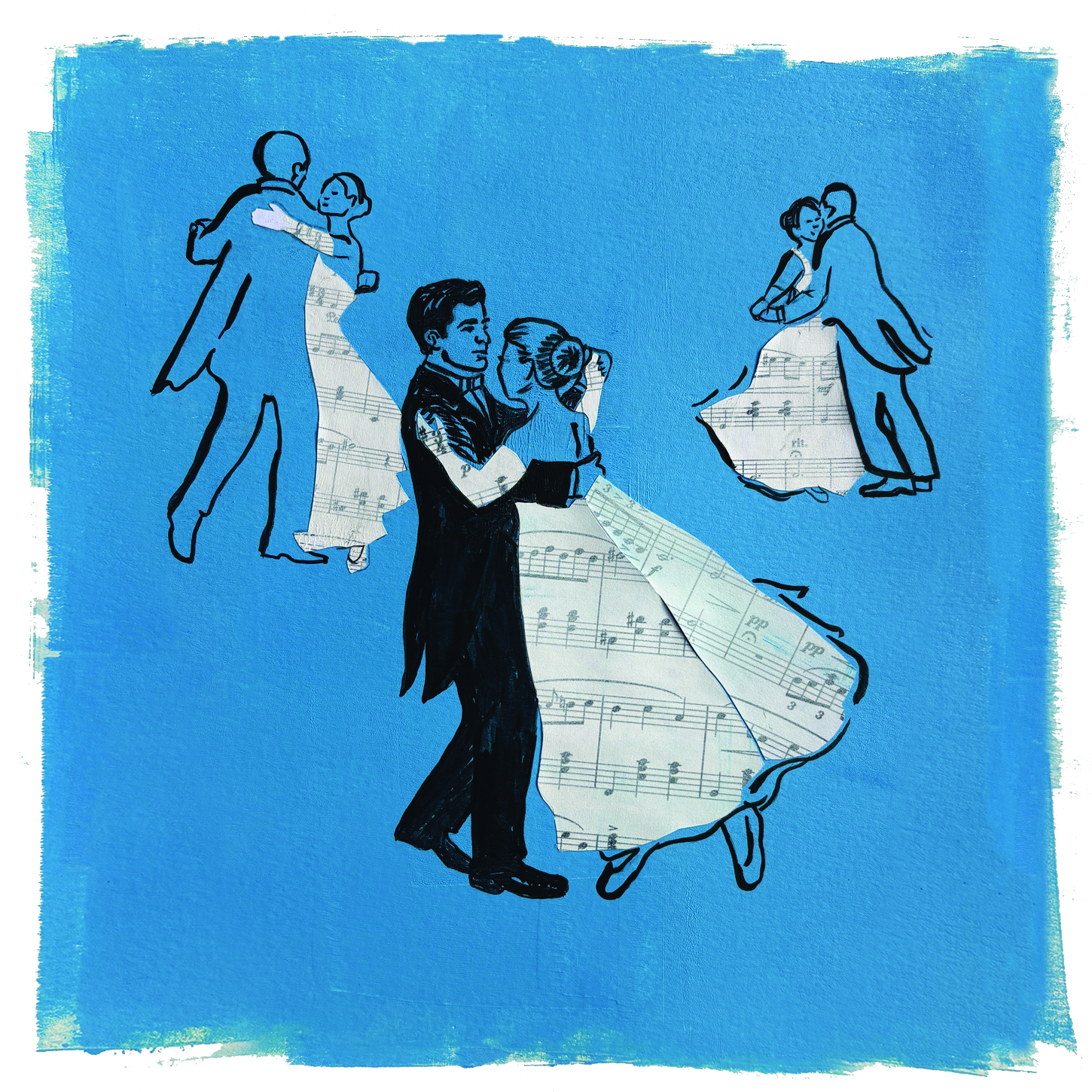
Two years ago, I walked into the Stanford Viennese Ball with no preparation and no expectations. A thousand people in black suits and white gowns turned across a single floor, the whole room revolving around some invisible center, and I stood at the edge and watched. I could not do any of it. I knew only that I would come back.
So a year later, I went to the first of the free social dance lessons offered in the two weeks preceding the ball. That Saturday in Roble Gymnasium, a PhD student named Rebecca Wang, MS ’22, stood in the middle of the waltz circle, giving her free time to something she loved. I took hold of a partner, and we began to turn. We spun and spun. There was an intoxication in it that I was not prepared for, the world blurring softly at the edges, another person’s hand in mine as we worked out the geometry of the thing together. Everyone was a beginner. It was fumbling and imperfect, and that was what made it beautiful.
Goethe got there first. “Never did I dance more lightly,” he wrote in The Sorrows of Young Werther, published in 1774. “holding this loveliest of creatures in my arms, flying, with her as rapidly as the wind, till I lost sight of every other object.” Two and a half centuries later, the description still holds. There is a reason the waltz was once thought scandalous.
In the days that followed, I threw myself into every class offered at Roble: cross-step waltz, Lindy Hop, swing, and the traveling dances, where everyone moves together in one great circle—dozens of partnerships orbiting the same center. A student instructor named Bella Archibald, MS ’23, told me to stop forcing it. “Dance is supposed to be improvisational,” she said. “Experiment. Play. Have fun.” Something unlocked. I stumbled often, and no one judged.
It was fumbling and imperfect, and that was what made it beautiful.
I focused instead on whom we danced with. On any given day, a college student takes a turn with a woman in her 70s. A retired engineer dances with a stranger half his age and nothing like him in politics or origin. On that floor, the ordinary sorting of American life falls away, and for three minutes, two people simply move together and attend to no one else. It is hard to hold a stereotype about someone you are waltzing with.
Social dance is also one of the few things that cannot be automated. You can now generate a song, or a picture, or a passable imitation of conversation. You cannot generate the weight of another person’s hand in yours in real time. Richard Powers, MS ’70, an advanced lecturer in theater and performance studies who has spent decades keeping this art alive, says that is the whole point. “Dance is the one thing AI cannot possibly replace,” he told me. You have to show up, and so does your partner.
When the 47th Viennese Ball arrived, I went back, this time knowing the steps. Afterward, I found myself waltzing home to my dorm, alone under the night sky, one-two-three, four-five-six, the rhythm still humming in my body.
Nikhil Jain, MBA ’26, works for DAVA Oncology in San Francisco and is active in the Bay Area social dance community. Email him at stanford.magazine@stanford.edu.