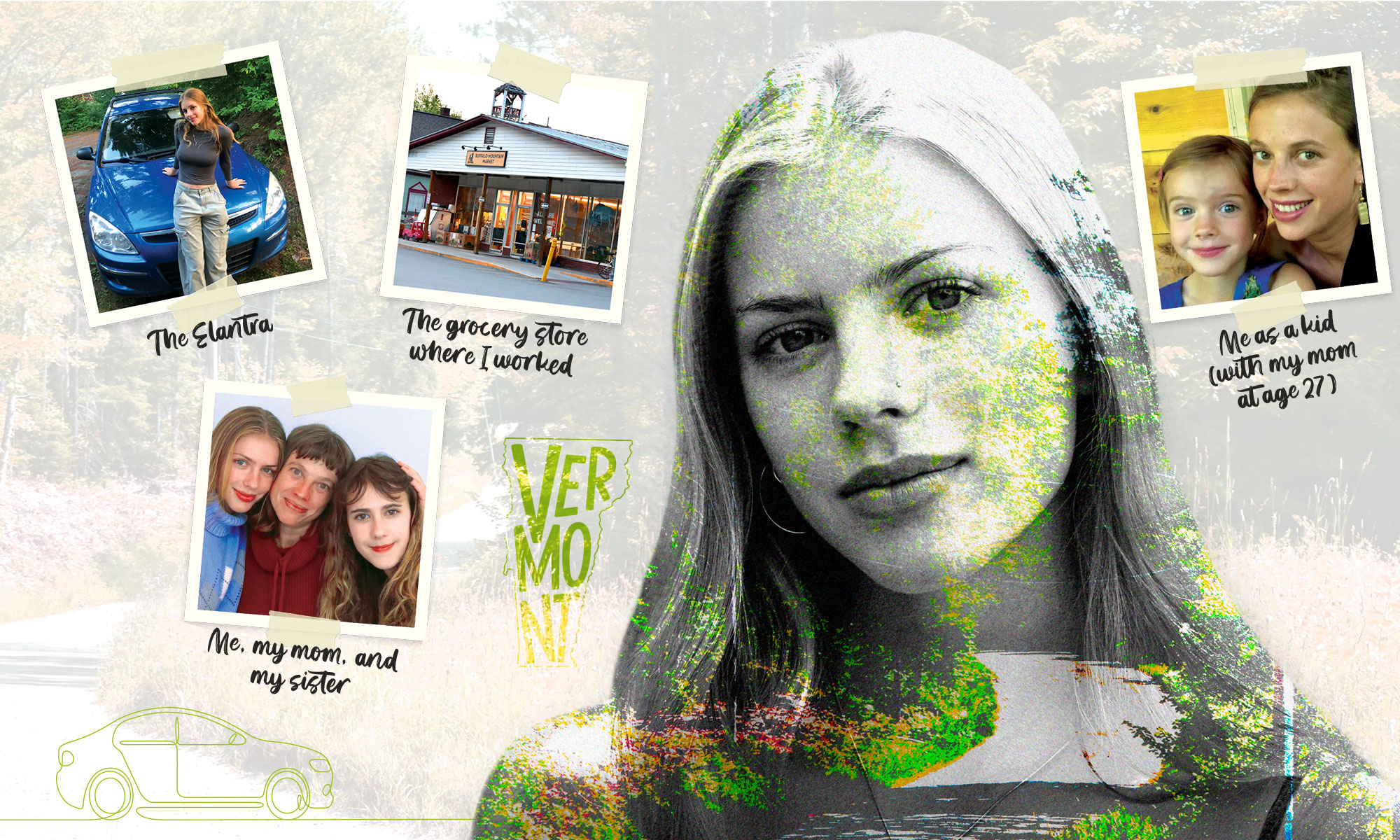
At the end of the summer before my sophomore year at Stanford, I decided to sell my car.
I bought it a few days after I turned 16. I’d saved money for years, working several jobs, including at a tearoom in rural Vermont owned by a British woman. Decades earlier, it had been my mom’s first job. Sometimes strangers called me by her name, as if I were reenacting her life: same place, same job, same face.
I was annoyed at her that day. She hadn’t been able to drive me to pick up the car earlier, and waiting any extra amount of time seemed unbearable to me, who felt trapped by the trees and hills that wrapped themselves around me like a coffin. I was adamant then: I’d buy this car first, and, a year later, I’d leave for good. I’d waited years. I’d opened my bank account when I was 12.
So, as I often was at that age, I was bitter when we arrived at Eloise’s house. The place was familiar: She’d once rented it to us after my mother’s divorce. It had become a shelter for us; my mom called it the “heartbreak hotel.” When, at 7, my sister could no longer sleep alone, when crying among the family was a daily occurrence, and when a pandemic isolated us from the world, the house held us. Then Eloise’s own divorce came. She moved in, we moved out, and a chain of moves began that flung me about like a rag doll. I wanted, for once, to hold the wheel myself.
Eloise greeted us and showed us the car. It was a blue Hyundai Elantra with an odometer in kilometers. One door handle had “just barely stopped working!” Inside that house where I’d once lived, where a woman, her little girl, and her angsty, ungrateful daughter took shelter, I signed for the car.
I had my doubts: It turned slightly bumpy back roads into pothole-ridden perils. It needed its brakes fixed. There was no air conditioning, but for used cars this was considered standard and inconsequential, especially if you were poor and/or a teenage girl. I looked past my concerns: I wanted something to be mine, to be able to grasp my fate in my hands and navigate away from the sticks and turmoil I felt so consumed by.
Now that I had a car, I had to actually learn to drive. I’d been given my license despite forging my practice hours and failing to parallel park on my test. I also needed to learn how to get to all the places I’d been driven over the years by my parents. (What I did on those car rides is a mystery to me, because I had not the slightest clue how to get from my dad’s house to my mom’s.) Sometimes I followed directions from my phone, balancing it on my knee and glancing down at my lap periodically.
Other times, I got directions from my 10-year-old sister, whose attention to the place we lived proved stronger than mine. I’d pick her up from school, she’d get in whichever side of the car had a working handle at the time, and while I held the wheel between my hands, she told me how to move it. She adopted a “Siri” voice, chirping at me from the back seat to take a left or right, directing us from her school to the grocery store to our home. The roads felt new when I learned them, a web of trails spread out over my home that became familiar over time. Sometimes, when I drove, the sun would set over those hills and impose the trees over the colored sky. I was shocked at the beauty of this place I’d spent my life in, this place I was finally leaving in a year but was just discovering.
I never drove on interstates. I was still too scared, still harbored an inexperience I hated to admit. Half my mileage was on the dirt roads around my house, where I flew over potholes I’d failed to anticipate, cringing as the vehicle jostled around me. Sometimes neither of the rear-door handles worked. I procrastinated fixing the brakes, endured the “thud thud thud” sound that came from them when I ground to a halt. After some time, I did replace them and installed studded snow tires, purchased for me by my dad. I drove through my first winter with a car, getting stuck only a few times. I commuted to work and school, transported my little sister, and sang along to music from a growing CD collection I acquired for my car. I opened my acceptance email from Stanford before closing time at the grocery store where I worked, then clocked out and called my parents while sitting in my frost-covered Elantra, and before I heard their voices on the line it was just me and my car. My car, my vessel, sometimes falling apart yet always hanging together, carried me through it all, away from those tumultuous years into new ones.
When I left for Stanford the next year, I left the car sitting on my mom’s lawn. I often thought about it when the Stanford bubble felt inescapable: memories of rocking across Vermont’s tree-lined, broken roads would flood me. When I returned home for Christmas, it welcomed me (after my mom jumped it). Perpetually problematic, covered in dirt or mud or snow, creaking more and more each day, the car was invariably linked to home. What began as the means by which I explored the state I was born and raised in became how I visited after I left.
But each time I came back, it was in worse shape; each time I came back, it felt less like a homecoming. So, at the end of my first summer break, it joined thousands of crummy used cars on Facebook Marketplace and Craigslist.
After several responses, I had two meetings. One was with Frankie, who barely looked at the car, probably because of the selling price ($1,500) and his hope of fixing it up (I’d often seen him tinkering with cars in his driveway). He gave me his number, and I promised to contact him.
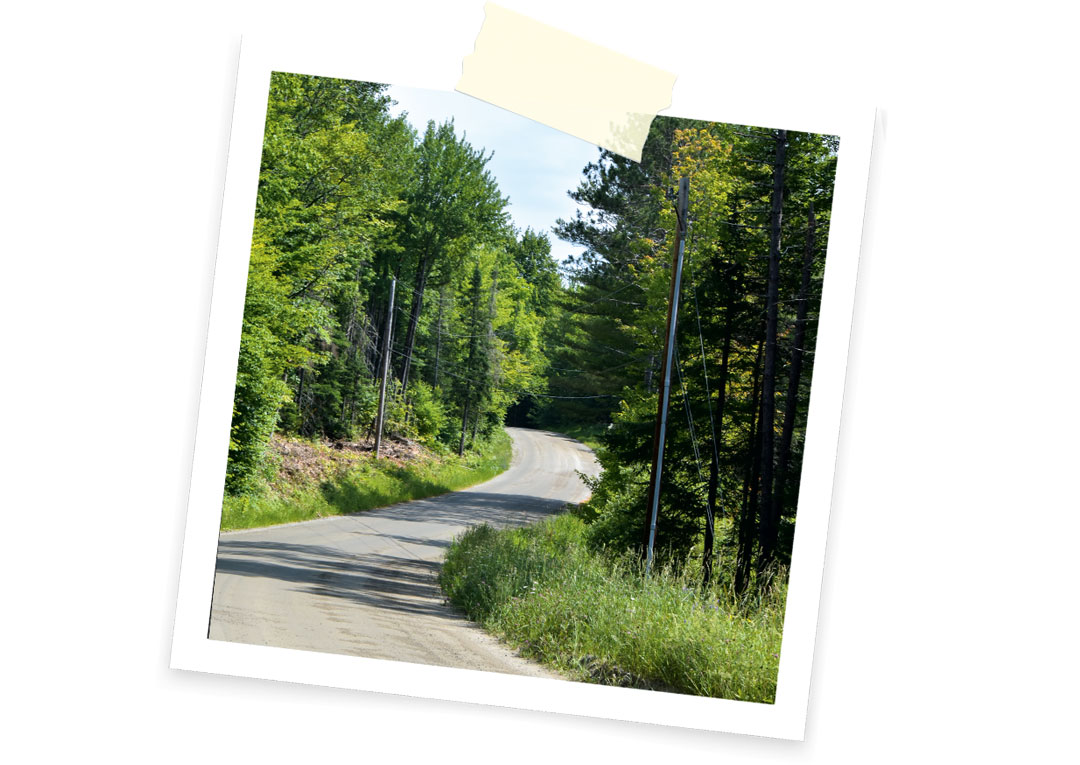 Image: Georgia Allen
‘I was shocked at the beauty of this place I’d spent my life in, this place I was finally leaving in a year but was just discovering.’
The other man examined the car much more. Driving up the hill from my old high school, he looked at me in shock when I told him that the sensations and sounds emitted by my little Elantra were normal.
“That is not normal.”
I laughed.
He wanted to get it examined by a mechanic, so I decided it would be easier to sell it to Frankie. I didn’t want to hear about all of its problems. I was protective. I was returning to Stanford in a week to begin my sophomore year, and I trusted Frankie to take care of it. It somehow seemed less sad to sell it to my neighbor who would fix it up—like gifting old clothes, stuffed animals, and other relics of an outgrown age to a family member for safekeeping.
So, a few days later, my mom followed me to the parking lot across from the grocery store I’d worked at for a while, where my dad had toted me along to shop a decade before that, and where I found out I was going to be a Stanford student. It lay at the base of the hill I’d once lived atop in the house my dad purchased when I was 5 and that—now that I’d left—he was considering renting out. It was September, and the air had been getting colder for some time.
I greeted Frankie, showed him the paperwork I’d printed and filled out as Eloise had done two years earlier. I felt like I was pantomiming adulthood.
As if it had just occurred to him: “Oh, I don’t have $200. Of the $1,500, I have $1,300. We can do it later, if you would rather.”
I’d already told him I was leaving in a week. I wanted to get it over with. “You can just give it to my dad when you get it.”
He agreed and used my car window to sign the papers.
My mom and I drove away, leaving my car in that parking lot across from the Buffalo Mountain Market, beneath my childhood home. Part of me wanted to stay with it, to keep traveling along those dirt roads. But my family had been in Vermont for nine generations, and there was a reason I’d gone to Stanford. I’d always thought of California as some sort of utopia as a kid, sunshine and dancing hippies. A perfect, dream place. By the time I sold the car, Vermont had begun to offer that allure. In a few years it had been transformed from my inherited reality to an unattainable dream: a dream of childhood and its wane, a dream I had to sell away once I recognized it, a dream I will never get back.
Eventually, my dad did get the $200 from Frankie and Venmoed it to me, a final, delayed note of closure to that chapter of my life, when I drove and loved my first car through the dwindling days of my childhood. But not all endings are immediate. Sometimes I still think of that car as mine, and sometimes I still think of Vermont as my home.
Georgia Allen, ’28, is an editorial intern at Stanford. Email her at stanford.magazine@stanford.edu.