During my years at Stanford, I was the only deaf undergraduate on campus, and American Sign Language (ASL) empowered me to participate in my classes and extracurricular activities, including my perpetual favorite: riding with the Stanford equestrian team.
When I started college, I felt unsure of how I’d navigate such a hearing-centric world. I stopped by the Stanford Red Barn during New Student Orientation, wondering how to try out for the team, which is how I discovered that the head coach, Vanessa Bartsch, ’99, had taken ASL during her own student years. She was entirely unfazed at meeting a prospective rider who was deaf. If anything, she seemed thrilled at the prospect of practicing her ASL again.
As I biked back to my dorm that day, I felt thrilled, too. I’d just glimpsed a place for myself on this actual Farm. Riding at Stanford had been a dream ever since I’d visited campus in high school, when I’d gaped at the Red Barn, with its brilliant red façade, white Victorian trim, and bronze statue of Leland Stanford’s horse Electioneer standing sentinel. Wow, I’d thought. I must come and live here.
Once I made the team, live in the barn is indeed what I did, whenever I wasn’t reading in Green Library. I started teaching Bartsch and my teammates some horsey vocabulary in ASL, including the improvised signs for “trot” and “canter” that I’d devised with my mother through her years of interpreting for my riding lessons. At Stanford, I brought ASL interpreters out to the riding arena, all of them arranged through the university’s Office of Accessible Education.
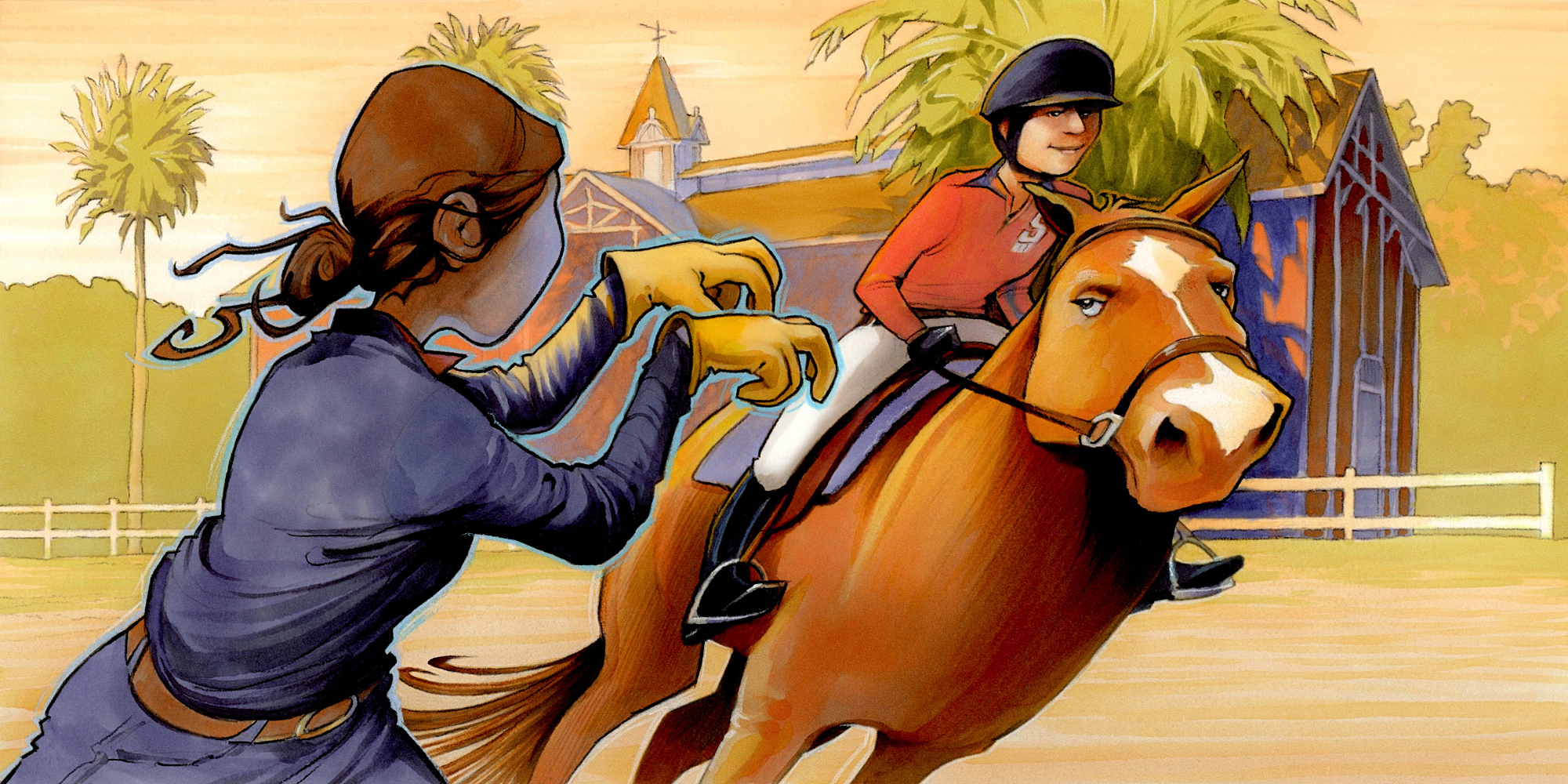
I chuckled at how many forms of communication were transpiring at once, spoken and signed, human and horse.
Each time I showed up for riding practice, I’d fix my gaze between my horse’s ears, then glance sideways at my interpreter as she signed the coach’s instructions. Oftentimes, she’d be jogging to stay within my viewing range, interpreting while also trying to stay clear of oncoming hooves. I chuckled at how many forms of communication were transpiring at once, spoken and signed, human and horse.
Long before college, I’d felt enthralled by the nonverbal communication of horses, and my Stanford coaches helped me gain greater fluency with this language. Hitting the gym weekly with my teammates taught me the importance of cross-training, while routine chores at the barn brought home how our equine partners were far more than pieces of sporting equipment. I was constantly biking out to the Red Barn between classes, rushing into my discussion sections smelly and manure-stained. Being an equestrian athlete is unlike participating in other college sports, not least because of the bonds that can stir from this mutual love for stinking like horse. My Stanford teammates and I did not always understand each other perfectly—but my time on the team showed me that human language isn’t always essential for experiencing a deep rapport with another living being.
Today, I am an author. Good writing often feels like sitting astride a powerful horse, inhaling at the singularity of each gait, as sentence builds upon sentence and the words bound ahead with imaginative momentum. Sometimes, crafting these written cadences makes me recall the Red Barn, where rhythmic hoofbeats shaped my inner thoughts as much as any literature class ever did.
Rachel Kolb, ’12, MA ’13, is the author of Articulate: A Deaf Memoir of Voice. Email her at stanford.magazine@stanford.edu.