
Sterling K. Brown and Ryan Michelle Bathé are grounded by their love. It is evident in the way they agree, disagree, and playfully rib each other. That’s an accomplishment for any couple married 20 years and raising two sons—let alone two people who have been in each other’s orbits since age 18. But Bathé and Brown, both ’98, have also weathered Hollywood together, from earning MFAs at NYU to striving for roles on the stage and screen to outright fame. Bathé is known for television roles in Boston Legal, First Wives Club, All Rise, and Army Wives, in which Brown was a lead. Then, in 2016, Brown’s star rose with roles in The People v. O.J. Simpson: American Crime Story—where his portrayal of prosecuting attorney Christopher Darden earned him his first Emmy—and This Is Us, which secured his second Emmy and made him the first African American actor to win a Golden Globe for best actor in a television drama. Bathé also appeared in the family drama, which ran for six seasons.
Brown and Bathé are also grounded by their love for their alma mater, which they credit with setting them on their professional paths. Stanford sat down with them on campus late one evening during the 2026 Stanford Black Alumni Summit. Brown was in the middle of shooting the third season of Hulu’s postapocalyptic thriller Paradise, in which he stars as Secret Service agent Xavier Collins. (A bonus for Bathé devotees: She makes an appearance in season 2.) Both the show and Brown were nominated for Emmys for seasons 1 and 2.
Tired from travel, satiated from reuniting with friends over dinner, Bathé and Brown reflected on the Farm, where it all started (while fielding texts from their children about whether they could order takeout. They could.)
Stanford: What parts of Stanford made you who you are?
Brown: I lived in Ujamaa three out of the four years that I was at Stanford. We had a house meeting, and I remember professor [of theater and performance studies] Harry Elam coming to the dorm and asking students to audition for a play that he was directing, by August Wilson. And I remember thinking, Oh man, I hadn’t planned on doing any acting, because acting is superfluous, and I’m here as an economics major and I’m trying to stay focused. But, oh, this seems like it would be interesting. And the big thing about it was he said that August Wilson was going to come to see the play. I did not know who August Wilson was, but I read the play and I was like, Oh, he seems like he’s pretty good.
It was Joe Turner’s Come and Gone. And Harry directed it. Having him come to the dorm and ask people to audition was like, all right, it must be meant to be. I wasn’t looking for this or whatnot, but this Black man is here in this dorm with these Black students asking for Black actors. And I was like, I’ll throw my hat in the ring. Both of us wound up being in the play, and Harry at the end of it, he’s like, “I know you’re not planning on majoring in this, but I think that you get something out of it. And I definitely know that the department gets something out of your involvement, so why don’t you just keep auditioning and see what happens?”
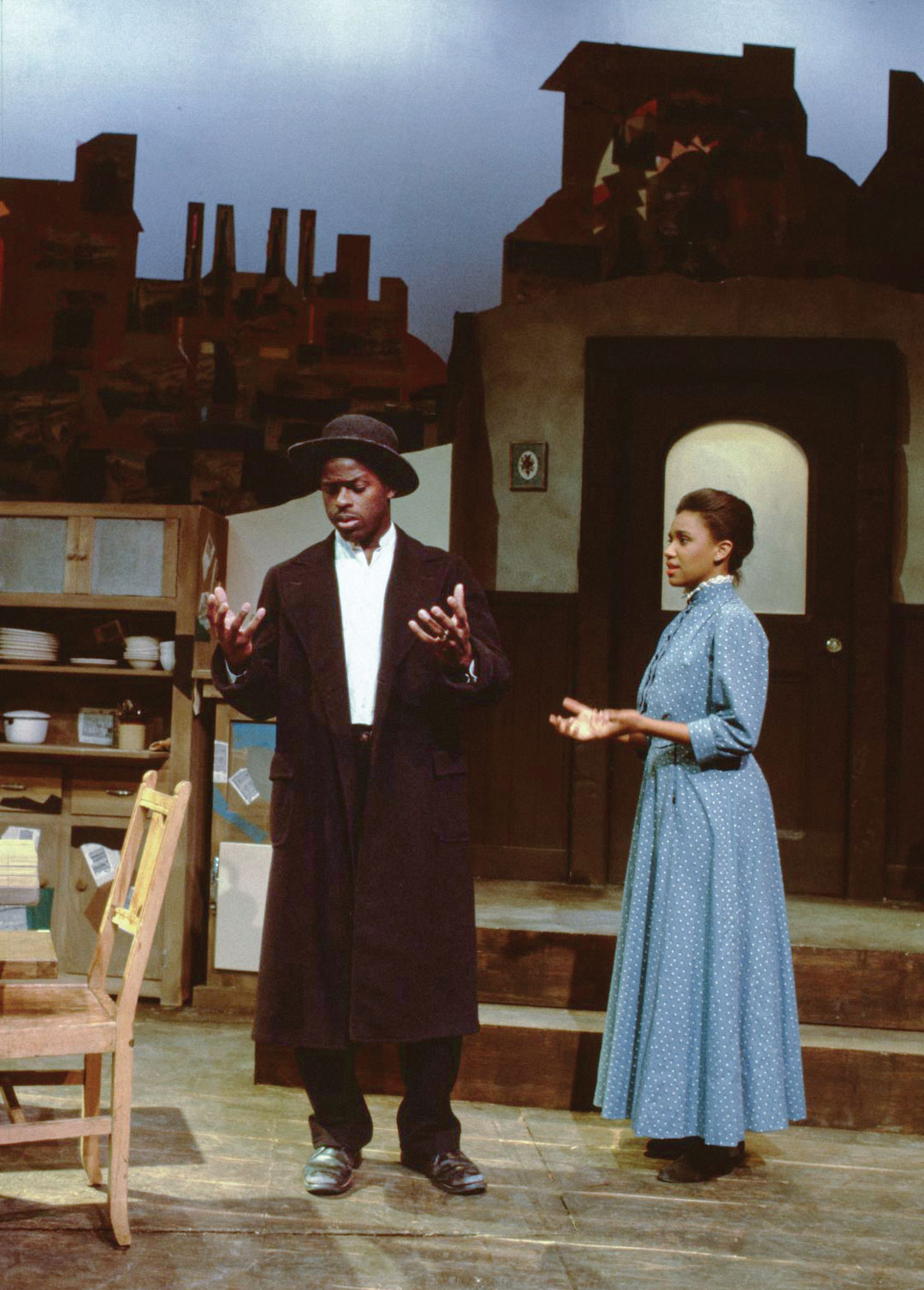 TWO CAN PLAY: Brown (as Harold Loomis) and Bathé (as Mattie Campbell) co-starred in Joe Turner’s Come and Gone at Stanford in 1994. (Photo: Courtesy Special Collections & University Archives/Stanford Libraries)
‘I realized that everything in my life got better when I was on stage.’
And that’s what I did for a year and a half or so until I realized that everything in my life got better when I was on stage. My grades in other classes got better when I was on stage. There was a joie de vivre that I was in possession of that was absent when I was not doing it, or if I was purposefully denying myself it.
Bathé: It’s funny because my experience of that play—I remember we got to be in community with grad students. It was such a good introduction to Stanford because I got to see that you could have this really rich academic life. They were getting their PhDs, they were getting their master’s degrees, but they still found time to do this play. And they were very good at it. I was like, Wow. I’m at a place where people are truly multitalented. We got to see these people with such intellectual prowess, with such incredible gifts as actors, just come together.
I’d always heard you met freshman year. And I thought, Oh, it’s one of those stories. But it didn’t go that way. Will you tell me a little bit about that?
Brown: It seemed like we had interest in each other at different times. Because—you know what? I actually want Ryan to go first, because I’ll start saying something and she’ll say, no, that’s not how it went. So, I’d rather her set the record from her perspective, and then I can add.
Bathé: Memory is a faulty storyteller in many ways. A wonderful storyteller, but maybe not the most factual storyteller. Yes, there were different points in time that we were interested in each other and, you know, went on about our merry way. It wasn’t until the very end of junior year that we actually were in an official relationship. And even then, it wasn’t that official.
Brown: Wasn’t it?
Bathé: No, it was not! It was at least recognized that we both had feelings for each other at the same time. And then senior year happened and we ended up going to NYU. The year before us, there was a guy named Jordan Gelber [’97]. Jordan was the first person in our circle to go to grad school. He illuminated a path that neither one of us had heard people talk about before. It wasn’t just graduate and go to New York or L.A. and hope for the best. There was a path that made sense for people who were like Sterling and me, who believe in the highest pursuit of a thing.
Do you want to fill in anything about the relationship?
Brown: I have to rewatch the movie, but it feels very When Harry Met Sally, because they just sort of missed each other a couple of times, you know what I’m saying? There are so many reasons why it shouldn’t have worked out. But I do believe it is divine providence. I believe that the universe put us in each other’s lives on purpose. And there’s been harmony and there’s been friction. And I think there’s been growth through all of it.
‘There was a path that made sense for people who were like Sterling and me, who believe in the highest pursuit of a thing.’
All I can say is I’m thankful. I think Ryan makes me a better person. I think she augments whatever level of ambition was already there. I won’t call her Lady M because that would seem tragic and this is not a tragedy. It’s a comedy in a Shakespearean sense. It ends in marriage and love. And babies being born.
How have you navigated fame together and then with kids?
Brown: That’s a great question. The first part of the negotiation is that the way Ryan and I approach life is different. I won’t say fundamentally different, but different in that my wife is a very task-oriented person. She takes care of business. And I’m the dude who will stop to have a conversation with whomever. It’s like, Oh, you want to talk about something deep? I’m down to have something deep happen. I’m looking for this connection thing, right?
And so, with regards to how we attach to our careers, there would be times in the past where she was like, “This is what you should do.” And I would be like, “I don’t want to. I think it’s going to happen like this.” She’s like, “But that’s not how things happen.” Until ultimately, we decided as a couple, I have to give Ryan the space to pursue her career the way that she sees fit, and she has to do the same thing for me.
Over the past 10 years, one of the most interesting things has been that my wife is such an essential part of my career, of my ascension, of my life, of my world, right? I think there are times in which she feels as if it is a solo journey. And there are times in which I’m desperately trying to say, “But it’s not. It is a collective journey.” And I think we’re doing great, but it needs constant vigilant attention. And it also means that I can’t just do it my way and she can do it her way—because we’re an us and it doesn’t really work that way anymore.
Bathé: And we’re naturally very independent people. So I think naturally, left to our own devices, we wouldn’t nurture the relationship, because it’s easy for us to be independent. Obviously, it was easier to be these independent people out in the world when we didn’t have children.
Brown: We had a six-week rule, and I think we discovered over time that six weeks apart—somebody has to get on a plane after six weeks. And then when kids came along, it became four weeks. And now we try not to go more than two or three. I think I had one five-week stint and that was it. But even my kids were like, “I think you’ve been gone too long.”
Bathé: The 15-year-old now likes to act like he couldn’t care less if we’re home. The 11-year-old is a little bit more, um—Sterling is his basketball coach. So, he needs his coach.
What do your Stanford friends mean to you?
Brown: There’s an incredible grounding that comes with people who’ve known you since you had bad skin and you didn’t know so many things. Who just appreciate you for who you are and have seen you through hard times and through seeing the good times come your way. So much of what happens for me these days is genuine enthusiasm for people to meet [me], which is very, very sweet and very cool. But they’ll say, like, “I know you.” But they don’t. They may know your work, and that’s always cool and it’s very sweet. But there are people who know me. There are people who have stayed up late with me as we’ve worked on problem sets for Econ 180. There are people who—we’ve taken questions for studying for sociology classes and worked on them together. There are people whose rooms I have cleaned when they were off busy doing things. There’s something irreplaceable about the level and intimacy of knowledge that your friends have who lived with you.
Bathé: You cannot put a price tag on the friendships and the family and community that you will find in your four years at Stanford University. You cannot do life alone. And you cannot do life with superficial relationships and superficial friendships. You plant the seeds here and they grow and by the time you graduate, you literally graduate with a tree. And that tree is the people that you know, and it will grow and it will shield you, it will shade you, it will feed you for the rest of your life.
Summer Moore Batte, ’99, is the deputy and digital editor of Stanford. Email her at summerm@stanford.edu.