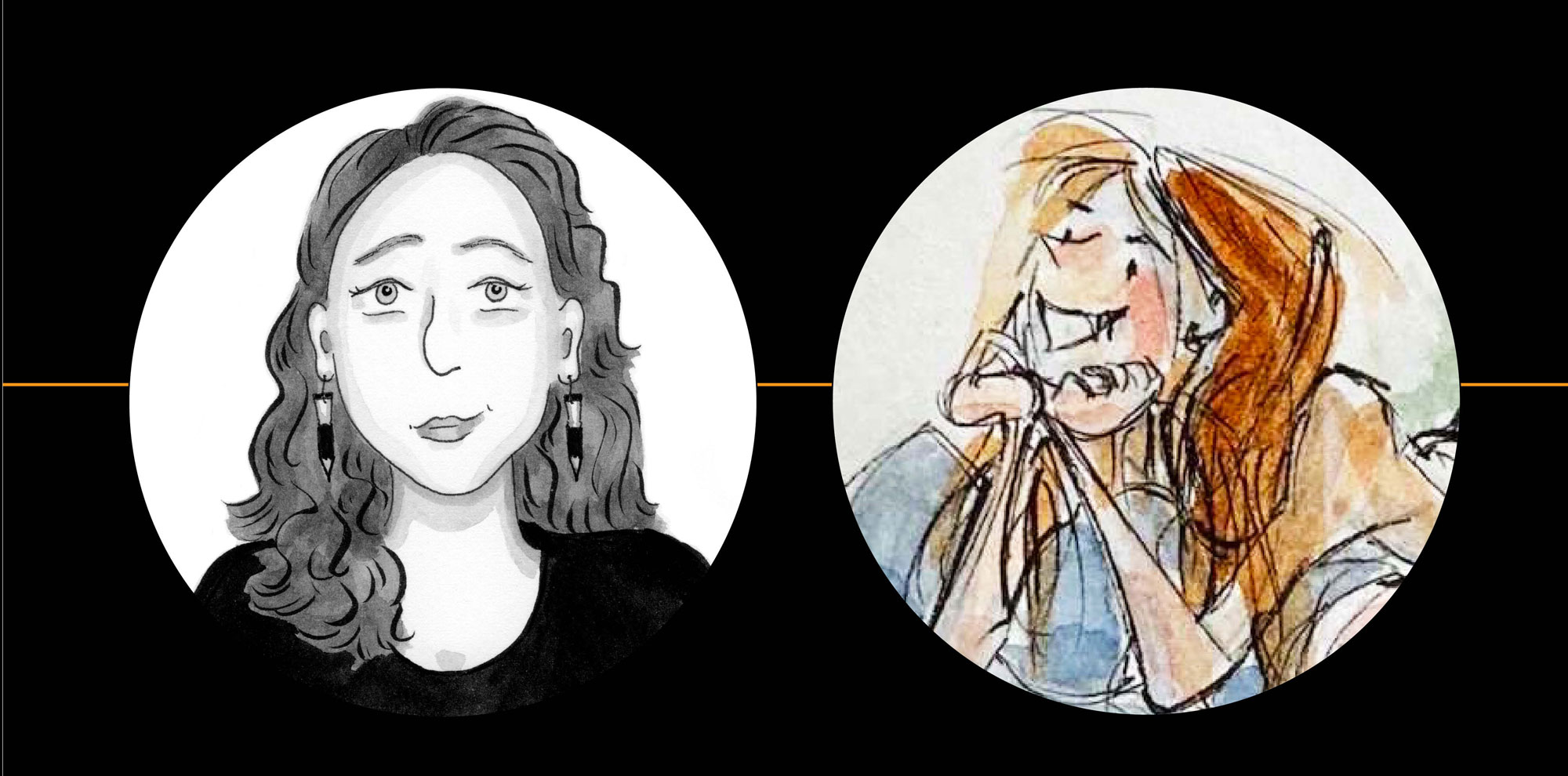
Two New Yorker cartoonists walk into a classroom, and it’s no joke.
Amy Kurzweil and Kendra Allenby are here, at Michigan’s prestigious Interlochen Center for the Arts, to lead a weeklong graphic novel intensive for some of the country’s most talented high school artists.
Both have taught art before. They’ve also written books and freelanced. Allenby, ’10, has been a bartender and a hiking and biking tour guide. Kurzweil, ’09, has taught dance, done speaking events, and been an adjunct English professor. The constant side hustling can be a struggle, but it’s paved the way to the New Yorker, where the two artists create some of the best single-panel—or “gag”—cartoons in the country.
 Images: Amy Kurzweil (2)
“When you nail it, it’s the most satisfying thing in the world,” says Allenby, who has published more than 40 cartoons in the New Yorker. (Kurzweil has published nearly as many.) “You’re creating this little five-second play.”
Being a New Yorker cartoonist isn’t just a job or freelance gig. It’s an identity. As soon as Kurzweil made her first sale, “I put it as the first line in my bio,” she says. The 101-year-old magazine has become the Everest of the single-panel cartoon world, helping define American culture with foundational contributors such as Charles Addams, who famously spun his macabre characters into The Addams Family franchise. Placing a cartoon in the magazine’s pages is a signal that a cartoonist has joined an elite club—in 2010, the cartoon editor wrote that just a few hundred cartoonists were responsible for more than 95 percent of the 75,000 New Yorker cartoons ever published.
 Images, from left: Kendra Allenby; Esin Üstündanğ
In front of the high school students at Interlochen, Kurzweil and Allenby don’t gloss over the challenges. “I often tell my students: ‘If you want to do this, you have to be as creative about your career as you do about the cartoons,’ ” Allenby explains. But she and Kurzweil say they’re deeply fulfilled by the form—the juxtaposition of words and images, the opportunity to boil down the common human experience to a kernel of insight both funny and profound. In the prime of their careers, the pair are still carving out their paths as artists, but today when they publish a cartoon, it appears next to those drawn by their icons, who are now mentors and friends. “To be part of that, artistically, is worth it,” Allenby says.
Drawn to cartooning
When the first issue of the New Yorker hit newsstands on February 17, 1925, an announcement in its pages read, “The New Yorker expects to be distinguished for its illustrations, which will include caricatures, sketches, cartoons and humorous and satirical drawings in keeping with its purpose.” The magazine paid top dollar for one-off purchases, and the best few dozen artists were offered a generous contract, which over the years variably included even higher pay per cartoon, health care benefits, life insurance, and company stock. Even without a steady stream of income from the New Yorker, cartoonists could make a decent living. Many walked door to door in New York, selling their rejected cartoons to dozens of other publications. Today, each New Yorker cartoon earns its artist $750, and regulars like Allenby and Kurzweil are unlikely to be published more than once a month. The magazine no longer offers new cartoon contracts, and nearly all of the other publications that used to pay for cartoons have either gone out of business or stopped buying.
But even in its heyday, cartooning was a grind. The artists were often self-taught, true as well for both Kurzweil and Allenby, neither of whom formally learned to draw until adulthood.
Kurzweil, an English major with a concentration in creative writing, didn’t begin drawing until her senior year at Stanford. While reading Maus, a graphic novel about the Holocaust, for a course, she was struck by the author’s ability to use images to capture a story that felt so real, and she drew her own comic as part of her coursework. She knew what it was like to receive feedback on her writing, and “the way people responded to the comic was different,” she says. “There was a lot more love and exuberance and people wanting to read it.” For her senior thesis, she created a 125-page graphic memoir, Flying Couch, which she published in 2016 after eight years of redrawing it and pitching it to publishers.
Allenby, who graduated a year after Kurzweil, didn’t realize a career in art was something she could pursue until she was out of college. “I didn’t know any practicing artists as I was growing up,” she says. “No one in suburban New Jersey was doing that.” Instead, she majored in anthropology at Stanford. “I wanted a juicy, academic major,” she says. “My brain likes this question of, at heart, why are humans weird?”
During a cross-country bike ride after graduation, she began drawing one cartoon a day to document the trip and fell in love with the ink, the lines, and how the visual brain works with ideas.
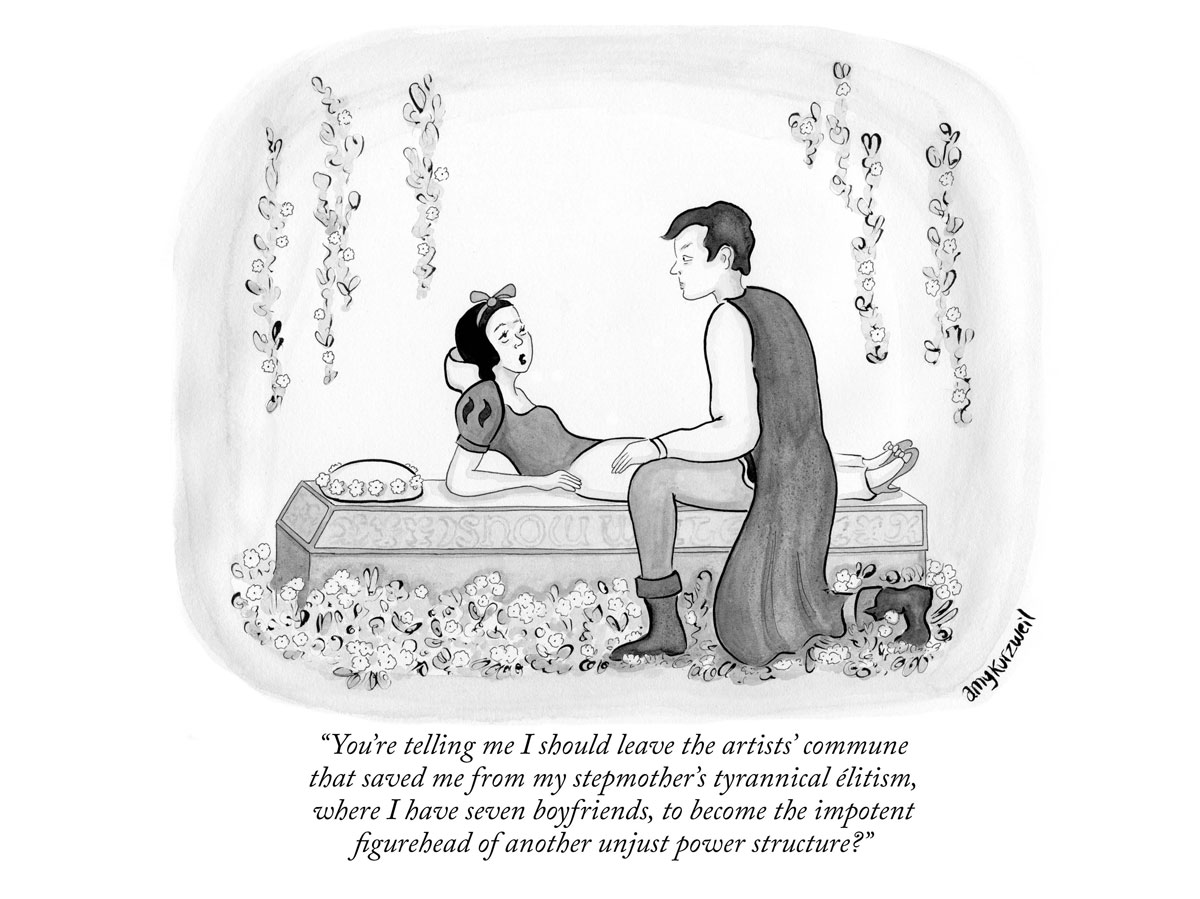 Image: Amy Kurzweil
She and Kurzweil didn’t get to know each other at Stanford, and they remained largely unaware of each other as they each settled in New York and committed themselves to the idea of becoming New Yorker cartoonists. Allenby was in Brooklyn, where she spent four years as a bartender and temp worker while grinding through continuing education art classes at the School of Visual Arts in Manhattan. Kurzweil was learning to cartoon as she made her living crisscrossing the city to teach dance, writing, and drawing at public schools in the Bronx, Brooklyn, and Newark, N.J. She spent a year earning an MFA in creative writing. “People don’t want to read my short stories,” she remembers noticing. “They actually want to read comics.”
About a decade ago, the pair finally met at the New Yorker headquarters, where they’d joined the lineup of hopefuls pitching their works to cartoon editor Bob Mankoff. His rejections were swift.
Pitch imperfect
Today, the New Yorker receives up to 1,500 submissions per week from its 200 regular contributors, plus hundreds more in a “slush” pile from unknown artists. The magazine buys 10 to 20 per week, an acceptance rate of around 1 percent. From 1997 to 2017, the editor sifting through all those submissions was Mankoff.
He’d begun his tenure with the New Yorker as a cartoonist in the 1970s. After 2,000 rejections, he finally sold his first New Yorker cartoon and later received one of the cartoon contracts (though notably, the word “cartoon” did not appear in the contracts, which instead used the term “idea drawing”).
In a 2013 TED Talk, Mankoff explained that each New Yorker cartoon truly is an “idea drawing”—something that requires both the cartoonist and the reader to think. It should also somehow defy expectations and offer incongruity in a way that is humorous. The target of the humor, importantly, is always the readership—“us” rather than “them.” “The humor is self-reflective,” he said, “and makes us think about our assumptions.” In Mankoff’s most famous cartoon, a businessman stands in his office with the city skyline behind him and a phone at his ear. The caption reads: “No, Thursday’s out. How about never—is never good for you?”
Even the most successful cartoonists struggle to predict which of their cartoons will resonate with editors and readers. “It’s not like putting together a machine part,” says Michael Maslin, who has made his living drawing New Yorker cartoons for nearly 50 years. Often, when it comes to identifying what makes a great cartoon, “we don’t know,” he says. “There’s a lot of mystery to why they work and what other people think.”
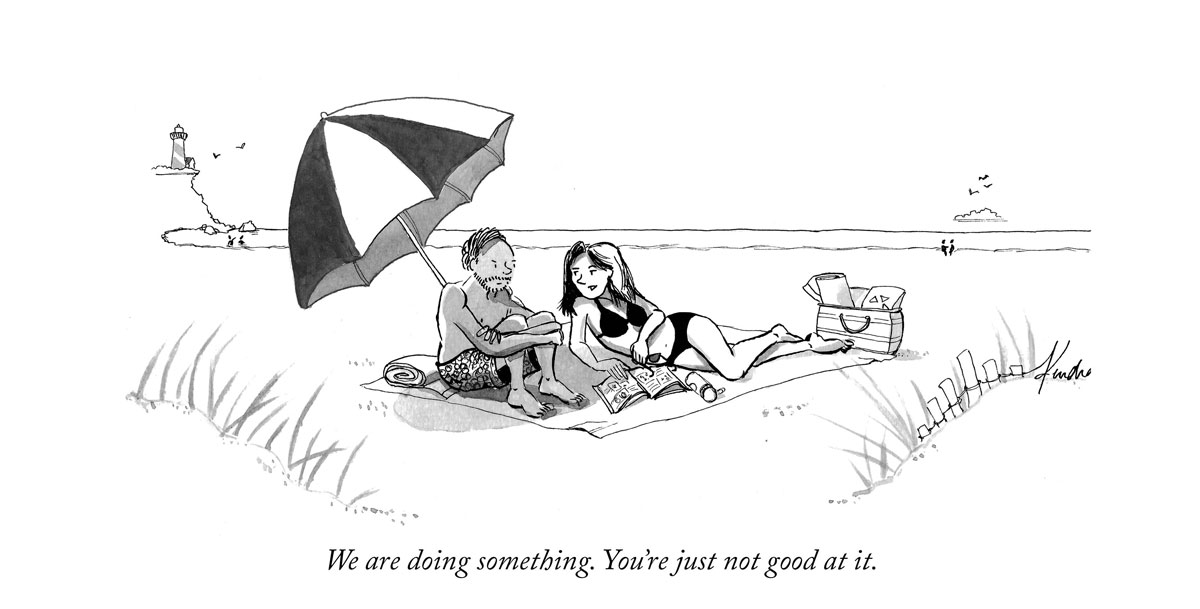 Image: Kendra Allenby
Before COVID, the magazine allowed cartoonists to submit their art in person. Every Tuesday, anyone who wanted feedback could show up at the New Yorker headquarters with up to 10 cartoons and personally hand them to Mankoff, who would either toss them back (a bad sign) or set some aside for further consideration. Although many cartoonists sent in their pitches via email or mail, up to 30 showed up in person each Tuesday, from newcomers to the most famous cartoonists of the day.
Allenby remembers her first pitch, in 2014. Mankoff “ripped me open,” she says. “He was like, ‘You can’t draw. You can’t draw at all. Your drawings aren’t charming at all. Some people have wonky drawings and it’s charming. Yours aren’t charming. You might never be able to learn how to draw.’ ”
It was, she says, the experience of discovering that the impossibly critical voice in your head is incarnate, and he’s the gatekeeper of your dream.
Her jokes, though, had something. Mankoff liked them.
“Can I come back?” she asked. Sure, Mankoff told her as he tossed the cartoons back across his desk.
For early-career cartoonists, “it was a bit of a speedrun of just over and over again getting noes,” says Colin Stokes, Mankoff’s longtime assistant. Persistence was key.
“The way I think of the dues I’ve paid at the New Yorker is that it was kind of a part of my education,” says Kurzweil. “I went to grad school for writing, and then I went to grad school for cartooning under Bob Mankoff.”
Kurzweil and Allenby’s close friendship was forged waiting in the conference room just outside Mankoff’s office. On pitch days, the quiet halls of the New Yorker office would fill with the chatter of dozens of feral cartoonists, who, after a week of sketching furiously in isolation, were desperate to commiserate. Legends like Sam Gross would amble up, his pitches for the week under his arm, same as rookies like Allenby and Kurzweil. Gross had been an accountant before becoming a cartoonist, and Allenby still remembers his thick Brooklyn accent as he’d bestow wisdom like, “Never sell your copyright!” Afterward, they’d all head to lunch, where newbies listened in as the old guard talked shop over plates of duck and glasses of wine.
“You’re just bonding over a very vulnerable thing that you’re doing,” Kurzweil says. She and Allenby both attended elite New England prep schools before Stanford, and many of their friends and classmates found stable income while the two were still bartending or teaching dance. “There were times when it felt really scary to be spending that much time on something that might not come to anything,” Allenby says.
‘When you nail it, it’s the most satisfying thing in the world,’ says Allenby, who has published more than 40 cartoons in the New Yorker.
They bonded, too, over traversing a career for which there is no road map. “I haven’t prioritized having a family or having a house,” says Kurzweil, who lives in San Francisco with her husband, Jacob Sparks. “Now I’m thinking about those things, but I’m almost 40, so it’s a much later-in-life movement towards those things, and a lot of ambivalence towards those.”
Allenby now lives with her husband, Ulrich Hammel, and their infant son in Bozeman, Mont. “Getting a house and having a kid is an expression of her artistry, too,” Kurzweil says. “She’s doing it in her own way. I think that’s the artist’s path.”
Line work
Kurzweil published her first New Yorker cartoon in April 2016 and has since developed a reputation as a cerebral, profound artist. “Amy is like a professional deep thinker,” says Ellis Rosen, a friend and cartoonist who met Kurzweil at a Tuesday pitch meeting. Kurzweil often connects her cartoons to larger themes—say, family and AI. “She tried to teach me what AI was before anyone was talking about AI,” Emma Allen, the current New Yorker cartoon editor, said in an email interview.
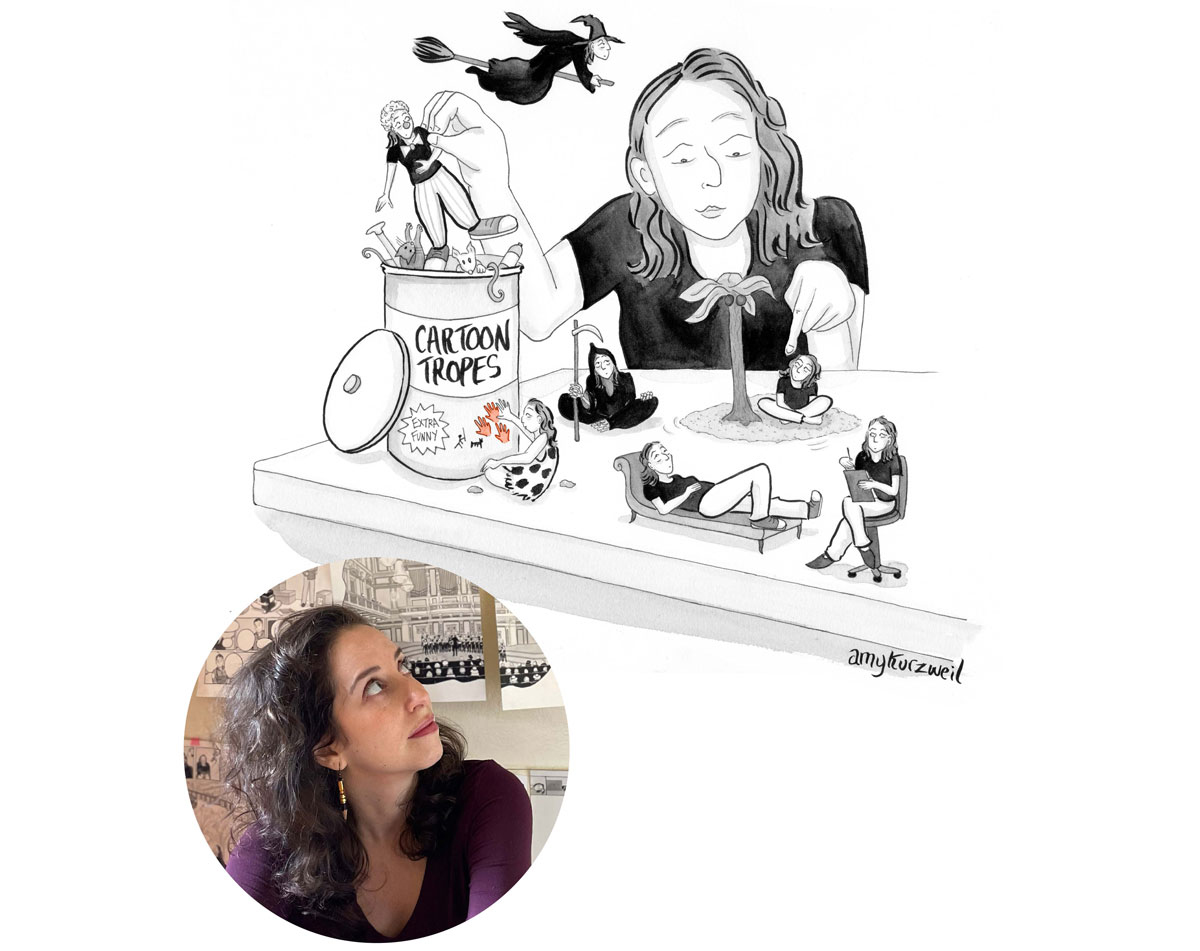
Over time, Kurzweil has developed formulas for cartoons that she now passes along to her students. One place to start is with a trope—a well-established setting for a cartoon, like a therapist’s couch, or a desert island, or Rapunzel in a tower. She then selects an observation, usually catalogued as a note in her phone, of something silly, or absurd, or deserving of mockery. “Then I just put together the trope and the observation, and that pretty reliably yields a cartoon,” she says. “It’s not always a good cartoon, but sometimes it’s a great cartoon.”
Whereas methods of craft, like show-don’t-tell, subtlety, framing, and layout, can be learned through study and practice, “I think the thing that’s harder to teach is that attention to a specific, interesting, overlooked phenomenon in human experience,” Kurzweil says. “The quality of your observations is the thing that makes the cartoon sharp or good.”
In one of her cartoons from 2023, a young girl in a toy-laden bedroom holds one smartphone and hands another to her friend. “You be the moral grandstander and I’ll be the politically incorrect troll,” reads the caption. The trope in that case, Kurzweil says, is children playing make-believe, and the absurdity is twofold: the idea that on social media, one must pick between two extreme personas, and that children imitate everything they see, including treating social media like a game.
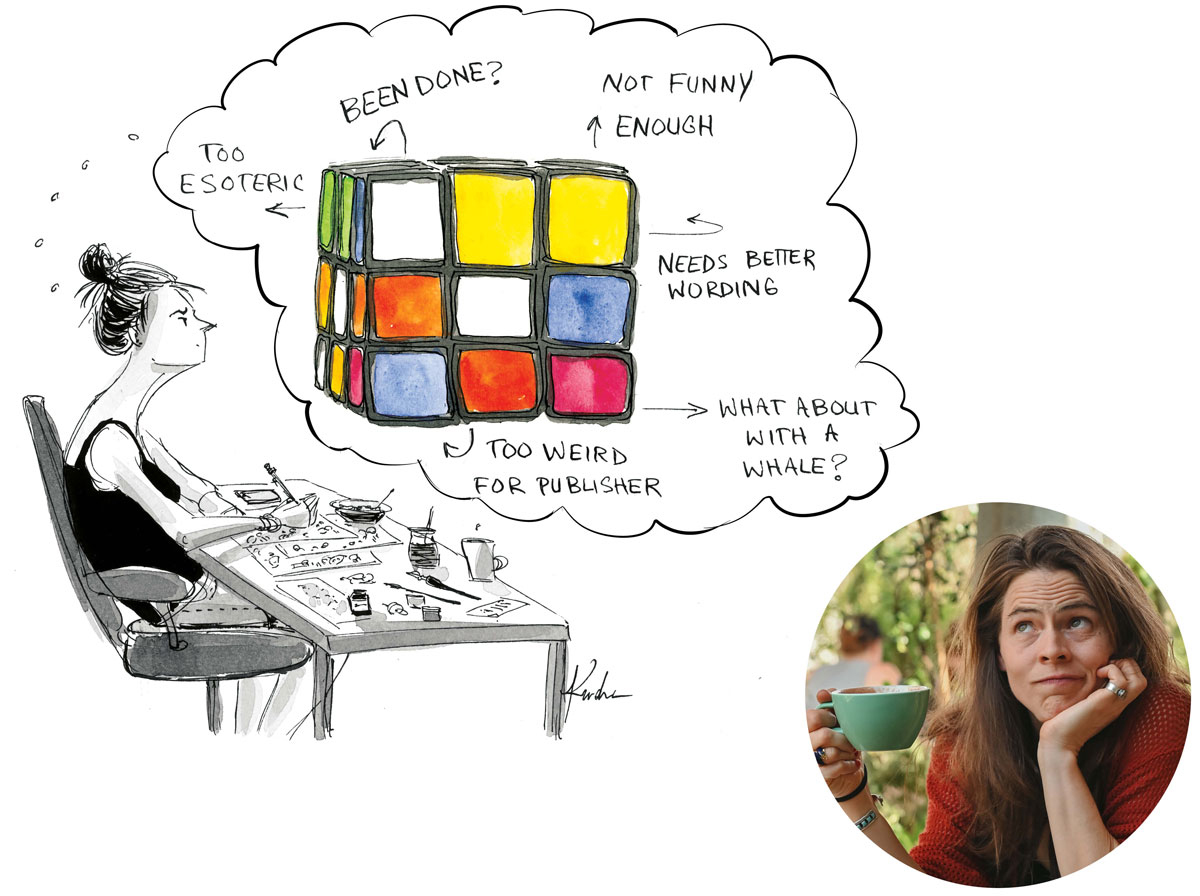
Allenby also published her first cartoon in the New Yorker in 2016. Her creative process has tended to take two forms. “I think of one as the muse, and one as the Rubik’s Cube,” she says. The muse happens when an idea comes into her brain almost fully formed. Sometimes, that means a joke that is ready to draw. Other times, the muse gives her a “fuzzy cloud area” to dig into more later. Her phone is filled with notes and ideas from the muse.
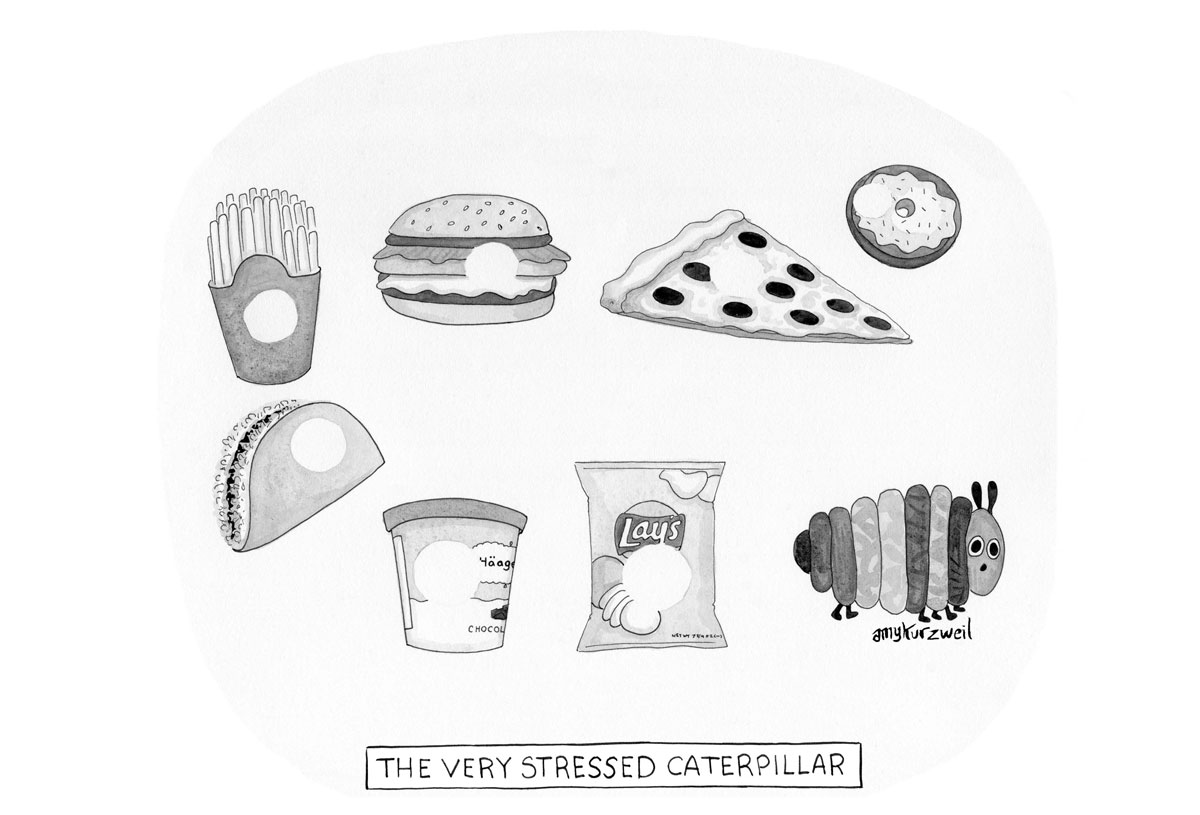 Image: Amy Kurzweil
On the other hand, “the Rubik’s Cube is the sitting down a bunch of days when there aren’t those ideas and just, like, tick tick tick tick tick tick,” she says, shifting her hands as if working out an invisible Rubik’s Cube. “You’re like, let me see, if I put these two together, does it make a joke? No. If I put these two together, does it make a joke?”
When she was annoyed by the cost of printer ink, she sat down to Rubik’s Cube that frustration into a cartoon. To find the best setting, she tried mixing and matching—dinosaurs and printer ink, pirates and printer ink, a boardroom and printer ink. She especially loves to layer the individual experiences humans share under the larger forces that shape us, like capitalism and Christianity. The cartoon she ultimately sold to the New Yorker showed two abbots whispering to each other in a monastery, with rows of monks writing studiously at desks behind them. Underneath, the text reads: “The monks are pretty cheap—the ink is where they get you.”
“They say your work sort of looks like you, and it’s true of Kendra, too, somehow,” Rosen says. Allenby’s lines are quick but controlled, free and loose but still thoughtful. And there’s a physicality to her drawings that mirrors her hiking, biking, pen-and-paper life. “She’s just meant to have ink beneath her fingernails,” says Sofia Warren, another friend and cartoonist Allenby met at a Tuesday pitch meeting. “I feel like she came out of the womb that way—a little bit of dirt and a little bit of ink.”
Both Allenby and Kurzweil “have such cool and disparate interests and experiences, which gives their work such a unique feel,” says Allen, the first female cartoon editor at the New Yorker and the youngest in its history. She has now been on the receiving end of their creative processes for nine years, and she’s published dozens of their cartoons. “I want to make sure that the cartoons and comics continue to reflect the most talented and interesting people working in the graphic arts field,” she says.
The drawing board
In-person pitch meetings have been on hiatus since the pandemic, so when artists pitch their cartoons today, they email them to Allen, whose standard reply is “O.K.” when she wants to buy one.
“I just sent a batch this week,” Allenby says. Those batches are smaller and less frequent these days. She spent much of the past year adapting to motherhood while working on a different kind of baby: a graphic novel with emotional underpinnings from “intense, contorted, difficult, darkly funny times” in her own life.
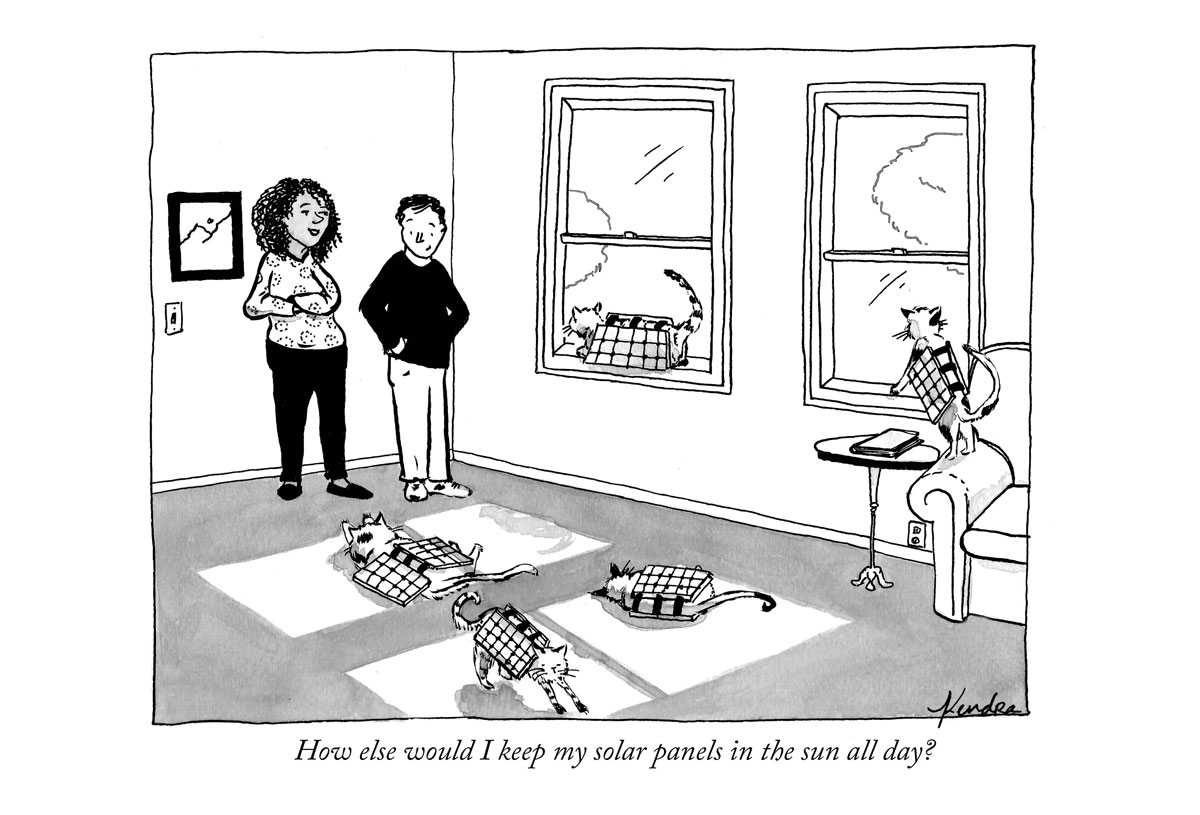 Image: Kendra Allenby
Kurzweil looked over an early manuscript as a friend and veteran of the publishing process. In 2023, she published a second graphic memoir, Artificial: A Love Story, about her attempts to help her father build an AI chatbot with his father’s voice.
In June, as Kurzweil returned to Interlochen Center for the Arts to teach her ever-popular intensive on graphic novels, Allenby was pitching her manuscript around to publishers. In some ways, it parallels those early days waiting outside Mankoff’s office, clutching her best idea drawings.
“I’m so grateful for my younger self for being the person who just showed up again and again at the New Yorker, even when, you know, I didn’t sell, I didn’t sell it, I didn’t sell it,” she says. “Now I’m doing a similar thing: Do a bunch of work that you care about and that you think is worth doing, and then—” She pauses. “And then see what happens.”
Kali Shiloh is a staff writer at Stanford. Email her at kshiloh@stanford.edu.