
Work smarter, bot harder.
Consider Japan your crystal ball: 30 percent of the country’s population is 65 and older, and its fertility rate is decreasing faster than expected, leading to a shrinking workforce right when the nation needs more people in caregiving jobs. What’s more, those jobs can be physically demanding, high-stress, and high-turnover. So the Japanese government has been promoting the use of robots in nursing homes—including devices that help lift residents from beds to wheelchairs (reducing physical strain on caregivers), help residents bathe or use the restroom more independently, or keep residents company. A new study is one of the first to check whether the effort is working. And it is, mostly. Using survey and geographic data, the study found that robot adoption helped address labor shortages without necessarily displacing human workers or lowering care quality. Robot adoption actually resulted in 26 percent higher total employment—including a 39 percent jump in nurses—largely among employees on flexible, often part-time, contracts. Use of the robots was also associated with a decrease in staffing retention problems. “The study provides evidence suggesting that robots can complement rather than simply replace care workers,” said Ellie Xi, ’28, a co-author on the study led by Karen Eggleston, a senior fellow at the Freeman Spogli Institute for International Studies.
Football season starts.
Stanford Football fell to the Miami Hurricanes on Friday after a victorious season opener against Hawaii. New head coach Tavita Pritchard, ’09, a former Stanford quarterback, spent over a decade in Cardinal coaching roles before joining the Washington Commanders coaching staff in 2023. For Pritchard, his return to the Farm is a true homecoming. He met his wife, Caroline Kusin Pritchard, ’10, MA ’14, in a sociology class, and three of their four children were born at Lucile Packard Children’s Hospital. As one of 11 siblings raised in a biracial household, Pritchard sees a lot of overlap between his Samoan heritage and his sport. He often encourages his players to “teu le vā,” or “nurture the space” between people. “In our culture, it’s about the intentional ways we nurture our connections,” he said. “We talk a lot about that on our team. One of our values in our program is connection, because that’s the foundation on which we have to approach this game.”
Looking for some water cooler football facts? Here’s who to watch, and more.
A toast to Azimuth.
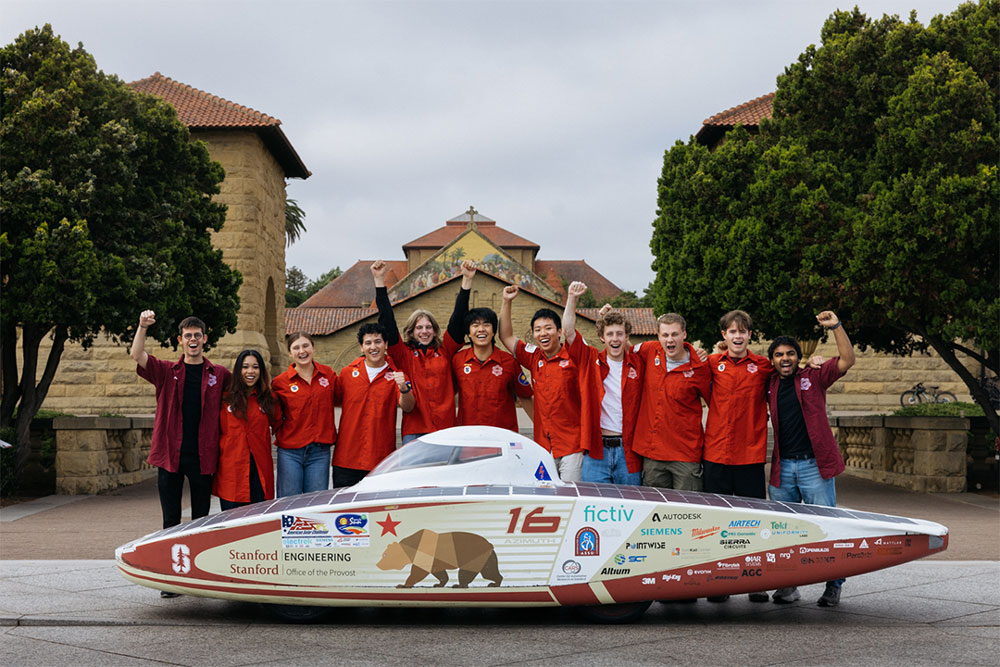 Photo: Andrew Brodhead/University Communications
Stanford’s solar car (named Azimuth) traveled nearly 2,000 miles to earn fifth place in the 2026 American Solar Challenge—the team’s first road race finish since 2017. Azimuth is optimized for everything from solar energy collection to aerodynamics. “We were driving highway speeds with the power of a toaster,” said team president Akhil Marri, ’28.
Mine your matter.
Dark matter makes up 85 percent of all matter in the universe, but it’s more elusive than a sharpened pencil in your home. More than a mile beneath Earth’s surface in a Canadian mine, scientists have built a laboratory to hunt down “light” dark matter, hypothetical particles so lightweight that their interactions with ordinary matter leave only the faintest traces, making them especially difficult to detect. Led by the SLAC National Accelerator Laboratory, the Super Cryogenic Dark Matter Search (SuperCDMS) SNOLAB in Ontario houses 24 silicon and germanium crystals, each about the size of a hockey puck, in a refrigerator that is colder than outer space. If a dark matter particle hits a crystal, it produces a small vibration (called a phonon) and an electrical signal. Superconducting sensors that only work in extreme cold can detect those signals. The lab is an international collaboration among 28 institutions led by SLAC and hopes to open new avenues in the search for dark matter. The team has already begun collecting its first scientific data, in an early phase that runs through this fall; a full year of data collection at optimized sensitivity will follow in 2027. “The search for dark matter at SuperCDMS SNOLAB is finally underway," said Tina Cartaro, the SuperCDMS operations manager at SLAC. “Even in this early phase, our most sensitive detectors have the potential to deliver breakthrough discoveries.” As for a pencil, maybe check the fridge?
A shot at allergy safety.
Eight percent of children and 10 percent of adults in the United States have a food allergy. The most common triggers—wheat, milk, eggs, peanuts, and tree nuts—are difficult to avoid. But now, a phase 2 trial involving 117 children with allergies to peanuts and at least two other foods has found that the injectable drug omalizumab, with or without oral immunotherapy, lets kids safely eat foods that once triggered reactions.
On campus, Branner Dining Hall serves as the university’s first allergy-friendly dining hall—serving up food free of the top nine allergens. What can you do without milk, eggs, peanuts, tree nuts, soy, wheat, fish, shellfish, and sesame? Branner chef Jay-Ar Pugao creates dishes that everyone can dive into.
But wait, there’s more…
Jimmy Viglizzo, who opened Jimmy V’s Sports Cafe in 1999, has died. The eatery, located in the Arrillaga Family Sport Center, features signature smoothies, champion jerseys, and a familial feel. “We want to have relationships, and not just with athletics,” Viglizzo told the Stanford Daily in 2022. “I think that a lot of people think that Jimmy V’s only takes care of athletes—no. It’s everybody here.”
The microphones and seismometers typically used to understand earthquakes can also measure the seismic signals and atmospheric pressure changes of hurricanes, opening a new path for understanding the storms.
Golfer Notah Begay III, ’94, a four-time PGA tour winner and founder of NB3 Foundation—a nonprofit dedicated to empowering Native youth to lead healthy lives—is the recipient of this year’s Payne Stewart Award, honoring his character, sportsmanship, and commitment to charitable giving. (You can watch the sneak presentation.)
Bask in this: The FDA has approved a new sunscreen ingredient for the first time in 27 years. Products containing bemotrizinol, or BEMT, will be in stores this month, and three Stanford Medicine dermatologists explain why the ingredient outshines competitors despite taking so long to be approved in the United States.
New Stanford research shows that “For You” pages on the social network X don’t feed users the content they prefer. Rather, the algorithm shows users the content they are most likely to engage with—specifically, posts that are likely to induce outrage.
Using a generative AI model, Stanford scientists have engineered a cocktail of 16 bacteriophages (aka bacteria killers) that can be used against E. coli and may usher in a new age of antibiotics.
The bright days of summer may be fading, but more people than ever are being forced to adapt to extreme heat. Stanford scientists are working toward practical, low-cost strategies that can be implemented quickly, from painting roofs white to optimizing natural building ventilation to adding plants along city streets, walls, and roofs.
Did you know: Country icon Dolly Parton, who died August 25, made her feature film debut in 9 to 5, directed by the late Colin Higgins, ’63.
Note: The Loop sometimes links to articles outside of Stanford that may require a subscription to view.