
You oughta see the Odyssey.
The Odyssey is sooo 8th century, but Christopher Nolan’s new film adaptation is bringing the Greek epic back to the spotlight. Stanford lecturer in English Miles Osgood, ’11, who teaches Storytelling and Mythmaking: Modern Odysseys, has some tips for interpreting the latest iteration. Part of its appeal for more than a millennium, said Osgood, is that Homer's story is already a type of adaptation; he was reworking an old tale for his own contemporary audience. Artists from James Joyce to Margaret Atwood have retold it since—removing gods and monsters, or recasting Odysseus as fugitive murderer, inquisitive pacifist, or cheating husband. The newest theatrical release has outperformed those other versions in one key way. “The original experience of the epic was that of a crowd at a show,” said Osgood. “Even if you can’t smuggle a silver mixing bowl of heady honeyed wine into your cineplex, I still hope this movie will give us something of the experience that Greek crowds sought out when they listened to their bards into the late hours of the night: collectively rapt, and a little intoxicated.”
A new phase of bacteria-killing phages.
Stanford scientists have taught an AI model to write entire virus genomes from scratch—and the results kill bacteria. Brian Hie, ’16, an assistant professor of chemical engineering, built Evo 2, a generative AI model that designs new DNA sequences, then set it loose on bacteriophage ΦX174 (pronounced “FYE-ex-1-7-4”), a virus that kills E. coli. Working from just a small starter sequence, Evo 2 wrote hundreds of new phage genomes. Hie and bioengineering doctoral student Samuel King, MS ’25, found 16 that killed E. coli exceptionally well—with some even outperforming the natural virus. The payoff: a cocktail of genetically diverse, AI-designed phages that could make it harder for bacteria to evolve resistance to medication. “If the bacteria gain resistance to a single phage, it’s game over for the medication,” Hie said. “But if you have multiple genetically distinct phages in a mixture, it would be harder for the bacteria to develop resistance to the entire cocktail.” Hie has made Evo 2 free to use, arguing that open tools like this are essential to research and real-world results.
Anything but plain.
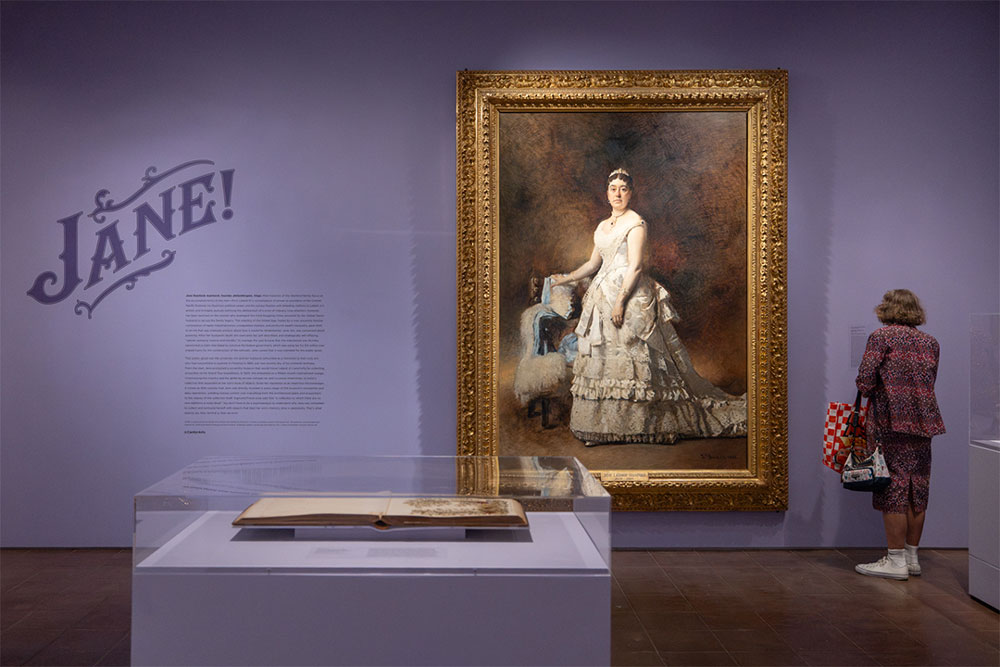 Photo: Andrew Brodhead
The Cantor Arts Center’s newest exhibition, “JANE!,” celebrates Stanford’s founding mother with 41 objects and art pieces, some never before shown in a museum setting. You’ve got some time—“JANE!” runs until May 18, 2028—and you can get a video overview with commentary by Patch Crowley, associate curator of European art.
The keys to excellence.
Concert pianist Elizabeth Schumann, a teaching assistant professor of music, is among the mere 13 percent of women who have hands large enough to span an octave on a piano (compared with 76 percent of men). Smaller-handed pianists are discouraged from certain repertoire, less likely to win competitions, and at greater risk of injury. So when Schumann tried a piano with narrower keys—a 6.0-inch octave, half an inch under the standard—she had an epiphany. “I felt like I’d been wearing the wrong size shoes my entire life,” she said. “People are blaming themselves and their bodies instead of asking if there’s a design problem.” With support from the Wu Tsai Human Performance Alliance, Schumann’s research offers what researchers believe is the first quantifiable evidence that the standard keyboard imposes a ceiling on speed, force, and accuracy. Now she’s partnering with professor of computer science and roboticist Karen Liu to understand why. “The larger goal is not simply to build smaller keyboards,” Schumann said. “It is to create the evidence needed to advocate for better design and more equitable access to excellence.” (Speaking of pianists, watch Stanford magazine’s video of Aliya Alsafa, ’26, co-founder of the Stanford Keyboard Studies Committee and the Stanford Piano Society. She joined AI research efforts to model the stresses that piano puts on hands.)
But wait, there’s more…
Karan Mahajan, ’05, rewrote the opening page of his new novel, The Complex, after advance copies had already gone out to reviewers—and you can vote on which version is better, just like his audience did at a recent reading.
The cost of water is rising three times faster than inflation, and within a decade, hotter, drier weather could make water bills unaffordable for one-third of Americans.
John Coyle, ’90, writes about the death of his best friend, poet Kevin Bennett, ’90—who, as told in a 2022 Stanford story, disappeared for 13 years after Hurricane Katrina—and what he learned about friendship, caregiving, and the quiet routines that mattered most.
Tomiko Brown-Nagin, one of the nation’s leading experts in educational law and policy, history, and constitutional law, will be the next dean of the Graduate School of Education.
Anil Menon, MS ’04, MD ’06, is on the International Space Station for the next eight months conducting scientific research on subjects like semiconductor crystals, ultrasound, and AI.
Stanford’s football team has become the first to organize a player-led chapter of the College Football Players Association, an organization advocating for unionization and collective bargaining.
A new study has found that how preteens talk about stressful events—their use of prepositions or connector words such as “and”—better predicts mental health problems six years later than what they say.
Four Cardinal baseballers were drafted by MLB teams last month: Aidan Keenan, ’27, New York Mets; Rintaro Sasaki, ’27, Miami Marlins; Eric Jeon, ’28, Seattle Mariners; and Cort MacDonald, ’26, Colorado Rockies.
New research finds the reward centers in autistic teens’ brains—unlike those of their neurotypical peers—do not become increasingly responsive to unfamiliar voices as they mature. That difference could help explain why making new social connections is harder for autistic teens.
Note: The Loop sometimes links to articles outside of Stanford that may require a subscription to view.