When Stephanie Kwok, ’08, was growing up in New York City, just about every sport was fair game. She tried swimming, gymnastics, soccer, and Little League before finding her sweet spot in competitive tennis. Football, though, was something she only brushed against. She’d play catch in the high school courtyard with mostly male classmates, and at Thanksgiving take part in an annual pickup game. “It never even crossed my mind that football could be more than that, right?” she says.
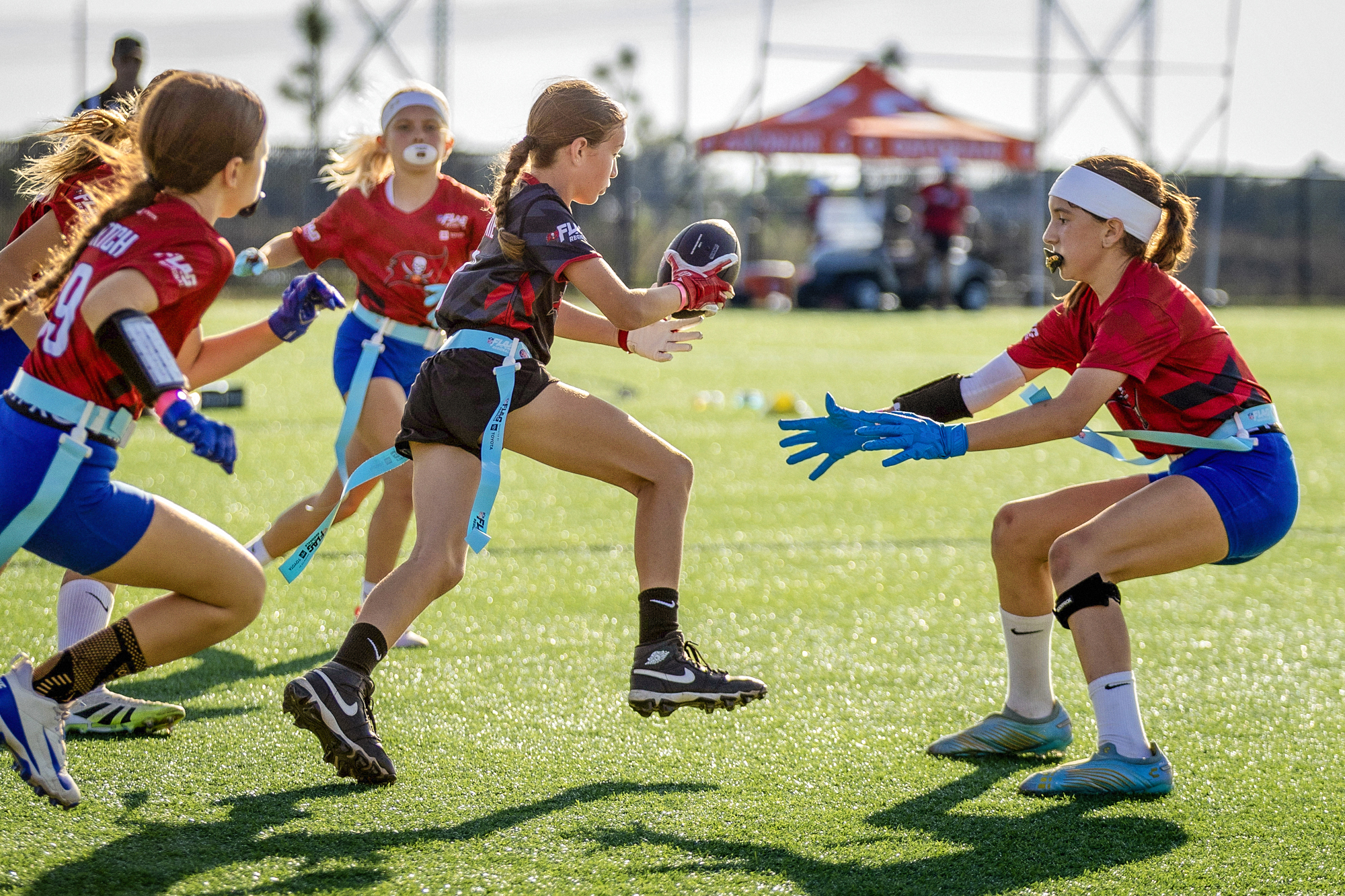
But in the past decade, a surge in the popularity of youth flag football—a noncontact variety of the sport—has opened football up to a new generation of kids, especially girls, who can suddenly aspire to play at every level, from rec leagues to the Olympics. For the past two years, Kwok has been part of the vanguard pushing to expand those opportunities further as the National Football League’s first-ever vice president, flag football. NFL Flag is the sport’s largest U.S. youth program, encompassing more than 830,000 youth and high school players in 2,000 leagues across all 50 states, but Kwok and her colleagues aren’t stopping there. “Our remit is, how do we grow flag football into one of the top sports in the world?” she says.
Flag football, in which players are stopped by grabbing flags hanging from their waists rather than by tackling, is commonly traced to games played by American GIs during World War II. It has traditionally been seen more as a recreational pastime than as a serious athletic endeavor. But that has transformed in the past 10 years, and Kwok thinks the sport, which carries lower risk of severe or head injury than does tackle and requires only inexpensive equipment such as flags, belts, and a ball, is poised to reach greater heights. “Flag football reduces so many of the barriers that currently exist for playing tackle football,” she says. “There’s no reason that it can’t be as popular or ubiquitous as soccer globally.”
‘I loved that I could line up on the outside with a male defender on me, just run past them, and catch a long ball in the end zone.’
To be sure, catching soccer remains a long-yardage situation. The world’s estimated soccer-playing population is an order of magnitude larger than flag’s 20 million, but flag’s momentum is undeniable. Between 2019 and 2024, flag was the only team sport that grew in popularity among American kids ages 6 to 17, according to the Sports & Fitness Industry Association, a trade group. In 2017, the number of boys ages 6 to 12 playing flag in the United States exceeded the number playing tackle for the first time, according to the nonprofit Aspen Institute, though tackle football has remained far more popular with high schoolers. In 2023, the NFL switched its annual Pro Bowl game to flag, a signal that the sports giant was taking flag with new seriousness.
It is among girls and women, however, where the pace of change has been dizzying. The trend has roots going back to the 1990s. The Kelly McGillis Classic International Women’s & Girls Flag Football Championship—named after the Top Gun actress, a benefactor—celebrated its 34th anniversary this year in Key West, Fla., as the “world’s largest women’s flag football tournament.” But in the past five years, flag’s popularity with girls has soared. In the 2021-22 school year, just over 15,700 girls in nine states played sanctioned high school flag football in the United States, according to the National Federation of State High School Associations. By the 2024-25 school year, that number had jumped to nearly 69,000 in 20 states, a 338 percent increase, which will only rise further with six states plus Washington, D.C., adding the sport in 2026. Part of Kwok’s focus is to support state and local athletic associations interested in offering flag as a high school varsity sport. “Each state has different rules for what sports they will consider adding, and they have different timelines for it as well,” Kwok says. For those less familiar with flag football, but “intrigued by what it can offer,” she and her colleagues provide toolkits, best practices, and connections to nearby NFL clubs and other partners that can help get them up and running.
“The sport lends itself so beautifully to any type of female athlete,” says Sam Rapaport, an NFL consultant who has worked to bring women into the coaching ranks and girls onto the field, where she herself is a longtime player. “You don’t have to be tall like a volleyball player, or as fast as a 100-meter track star. No matter what your strengths are, there’s a place for you on the field.” Many girls embrace flag football, she says, because it allows them to play the sport they already love. “Tackle football is far and away the most popular spectator sport, and I think girls want a piece of that.” The 2026 girls’ high school championship averaged 1.12 million viewers on ESPN, making it the most-watched NFL Flag game ever.
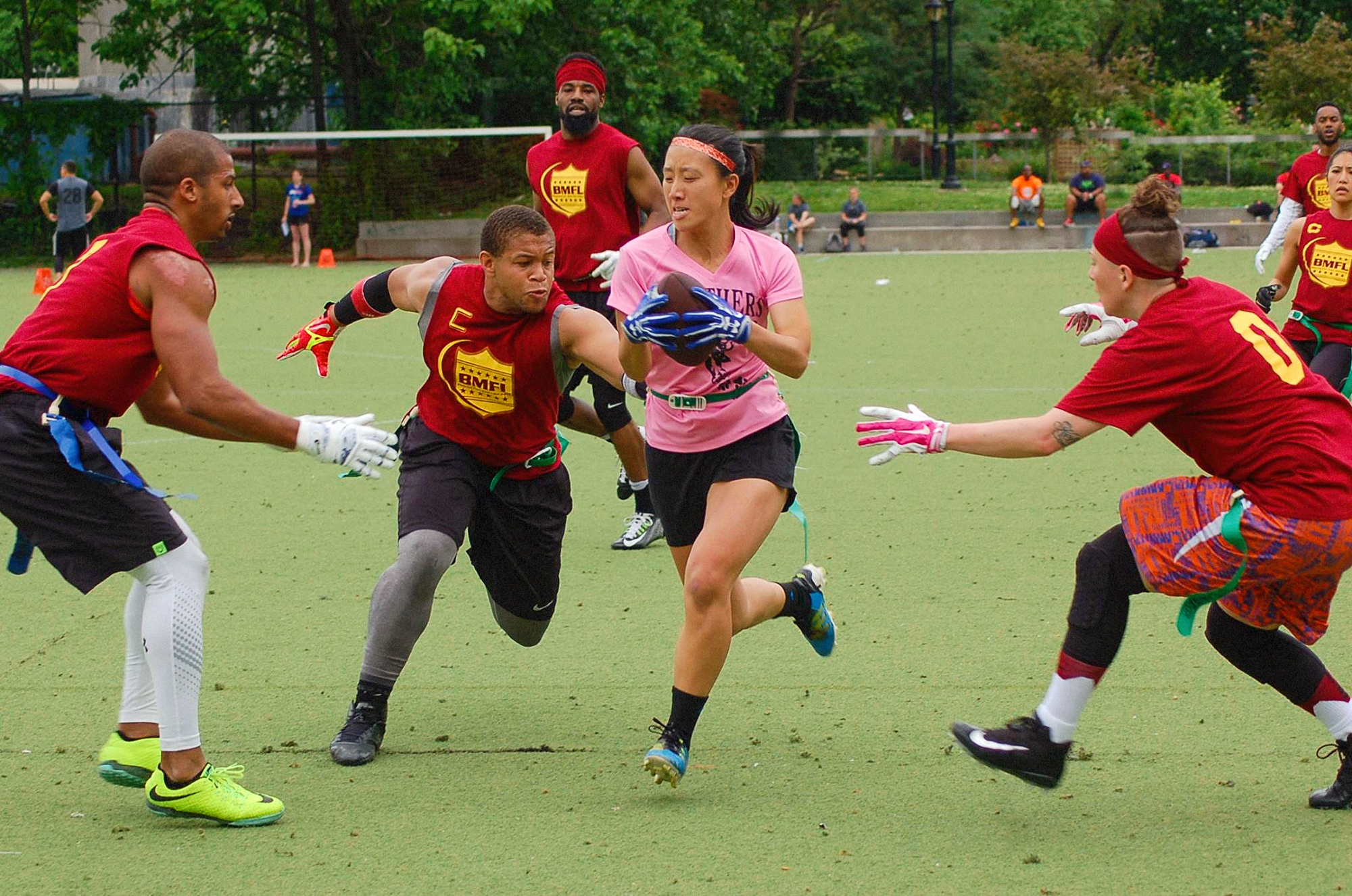 WHAT A RUSH: After flag captured her in grad school, Kwok, center, played in rec leagues four to five times a week. (Photo: Alan Galo)
Meanwhile, the NCAA is on a path to making flag football an official women’s sport as early as spring 2028, months before men’s and women’s flag debuts at the Summer Olympics as one of five optional sports being hosted by LA28. Pro flag leagues for both men and women—financially supported by the NFL—are also ready to kick off. “I think we’re in the early stages of the explosion right now,” says Jon Solomon, the Aspen Institute’s director of research for sports and society. He attributes the growth to injury concerns about tackle, the NFL’s investments, and the immense appeal of football. Flag, he says, has also welcomed kids who’ve felt left out of other sports because of the trend toward early specialization and travel teams.
Kwok’s path into this world is a mix of happenstance, hard work, and a deep love for catching touchdowns and batting down passes. At Stanford, she got her first taste of organized football, playing the touch version in intramurals, though her main athletic focus was elsewhere. She played rugby for a year. Then, aided by her time on the tennis court, she picked up squash her sophomore year, helping the squad transition from club to varsity status and a top-10 ranking by her senior year. It was later, at Harvard Business School, that flag football captured her. A lifetime of racquet sports had given her a level of hand-eye coordination that translated well to catching and throwing the ball. “I loved that I could line up on the outside with a male defender on me, just run past them, and catch a long ball in the end zone,’ ” she says.
Kwok, a political science major at Stanford, has a long-standing interest in working in sports. One of her first jobs was as a ball girl at the US Open, and at Stanford she interned at the U.S. Tennis Association. At Harvard, she was “sports czar,” running intramurals for her MBA classmates. “Sports has always just had such a power to create community and bring people together,” she says. After graduating from Harvard in 2013, she returned to New York to work for the Madison Square Garden Company, doing marketing for a trio of Big Apple teams: the Rangers, the Knicks, and the Liberty. She later worked for FanDuel, a fantasy sports website that became a betting giant during her time there.
Away from work, flag remained a constant presence. For more than a decade, she played in New York rec leagues four to five times a week. In 2018, she and several friends, as a side hustle, co-founded a company that organized coed, men’s, and women’s flag football tournaments in the New York tristate area. By the time Kwok saw the NFL’s job posting for a vice president of flag football on LinkedIn in early 2024, her background had given her an ideal résumé for the post. Not that she planned it that way. “I couldn’t have ever prepared for this job, because this job didn’t exist,” she says. The game has changed. She is working to change it further.
Sam Scott is a senior writer at Stanford. Email him at sscott3@stanford.edu.