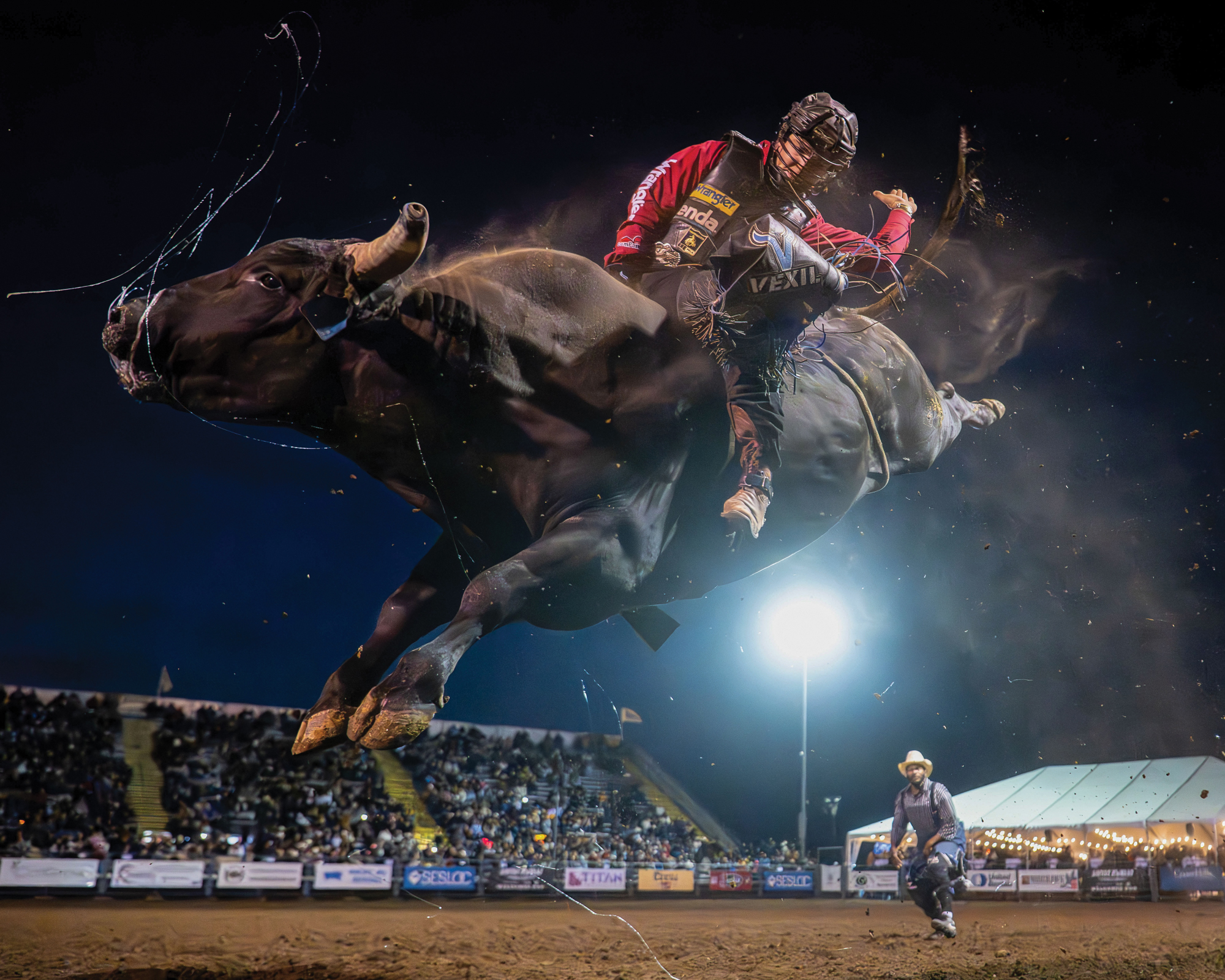
Like a lot of people, Ryan Jae, ’19, felt like he needed to mix it up during the COVID-19 pandemic. But rather than bake bread, he jumped on the back of a bull and started competing in rodeos. Before he knew it, he was getting paid to photograph them too.
It started with horseback riding lessons. Jae, a software engineer who lives in Walnut Creek, Calif., had been looking for something athletic he could do outdoors. During one ride, a wrangler at the stables—slender, like Jae—mentioned that he also rode bulls. He recommended a place Jae could learn, if he was interested.
Jae soon attended La Grange Rodeo—his first—with his camera in tow. “I thought it was the most glorious thing I’d ever seen,” he says. He snapped a lot of photos, then a week later tried roughstock himself, on steers, at Flying U Rodeo’s Free Rough Stock School in Marysville, Calif. After getting thrown repeatedly, he stayed on one for about eight seconds. “That’s when you get addicted,” he says. “That was the most fun ever.”
‘Getting down low is the biggest thing. You’re looking up at the most interesting perspective. That bull is larger than life.’
Next came bulls. “The first time on a bull I was as terrified as I’ve ever been,” Jae says, even though he’s “a bit of a thrill seeker” and has tried everything from skydiving to cage diving with sharks. “It’s different when you climb on this animal and feel them. You think you’re going to die, and then you don’t die.”
Since then, Jae has photographed about 100 professional rodeos, publishing in several pro rodeo news magazines, including ProRodeo Sports News, the official publication of the Professional Rodeo Cowboys Association since 1952. In 2024, he was the National Finals Rodeo Open and National Finals Steer Roping photographer. To capture the thrill of such events, he likes to get as close as possible to the bull—a calculated risk.
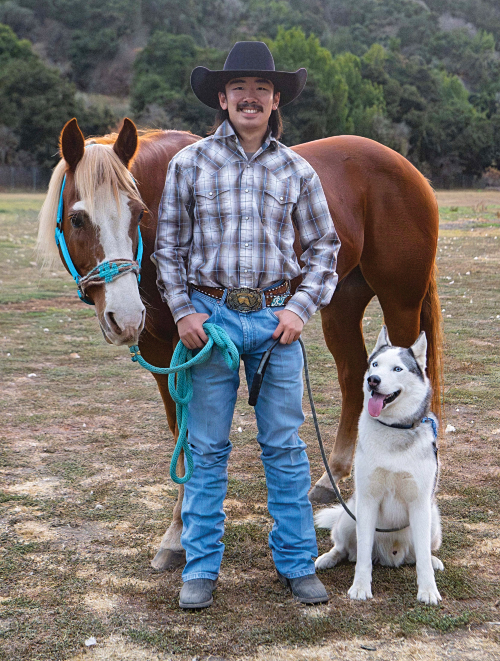 Jae (Photo: Nicole Fava)
“Getting down low is the biggest thing,” he says. “You’re looking up at the most interesting perspective. That bull is larger than life. I’m lying on all fours in the dirt to get that perspective.”
He has also competed in about 30 rodeos. Sure, he’s gotten hurt. A kick to the abdomen lacerated his kidney and fractured his lumbar vertebrae. “You’re always going to break something,” he says. “I was in the hospital watching bull riding videos on my phone. I knew I was going to come back.”
Tracie White is a senior writer at Stanford. Email her at traciew@stanford.edu.