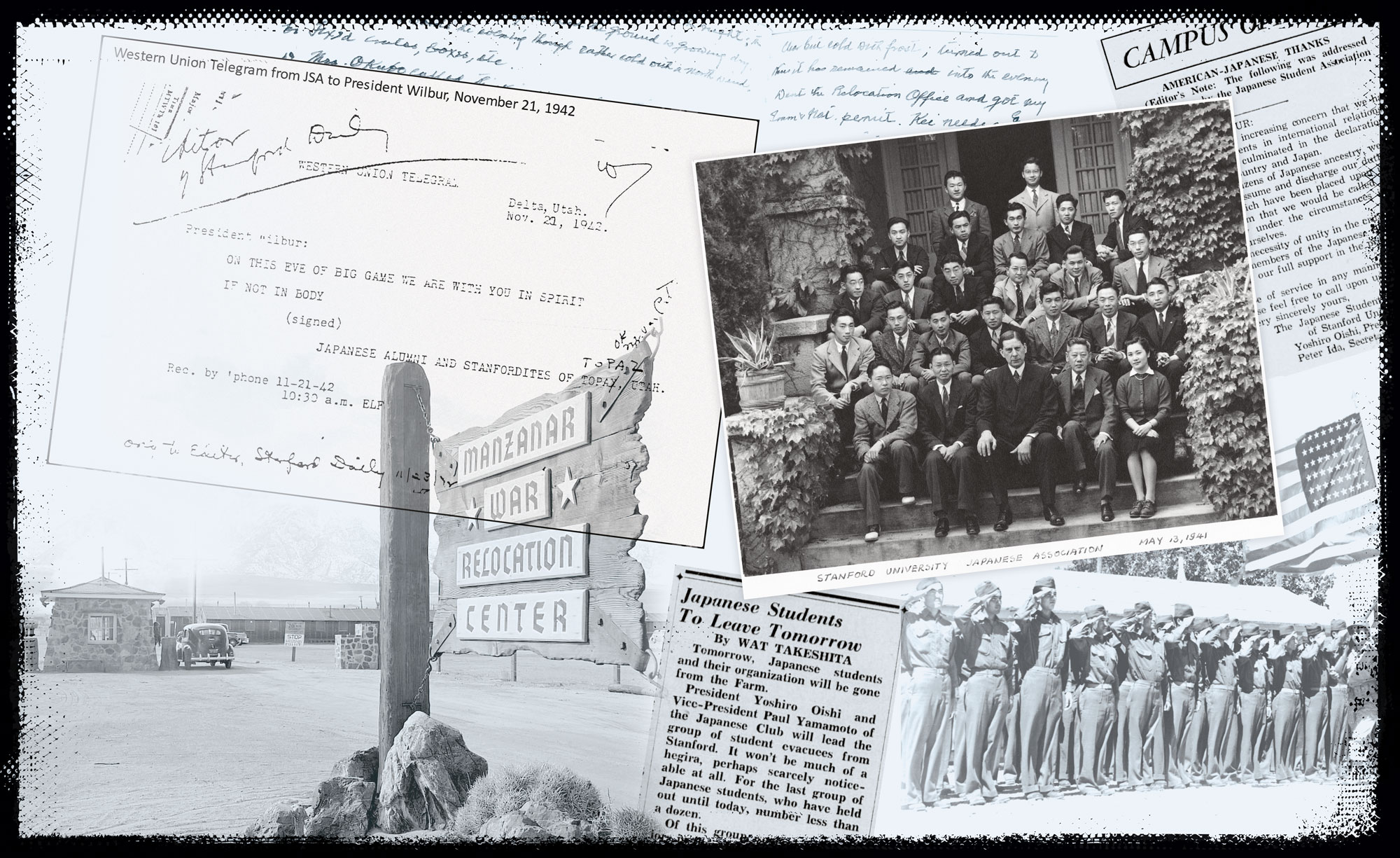
On December 7, 1941, the lights were off and all was quiet at the home of Yamato Ichihashi, Class of 1907, MA ’08, Stanford’s first and, at the time, only professor of Japanese descent. A historian who studied U.S.–Japan relations, Ichihashi was in a state of shock. Japan had attacked Pearl Harbor, and suddenly, the country of his birth was at war with his adopted nation. As the sun rose the next morning and President Franklin Roosevelt prepared to give his “Day of Infamy” speech to Congress asking for a declaration of war, Ichihashi agonized over whether to go to his classroom. That quarter, he taught an 8 a.m. course on the political, social, and economic development of Japan.
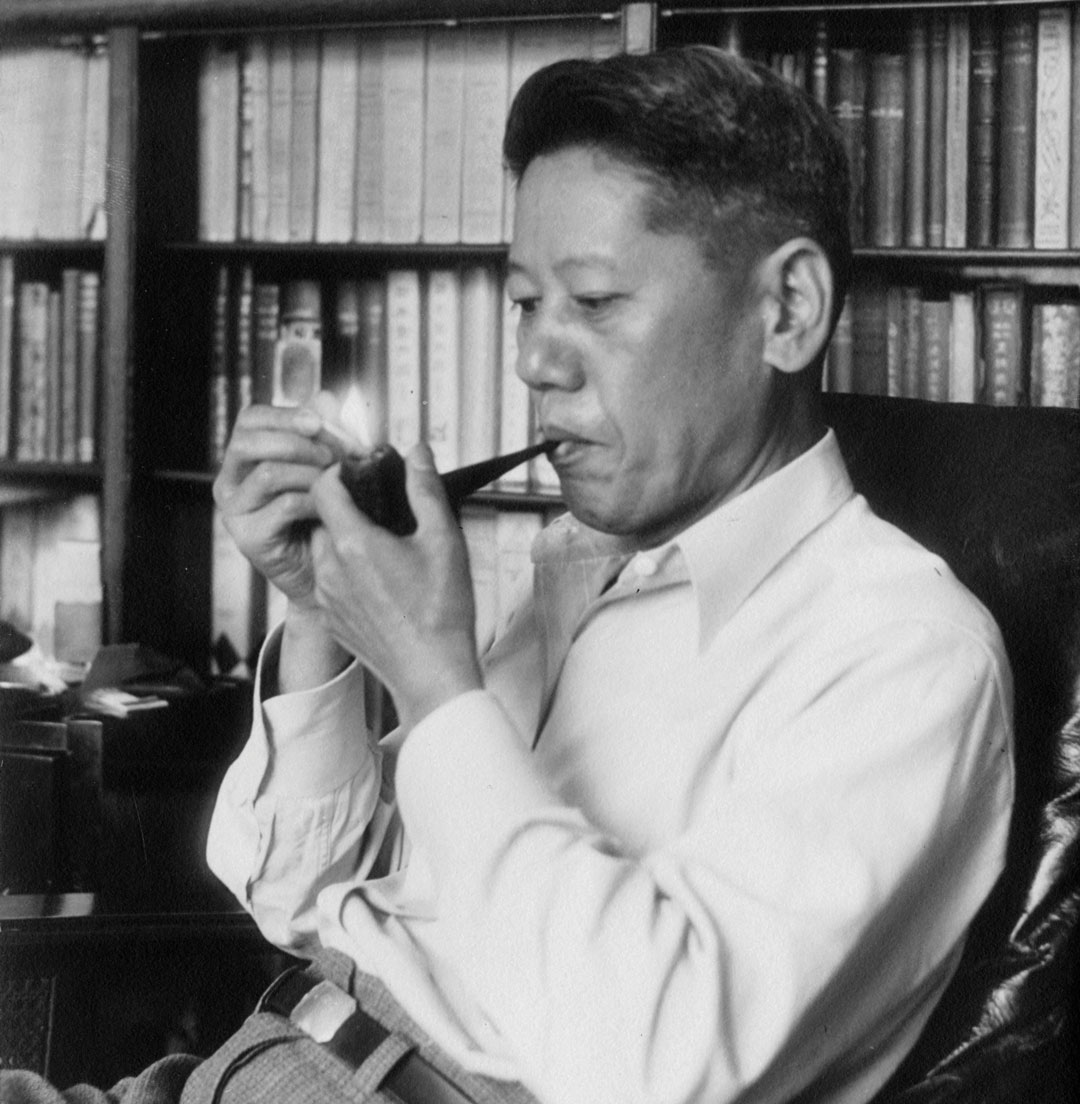 WAR TORN: Ichihashi. Photo: Carlotta Case Hall/Courtesy Special Collections & University Archives/Stanford University Libraries
He crossed campus and shyly poked his head in the door. “Shall I come in?” he asked. The class had swelled from its usual 30 to more than 100 students, and they all broke out into applause, welcoming Ichihashi into his lecture hall. He took his spot at the front of the class. One of the students, Leslie Langnecker Luttgens, ’43, would remember decades later that Ichihashi looked like “a broken man.”
In the Stanford dormitories, Japanese maids stopped chatting with each other in Japanese and spoke English instead, according to one senior’s diary. Japanese Student Association president Yoshiro Dan Oishi, ’42, began considering how to respond to the attack. Oishi and his brother Goro, also ’42, lived in Stanford’s Japanese Clubhouse, a handsome craftsman-style home a few blocks off the Row, along with many of the roughly 30 students of Japanese descent then at Stanford. (That number had grown from six when Stanford opened its doors in 1891.) A mere mile away, Palo Alto police started detaining and questioning any Japanese person found “motoring” on the city’s roads, on instruction from the FBI. Across the West, the FBI fanned out and arrested more than 1,500 issei (the generation of Japanese who first immigrated to the United States). Pastors, business leaders, journalists—anyone deemed to have sway was targeted. That included the Oishi brothers’ father, Yoziro, a community leader and farmer near Santa Barbara, Calif.
Within six months, Yoshiro, Goro, and nearly two dozen other people of Japanese descent on Stanford’s campus would be incarcerated, as would 110,000 others across the American West.
Today, 80 years after the last Japanese concentration camp closed, none of these students (nor Ichihashi) is still living. But some of their descendants are working to ensure that successor generations remember what they went through during World War II. Caroline Takahashi, ’79—the daughter of Kazuyuki “Kaz” Takahashi, ’40, MD ’49, a PhD student at the time—recently loaned her father’s papers to Stanford Special Collections to be digitized and shared publicly. Available since February, these papers include a trove of letters and notes from Kaz’s time in the Manzanar camp. Those letters, alongside interviews and other documents, show how Stanford faculty maintained ties with their students, and even the university president sought to keep in touch. These Stanford students continued to pursue their education in the camps—one freshman finished his spring finals from a horse stall—even as incarceration cost many of them their careers, property, and years of their lives.
Campus, December 1941
Palo Alto had seen a spate of “ugly anti-Asian agitation” during the early 20th century, writes history professor Gordon Chang, MA ’72, PhD ’87, in his 1997 book, Morning Glory, Evening Shadow. But “the Stanford vicinity,” he adds, “had not been known to be particularly anti-Japanese in climate, and the university itself had been a relatively hospitable place for students of Japanese ancestry.” After Pearl Harbor, as much of California exploded into anti-Japanese hostility, this welcoming attitude on Stanford’s campus appears to have remained intact. Wataru “Wat” Takeshita, ’42, MA ’52, a reporter for the Stanford Daily, would later remember Stanford as “an island of tolerance amid the surrounding sea of hatred and animosity.” In the months after the attack, Takeshita sat in gaggles of students listening to the news on portable radios. “They all treated me like any other student on campus,” Takeshita wrote in his 2002 memoir, The First 80 Years.
On December 10, three days after the attack, Stanford president Ray Lyman Wilbur spoke to an audience of 3,500 on campus. “We’ve got to eliminate the Japanese as a major power in the Pacific,” he said. “There is no safety for California or for the United States until they are eliminated.” At that time, it was unknown whether Japanese aircraft were in range, and Wilbur, Class of 1896, MA ’97, MD ’99, ordered all students to strictly obey blackout orders. “We are right up against the guns,” he warned. But the president made it clear that Japanese and Japanese Americans on campus were not the enemy. “They are just as good Stanford people as we are,” Wilbur said.
The next day, the Japanese Student Association published an open letter to Wilbur in the Daily. In the letter, signed by president Yoshiro Oishi and secretary Peter Ida, ’43, the students took the opportunity to profess their loyalty:
“As American citizens of Japanese ancestry, we have been prepared to assume and discharge our duties and responsibilities which have been placed upon us. Yet little did we dream that we would be called upon to prove our loyalty under the circumstances in which we now find ourselves.
“Realizing the necessity of unity in the critical period ahead, we, the members of the Japanese Student Association, pledge our full support in the present emergency.”
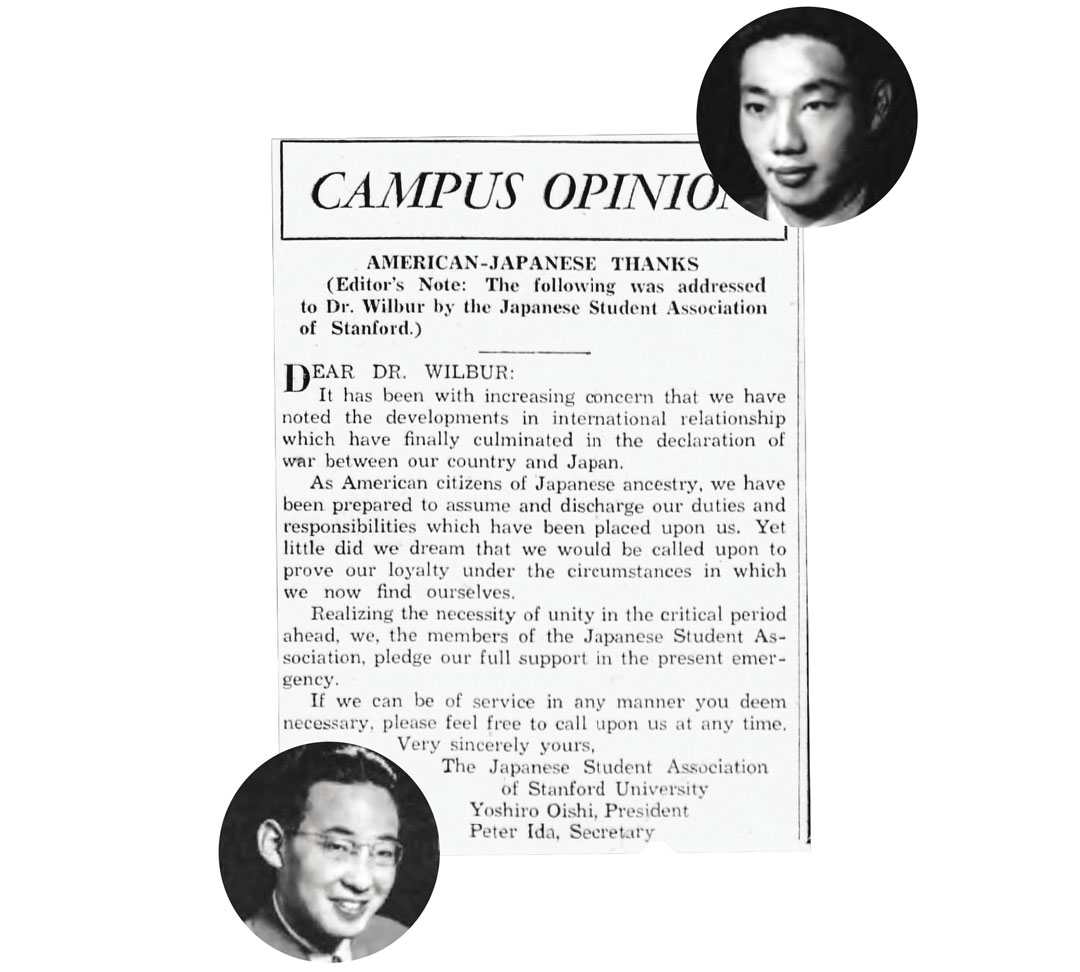 CONCERNED CITIZENS: Oishi (top) and Ida (bottom) co-authored a letter to President Wilbur in a pledge of loyalty to Stanford and to the United States. Clipping: The Stanford Daily, Inc. All rights reserved. Reprinted with permission. Student photos: 1942 Quad (2)
In the days following, campus emptied out as students went home for winter break. Takeshita had plans to return to his family’s farmhouse in Selma, Calif. But when he tried to buy a bus ticket at Palo Alto station, he was refused: “Japs” were not allowed to travel beyond three miles, the attendant told him.
Another Stanford student, “a complete stranger,” he recalled, overheard the conversation and offered to drive Takeshita as far as his own hometown, Fresno. At the Fresno bus depot, Takeshita was turned away again. So his fellow student drove him the extra 15 miles to Selma. “I do not remember the Good Samaritan’s name; I don’t even recall what he looks like,” Takeshita wrote 60 years later. “But I am forever grateful to him and others like him.”
Back at home, things were tense. Takeshita argued with his father about how the U.S. government would respond to Pearl Harbor. The elder Takeshita warned his son that mass detention could be in their future, but Wat dismissed his father’s concerns. “For alien Japanese maybe,” Takeshita told him. “But for us, that would be impossible. After all, we’re American citizens.”
Removal
When Yoshiro and Goro Oishi returned to Stanford from winter break, they were just months from graduating—Yoshiro, the eldest, studied economics; Goro was premed.
On February 19, 1942, Roosevelt issued Executive Order 9066, establishing special “military areas” across the West Coast and authorizing the forced removal to “relocation centers” of anyone deemed a threat to national security. While the language was ambiguous, there was no confusion that the order would target people of Japanese descent.
California Attorney General Earl Warren, who would be elected governor later that year (and eventually serve as Chief Justice of the United States Supreme Court), testified before Congress two days later, arguing that, even though the United States was at war with Germany and Italy as well as Japan, ethnic Japanese in the United States deserved harsher treatment. “We believe that when we are dealing with the Caucasian race, we have methods that will test the loyalty of them, and we believe that we can, in dealing with the Germans and the Italians, arrive at some fairly sound conclusions,” Warren said. “But when we deal with the Japanese, we are in an entirely different field.”
Some Japanese American Stanford students immediately began arranging to transfer to universities in the Midwest, where they wouldn’t be subject to evacuation orders. The entire Japanese population of the United States at the time was just 127,000, and over 60 percent were U.S. citizens. By the end of 1942, 110,000 of them were ordered behind the barbed wire of rapidly built camps across the West. Another 16,000—including 6,000 newborns—would join before the war’s end.
Incarceration occurred in waves. California and other states were split into “exclusion areas,” and people of Japanese descent were ordered to travel to assembly centers zone by zone. Nuclear families—especially parents and minor children—were generally permitted to remain together, but more distant relatives, friends, and loved ones often got separated. Some Stanford students traveled home when their parents received their relocation orders, to ensure they stayed together. Kaz Takahashi, then a doctoral student in biology, proposed to his Palo Alto-born girlfriend, Soyo, and they rushed to get married so they could remain together in the camps. “We honeymooned at Santa Anita assembly center,” Soyo would later remark to National Geographic. (Soyo’s mother, a maid at Stanford, got a letter from the university letting her know that, while the university hoped to keep them at work until their removal dates, she and other Japanese maids might be fired prior to relocating, in order for the university to ensure continuity by hiring new staff.)
By May 1942, just seven undergraduate students remained in the Japanese Clubhouse, mostly seniors like the Oishi brothers and Takeshita. On May 23, an official military poster with the title “Civilian Exclusion Order No. 96”—Santa Clara County’s forced removal order—was tacked on the telephone pole outside the Clubhouse. All people of Japanese descent had to report to a registration site within two days. There, they were given a departure date and location and told to bring only what they could carry. For the remaining Stanford crew, that day would be May 26.
In Morning Glory, Evening Shadow, a biography of Ichihashi that includes his journals, Chang writes that the professor and his wife, Kei, were devastated by the order and its rapid timeline. The couple rushed to find someone to tend to their home and expansive garden; a neighbor agreed to rent out the house for them. The Stanford history department promised to hold Ichihashi’s salary for him, and his office was closed up and locked. A little after 3 p.m. on May 25, Ichihashi went to Wilbur’s office to say goodbye and leave a new mailing address.
That day, Takeshita published his final Daily article: “Japanese Students to Leave Tomorrow.” “It won’t be much of a hegira, perhaps scarcely noticeable at all,” he wrote. “For the last group of Japanese students, who have held out until today, number less than a dozen.” On May 26, Yoshiro led the small group of students off Stanford’s campus; some of them would never return. The Japanese Clubhouse was leased to a local co-op, with the plan to welcome Japanese students back one day. But it would never again serve as such a home. In the 1960s, the house was demolished.
At the relocation site in Palo Alto, a local Quaker woman saw Ichihashi with his wife. “He sat quietly halfway down on the left side of the bus, very disciplined and remote from his fellow passengers,” she said, as her husband later recalled in a letter to Chang. She sensed “the humiliation he must have been feeling.”
It’s impossible to capture the diverse array of emotions the people on that bus felt. For Yoshimaro Shibuya, a freshman at Stanford in 1941-42, it was resignation. “I guess those were different days. It was no big surprise or anything. You just did what you were told to do,” Shibuya said in an interview in 2017, shortly before his death. “It happened, and I went. There were no two ways about it. You just went.”
Incarceration
The federal government moved at such speed to incarcerate people of Japanese descent that tens of thousands were initially housed in temporary “assembly centers” while the 10 long-term concentration camps were completed. Most of the Stanford group who left campus in May went to the Santa Anita racetrack, where the Army had rushed to convert horse stalls into barracks.
Kaz and Soyo Takahashi were placed in a stall with another pair of Stanford newlyweds—George Taoka, ’40, MA ’42, and Matsuye Takeshita Taoka, ’41 (Wat Takeshita’s sister). Manure flecked the walls, and squalid dust fell from the walls and ceiling as the two couples moved about the cramped space. They slept on straw mattresses atop wood-frame cots. The four of them were allotted one roll of toilet paper per week.
The couples did their best to adapt. Kaz used wrapping paper to cover the manure dust on the walls; Soyo hung a Stanford pennant as decoration. On June 6, nearly two weeks after arriving at the camp, Takahashi wrote a letter to one of his advisers at Stanford, anatomy professor Hadley Kirkman. He told Kirkman how he and Soyo had torn down the stable door to use as a table and fashioned scraps of wood into shelves. They had hung a sheet on some spare rope strung along the ceiling to give themselves and the Taokas some privacy. “If one does not ask too much, this center is a fairly comfortable place,” he wrote.
‘It happened, and I went. There were no two ways about it. You just went.’
In a stall nearby, Shibuya, the freshman, completed his spring quarter finals. At that time, he and the other incarcerated people had no idea how long they’d be in the camps—a year? A decade? Letters establish that the simple matter of survival was on many of their minds, but some of the Stanford students expressed angst about their education.
In the weeks after their arrival at Santa Anita, news reached the Stanford students that a nonprofit organization, the National Japanese American Student Relocation Council, had been established to help place students in colleges in the Midwest. Professor Ichihashi met with some of the NJASRC representatives, and on July 3, 1942, he wrote to Wilbur—who had been a leader in the effort—to update him.
Takeshita Taoka, who, in 1941, was the only female member of the Japanese Student Association, wrote to Stanford professor Payson Jackson Treat, PhD 1910, to express her excitement about the “encouraging news about student relocation,” which offered her the chance to continue her education. Kaz Takahashi also wrote to Treat—the first professor of “far eastern” history at an American university—to tell him the prospect of relocation had improved morale in the “Stanford barracks.”
But instead of immediately pursuing relocation, Takahashi sought a job as an educator in the camps, for students of all levels. Multiple Stanford leaders wrote letters of recommendation to Santa Anita officials on his behalf. “I trust that you will do what you can to see that Mr. Takahashi is put in a position where his training and personal attributes will be of the greatest service to the community,” wrote Wilbur. “He is a young man not only of superior brains and superior training but also of unusual personal charm, outstanding ability, and reliability.”
As the permanent camps were completed, families were shipped east out of the assembly centers. Kaz and Soyo Takahashi went to Manzanar, on the desolate eastern reaches of California’s Sierra Nevada. Several other Stanford students were sent to Topaz in Central Utah. Ichihashi was shuffled among multiple detention centers and, at Tule Lake, separated from Kei for a while. Once reunited, they were moved again, to the Granada War Relocation Center, known to camp residents as Camp Amache.
Life behind barbed wire did not stop Stanford students from celebrating Big Game. At the Topaz camp in 1942, some 350 students and alumni of both Cal and Berkeley built a bonfire to celebrate. Some of the students sent a telegram to Wilbur: “On this eve of Big Game we are with you in spirit if not in body.’ ”
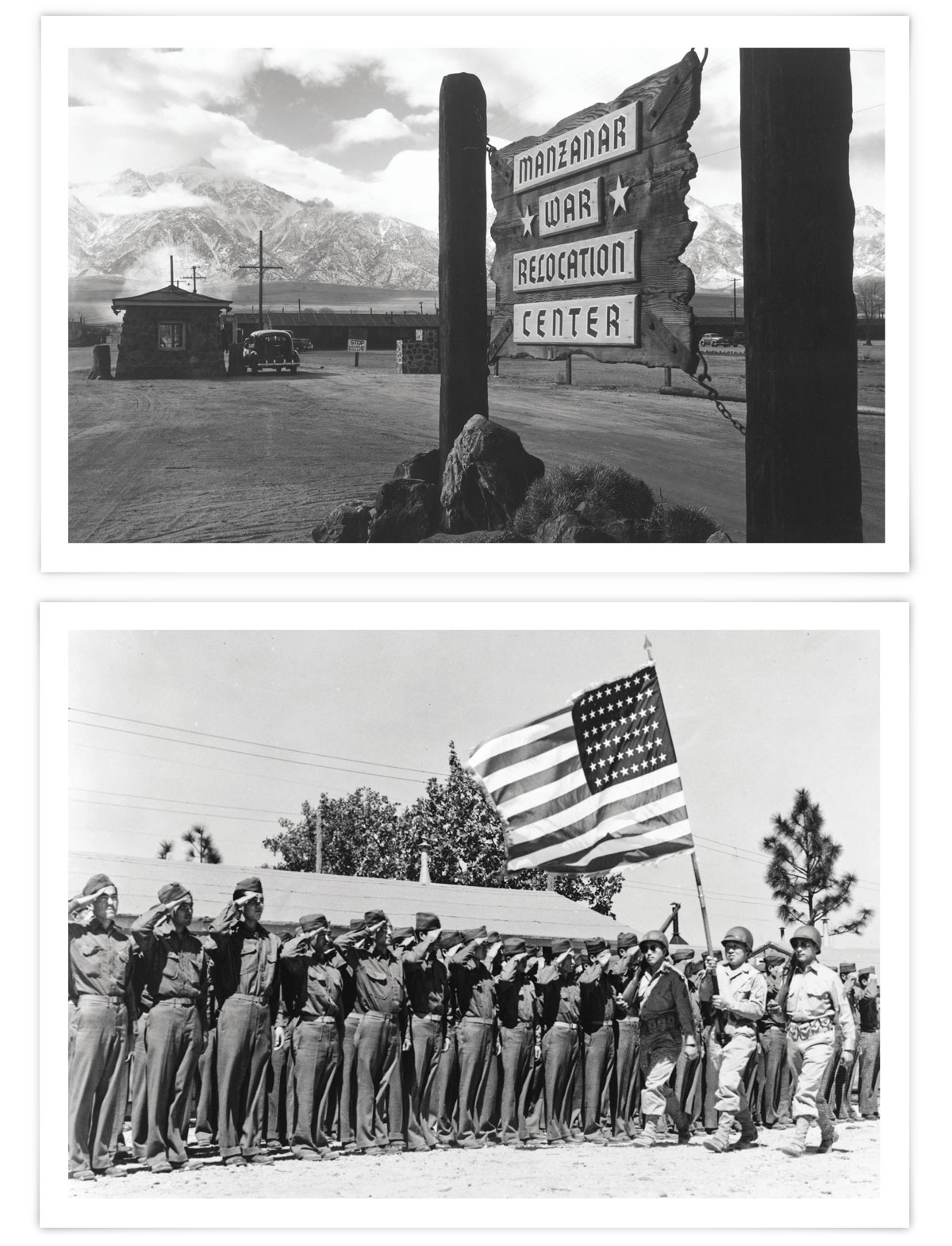 UPSTANDING: Newlyweds Kaz and Soyo Takahashi were incarcerated at Manzanar, where Kaz helped found the Manzanar Junior College. The all-nisei 442nd Regimental Combat Team became one of the U.S. military’s most decorated units. Photos, from top: Ansel Adams/Library of Congress; Bureau of Public Relations, U.S. War Department/Library of Congress
At one point, Yoshiro and Goro Oishi were reunited with their mother, Tama, and siblings. In the summer of 1942, the family was put on a train to Casa Grande, Ariz., near Phoenix. From there, buses took them through desert to the Gila River Indian Reservation, where the military was still completing the Gila River camp. Rows and rows of barrack houses—white with red roofs—stretched out to the horizon. Summer daytime highs in the camp were over 100 degrees most days. Some people braved scorpions and snakes to sleep outside. Dust filled every corner, every eyelash, and hung in the air.
At the camp, Yoshiro and Goro would have had one consolation: The Stanford Board of Trustees had decided to award them their diplomas even though they couldn’t complete their final exams. They received them by mail in June. Yoshiro’s daughter, Carol Nagai, said that Stanford’s decision was a kindness her father would be grateful for throughout the rest of his life. He told her that some of his former professors wrote him letters at Gila River, checking in on him and Goro.
Within a year of arriving at Gila River, Yoshiro and Goro—like many young Japanese men in camps across the West—left for work assignments (Goro, at a hospital; Yoshiro, a factory) and then served in the U.S. military. Shibuya also served. All three worked in the Military Intelligence Service, a branch of the Army that placed a premium on Japanese fluency.
Nagai recalls that her grandfather did not approve of his son joining the Army. “Why would you join?” Yoziro asked his son. “The United States is going to lose the war.”
Yoshiro, however, was a deeply proud American. “My dad told his father, ‘You don’t know American ingenuity—the Americans are going to win the war, and I’m going to join the Army,’ ” Nagai recalls.
Many nisei (the first generation born on U.S. soil)—including Eric Andow, ’43—served in the famous 442nd Regimental Combat Team, an all-nisei unit that fought in some of the most ferocious battles against Germany and Italy. Throughout the war, about 14,000 men served in it. With 21 Medals of Honor, 9,486 Purple Hearts, and an uncommon eight Presidential Unit Citations, it was the most decorated unit for its size and length of service in U.S. military history.
Takahashi found another form of service. He helped found the Manzanar Junior College, an accredited school for people incarcerated there. He taught physiology and eventually served as the college’s registrar. Despair, though, crept into his thinking. In a letter to Treat in 1943, he wrote, “I really feel helpless and thoroughly sick in seeing race hatred develop right in front of my eyes.”
Legacy
Before the last of the camps closed in 1946, many Stanford students had already left—some for the Army, others to continue their education through the relocation program. Shibuya finished his degree at the University of Nebraska. After serving in the Army, George Taoka moved with Matsuye to Ohio to do postgraduate work. Takahashi became a graduate student at Washington University.
From his new home, Takahashi wrote a letter to Professor Treat: “I cannot express in words how happy we are to have left Manzanar. That place is a moral concentration camp; and we used to joke about ‘barbed wire neurosis,’ though we knew that that was partially true.”
The effects of incarceration were both psychological and economic. Though Matsuye Taoka had a Stanford degree in political science, in Ohio she took a job as a billing clerk. By the time Yoshiro and Goro Oishi’s family members were released, they had lost everything—the farmland they’d once leased was taken over, and squatters had ransacked their home in Guadalupe. In 1983, a study commissioned by Congress estimated that people of Japanese descent incarcerated during the war had suffered economic losses between $2.5 billion and $6.2 billion (as much as $20 billion in today’s money). Those released from camps early after a loyalty check—in 1943 and 1944—couldn’t even have come home; California barred people of Japanese descent from returning until January 1945. Yoshiro eventually left the Army and returned to Southern California, but discrimination stunted his job prospects. An honorably discharged veteran with a Stanford degree, he eventually found work selling vegetables from a cart.
Over time, vegetable peddling turned into a small grocery store, then a restaurant. By the time Nagai was old enough to remember, her father was supporting both her grandparents in the house next door, and her uncle Goro was working at Yoshiro’s various businesses.
Nagai remembers that her father’s loves included a steak, golf, and Stanford. Though he lived in Los Angeles, Yoshiro was a football season-ticket holder, a die-hard Stanford fan. Father and daughter traveled to Stanford for games multiple times each season, and they almost never missed a chance to root against the Trojans at Stanford-USC games.
Nagai said that her father never expressed bitterness about his time incarcerated, at least not openly. But Goro sometimes wished he could’ve been a doctor. Instead, he worked at a market and a restaurant run by his brother, later returning to school to become a hospital lab tech.
For Ichihashi, the camps appear to have smothered his intellectual life like a blanket over a candle. During his early years incarcerated, he kept detailed journals, hoping to write an account of his incarceration after his release. But as the years went by, and he was shuttled between different detention centers under fierce suspicion of treason, his journals thinned out. He stopped publishing. Though he eventually returned to Stanford’s campus, he would never teach again. Stanford made him an emeritus professor in 1943. He died in 1963, less than two weeks before his 85th birthday.
|
|
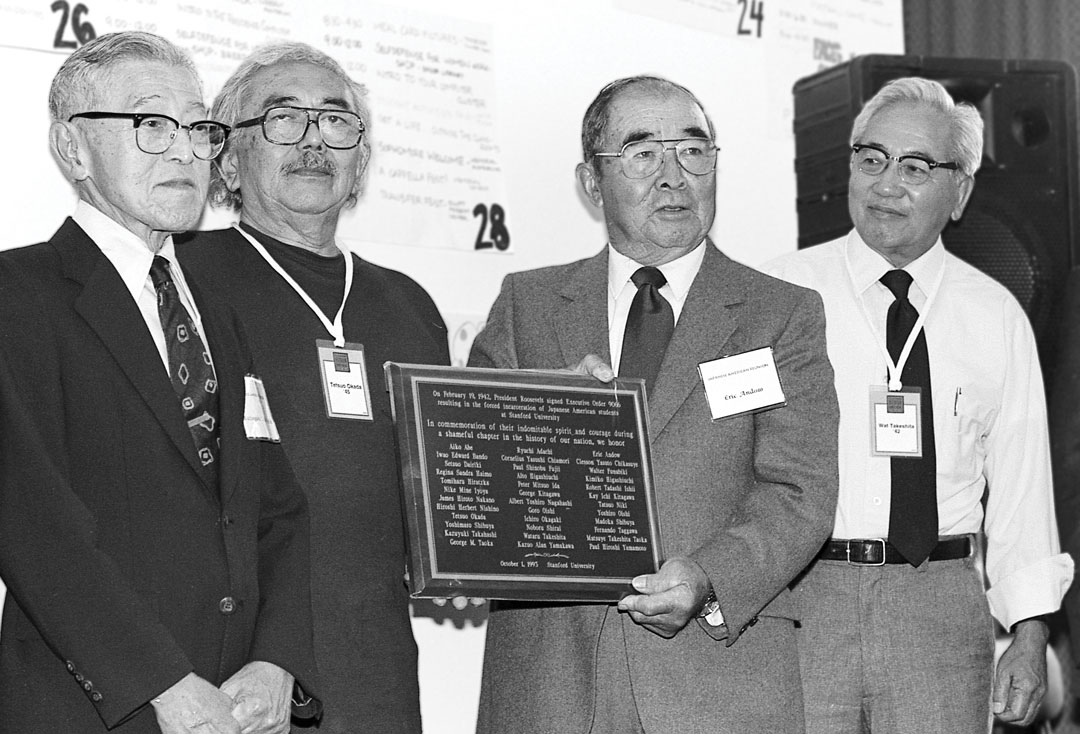
A 1993 Reunion event honored Japanese American students incarcerated during World War II, including, above, Tetsuo Okada, ’45, Andow, and Takeshita. The plaque now hanging in Okada, the Asian American theme dorm, recognizes their “indomitable spirit and courage during a shameful chapter in the history of our nation.” The students incarcerated include: Ryuji Adachi Eric Andow Iwao Edward Bando Cornelius Yasushi Chiamori Clesson Yasuto Chikasuye Setsuo Dairiki Paul Shinobu Fujii Walter Funabiki Alto Higashiuchi Kimiko Higashiuchi Aiko Abe Higuchi Tomiharu Hiratzka Peter Mitsuo Ida Robert Tadashi Ishii Nicholas Mineo Iyoya George Kitagawa Kay Ichi Kitagawa Albert Yoshiro Nagahashi James Hiroto Nakano Tatsuo Niki Hiroshi Herbert Nishino Goro Oishi Yoshiro Oishi Tetsuo Okada Henry Ichiro Okagaki Yoshimaro Shibuya Madoka Shibuya Noboru Shirai Kazuyuki Takahashi Walter Wataru Takeshita George Mazumi Taoka Matsuye Takeshita Taoka Kazuo Alan Yamakawa Paul Hiroshi Yamamoto |
Jack Herrera, ’18, is a freelance writer in New York City. Email him at stanford.magazine@stanford.edu .
(Top Image Photos) Clockwise from top left: Okada House/Stanford University; Yamato Ichihashi/Courtesy Special Collections & University Archives/Stanford Libraries; Stanford Daily; Berton W. Crandall/Courtesy Special Collections & University Archives/Stanford Libraries; Bureau of Public Relations, U.S. War Department/Library of Congress; Stanford Daily; Ansel Adams/Library of Congress