Dish Discoveries
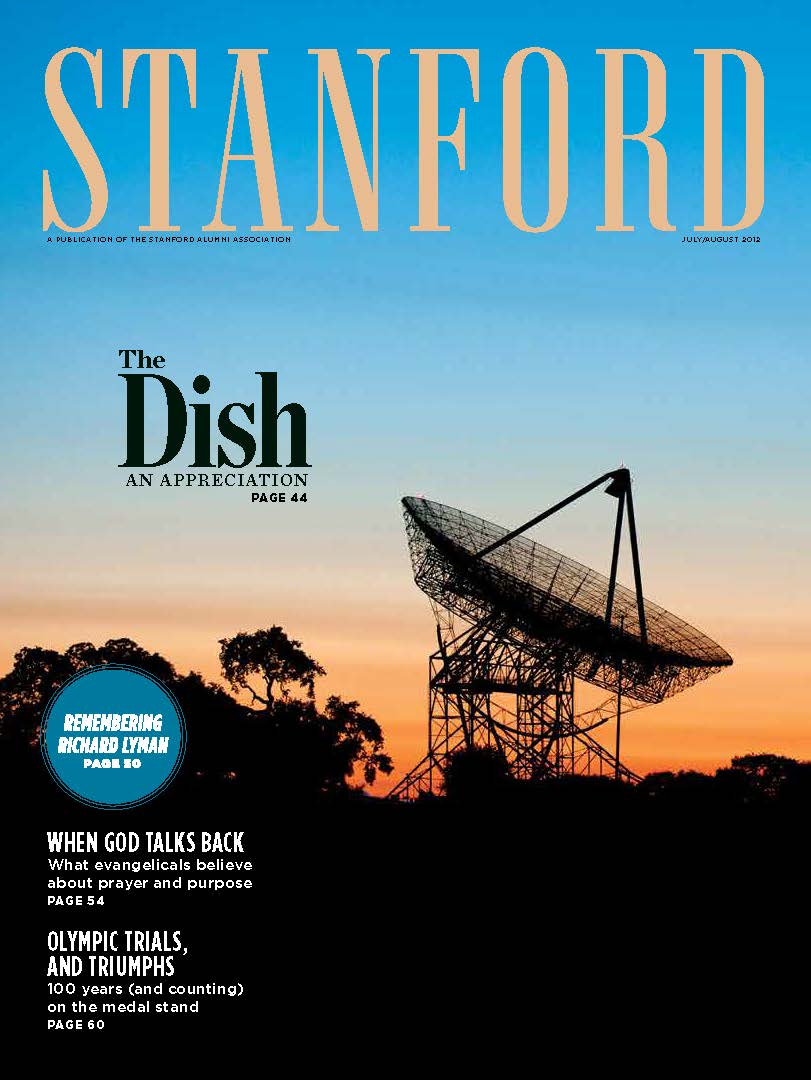
Thanks for the tribute to the Dish and its history (“The Golden Path,” July/August). One thing the coverage didn’t capture is the camaraderie among the Dish “regulars.” The greetings, smiles and periodic conversations that I have with my Dish friends keep me motivated to get out of my warm bed each morning and complete my jog with a smile on my face. I’m grateful that Stanford offers this beautiful space to the community.
Mary Rauner, MA ’92, MA ’94, PhD ’98
Palo Alto, California
[The story] reports that the cattle who graze the Stanford lands where so many love to walk and run are shipped off by their owners to a feedlot. Given what is known about the poor health of animals who live out their last days eating corn and soy in concentrated animal feeding operations, and the poor health that humans suffer from eating that marbled beef, I suggest that the system that serves the campus dorms contract with the farmer to fatten the cows there in the bucolic setting and have them slaughtered at the nearest USDA facility for consumption on campus. Why not close the loop here?
Nice to see the garden project developing on campus (“Growth Opportunity,” Farm Report, July/August). Stanford has a long way to go to catch up to Yale’s great organic food growing on campus; but it’s not a contest, rather a process.
Thanks for a magazine I always enjoy reading to learn anew.
Illène Pevec, ’70
Paonia, Colorado
It was probably in the spring of 1964 when Time magazine printed a photograph of the Dish at Stanford. My response was “Really? Here on this campus? I’ve never seen that!” So one Saturday morning I set out on my clunky balloon-tired bicycle and rode toward the Foothills. I found an unmarked gravel road feebly blocked by a rope and followed it uphill, biking when I could and walking otherwise. Over the hill I did indeed find the Dish and took a close look at it beside the road before continuing on. There seemed to be no activity around it, and the only person I saw was a lone man walking along the road who seemed to be there in some official capacity. He asked me how I had found my way in and implied that I was not supposed to be there. It’s good to know that the Dish is now a route marker for joggers; I’ll have to try to check it out again at my next reunion.
John Markham, ’65
Arch Cape, Oregon
Reason and Religion
I just finished reading “Hearing the Voice of God” (July/August). If this short article is representative, Professor Luhrmann’s adventures were among mystics, not among those who make up the bulk of the born-again and Reformed Christian community in the United States.
Christianity does not diminish the use of man’s reason and rational skill, even if at its heart it is supernatural, as God is indeed a supernatural being. With apologies to the Rev. Matthew Winzer, Christian mystics in the present day might revel in the expression “Let go and let God.” Either anti- or supra-rationality is the mode of the experience, while passivity is its mood. Anyone who has read even the smallest portion of Reformed writings will be unable to equate them with what is described above. That is because the Reformed experience of the things of God was always viewed as covenantal. To quote the Westminster Confession of Faith:
“The distance between God and the creature is so great, that . . . reasonable creatures . . . could never have any fruition of him as their blessedness and reward, but by some voluntary condescension on God’s part, which he hath been pleased to express by way of covenant.”
There are some truths above human reason, but none contrary to it; for God’s grace is not contrary to nature, but perfects it. Therefore there is nothing in the gospel but what is agreeable to sound reason. The mind, the will, the affections, the conscience: All are to be engaged. Man’s soul is not only reasonable, it is living and active as well. Therefore, the whole man—guided along by reason, set to work by the will, moved to action and carried along by the affections, confirmed by the testimony of a good conscience—is to be employed in the service of God.
I would suggest that the group of “evangelicals” studied in Luhrmann’s book, if the article is accurate, do not represent the vast majority of believing Christians in the United States. If you are curious as to what believing Christians are really like, find a Reformed congregation near you and engage them for yourself.
William Mathieu, ’80
Atlanta, Georgia
Tanya Luhrmann’s anthropological study of evangelical Christians’ personal experience of God is most interesting. She makes a convincing case that through “sensory honing and imagination building techniques” people can come to have visual and auditory contact with supernatural entities. While pursuing witchcraft self-training she saw six Druids outside her window. She suggests that it is a similar process that allows evangelical Christians to have a personal, conversational experience of God. In general her research and writing has played well with the evangelicals.
However, she mentions one psychological experiment that suggests a less positive theological interpretation. In this study Stanford undergraduates were given similar sensory honing and imagination training, but with the focus on Leland Stanford Jr. rather than God. Some reported “seeing young Leland and feeling that he spoke back.” I hope Luhrmann or others will pursue this line of research. If confirmed and extended, it would cast a broader light on the phenomenon, and one likely not as pleasing to the evangelicals. Similar experiences may turn out to result from contacts with Elvis Presley or Marilyn Monroe, maybe even inanimate objects. Can one be enabled to engage in a conversation with the Hoover Tower, imagined as a warm and caring structure that conveys unconditional love and support?
Barclay “Bob” Martin, ’47
Chapel Hill, North Carolina
Professor Tanya Luhrmann has done a great service to the various religious communities with her study of the evangelical interior experience, one that reaches back at least to the Wesleyan movement. The description of her research, however, makes it seem that she looked most carefully at the Western “peripheral” religious communities, ones that, from the characteristics of cult, code, community and creed, emphasize community and take from cult the very private “me and Jesus” reality, often de-emphasizing creed and even code. The other growing (yes, despite the abuse scandals) facet of Western religious experience is in the Roman Catholic communion, where the tradition goes back much farther and admits in the deepest personal religious experience what John of the Cross called the “dark night of the soul,” the experience of God as present although felt as absent. Moreover, the Catholic reality puts relatively equal weight on the “four C’s” listed above, and has the advantage of a hierarchical constitution in which the believer can submit his/her own personal experience to the guidance and authority of a spiritual father.
The Rev. W. Patrick Cunningham, MA ’70
San Antonio, Texas
So now people of faith are to be examined like specimens under the virtual microscope of detached, but supposedly benevolent, anthropologists like Tanya Luhrmann? Author Jill Wolfson adds her own subtle commentary by finding a way to lump them with witches, pagans and magicians and their “really batty dissertation[s].” Sure, there is no direct linkage, but the mention of each pathway in the same article links them as equally valid choices in the mind, if not on the page. As a Christian, I am offended.
We Christians believe we are under as much assault as we were in the last days of Rome. To date, it has not come to jungle beasts, ovens or gas chambers, but the incessant drumbeat of the war on Christians is getting more intolerable with each example.
What’s really interesting, however, is the final paragraph that gives advice to Democrats/liberals: “If Democrats want to reach more evangelical voters, they should use a political language that evangelicals can hear.” If only there were such advice on how evangelicals could reach wacky Democrats/liberals, whose only religion is socialism/communism with devout adherence to militant atheism.
Ward S. DeWitt, ’62
Missoula, Montana
The Vineyard Fellowship is a charismatic, not evangelical part of the Protestant community. The two are not compatible, except in basic belief in Christ and the Bible. The professor should realize this when putting out a [book subtitle] about evangelicals.
Carol O’Brien, ’61
Highlands Ranch, Colorado
I have no doubt the subjects of Tanya Luhrmann’s study report hearing God communicate to them. Of course, practicing prayer repeatedly can induce someone to “hear what they determine to be God’s voice” and, with more serious intent, believe it to be more real. “How are rational, sensible educated people able to sustain faith in an invisible being?” One gets what one seeks when the awesome power of belief is involved.
It also seems obvious that this perceived communication with God happens in the human mind. Where else? Hence, we can see the importance of approaching her study from a psychological standpoint. But a good many people, many mentally ill, claim to hear voices, if not God’s. If pretty much anyone can claim to be in contact with God, because none can prove them mistaken, how meaningful can such claims be? “The church encourages them to interpret these clues as the external voice of God.” Not only the power of belief but the power of suggestion seems to be involved here.
It is nice that Luhrmann has a greater appreciation for the sincere religious experience of her subjects and that it is, indeed, “private and precious to them.” There is nothing wrong with that. But it is good to ask how people can believe in an omniscient, all-powerful and all-benevolent God when the existence of evil in our world is obvious, and much evil is done in the name of God.
As for the real difference in politics between political progressives and conservative evangelicals, the latter claim to aspire to be like Jesus yet so plainly must have not actually read the New Testament nor have any desire to live according to his teachings concerning the poor and disadvantaged. What would be the point of liberals reaching out to evangelicals when their minds are already made up, and their certainty trumps reality, reason or alternative perspective? I would assert that the problem with evangelicals is not that “they think more immediately about what kind of person they are trying to be become—what humans could and should be,” but that they believe that everyone must believe as they do.
It is intriguing and useful for academics to explore “myths and stories and the way people construct their world,” as Luhrmann has done, but stating that mental images “could become the vehicle by which supernatural power entered the mundane world,” although impossible to disprove and therefore theoretically possible, stretches credibility. In science, supernatural forces cannot be legitimately used to draw conclusions or describe our experiences, nor can the author make a scientific claim for their existence. But, perhaps, she did not mean this literally. Anthropology is an important field of study, but being the “most scientific of the humanities” does not make it scientific. Belief has no place in scientific investigation, which is based upon a logical and reasonable analysis of data collected via experiment and observation.
Most importantly, simply wanting something to be true does not make it true. The experience of evangelicals in her book is clearly the providence of belief. It does not make it real, except in their minds. While it is nice that Luhrmann has a greater respect for the religious process, she clearly has not found any empirical evidence for the existence of God (which, thankfully, she admits), his actual communication with some humans, or the experience evangelicals claim to have in Jesus. My money is on calling it a “crock.”
Mark Alton
Petaluma, California
Stanford’s Reputation
Thumbs up: your July/August issue with its excellent article “Man in the Middle.” My former husband, Rodney H. Adams, ’60, MBA ’62, worked in the comptroller’s office in the mid ’60s and was later Stanford’s treasurer. It was a pleasure to read an article detailing the contributions made by the Lymans to Stanford, one that also reflects the qualities that made them so unique.
In the late ’60s, when student riots on Stanford campus were at their worst, my husband and I would sit by the radio while KZSU broadcast speeches by Dick Lyman, marveling at the clarity and coherence of his ad-hoc delivery. He spoke as if he’d had a good speechwriter, but it was always extemporaneous. He knew how to take command of a situation and bring control when it looked like things were destined to remain uncontrollable and dangerous. Dick Lyman was a brave and assertive man, managing to be both without unduly antagonizing the people who needed to be brought into line—never an easy thing to do.
Thumbs down: the following comment, “The Stanford at which he [Dick Lyman] arrived in 1958 . . . bore little resemblance to today’s world-class institution. . . . By most accounts, it had earned its reputation as a conservative bastion for affluent students less than fully engaged in the pursuit of academic excellence.”
My twin sister and I came to Stanford in the fall of 1957, a credit to our dad believing in his daughters’ abilities and academic potential. We’d been accepted by Stanford and Cal, the latter including Honors at Entrance. Our dad believed in Stanford University and its ability to give us an excellent education. [We] didn’t come as “affluent students”—our parents remortgaged our house to send us, a sacrifice and commitment for people who survived the Great Depression. We were 4.0 scholars when we came to Stanford, and not only found academic excellence there, but found we had to work long and hard to attain it.
Rich Jaroslovsky, ’75, wasn’t on campus in 1958, and had he been, he wouldn’t have given credit to such a comment. Of course the University has changed in the 55 years since my sister and I came in as freshmen, but every university of any merit is changing all the time. Our graduating class of 1961 has given much to the world in the years since, something that can be said or written about every class before us and many after us—a credit to the quality of our Stanford education.
Norma Jean (Auer) Anderson, ’61
Mountain View, California
Whatever Richard Jaroslovsky’s major at Stanford may have been, “Man in the Middle” displays sloppy history, and Lyman’s views, if accurately quoted, were surprising. “By most accounts” is hardly a valid source for the notion that Stanford in 1958 was a place for the “affluent” who were “less than fully engaged in the pursuit of academic excellence.” Among my fraternity brothers, only one may have been “affluent”; only a $600 Woodbury Scholarship enabled me to attend. I worked as a cashier at the bookstore to pay room and board; many of my roommates worked as hashers for meals. We had one party a month, and TV and the pool table were off limits, save an hour before and after dinner. The library was open and packed 24 hours a day during finals weeks. Aside from calculus and chemistry, I don’t recall a single one-text-only course during my four years, unlike my later graduate work elsewhere. As for comparisons between Berkeley and Stanford, my two Cal-grad parents made it clear: “Go to Stanford; at least most of your
classes won’t have three or four hundred students like ours did.”
Stephen Phillips, ’63, MA ’64
Brooklyn, New York
Olympics History
The articles on Stanford’s participation in historical Olympics were not only timely but an important addition to Stanford’s sports history (“Rising to the Challenge,” July/August). For more information on the U.S. rugby teams of 1920 and 1924, and in particular the events leading up to the Paris riot in 1924, I highly recommend Mark Ryan’s For the Glory. This is a recent, well-researched and highly readable history of these teams and their numerous Stanford participants. I think the book is a great addition to the history of athletics at Stanford. Incidentally, Bob Mathias, ’53, pictured in your story, was a very well liked and modest member of my class.
Don Price, ’53, MBA ’58
Palo Alto, California
Bob Mathias, ’53, was from Tulare, Calif., not from Fresno. (Tulare is about 40 miles south of Fresno on Highway 99.) He was a schoolkid’s hero. Bob’s mother would bring his medals to show at the local schools. It was a thrill to see real Olympic gold medals.
Gary Warren, Engr. ’80
San Juan Bautista, California
The Price of Power
I sympathize with the position taken by Professor Mark Jacobson, ’87, MS ’88 (“How to Solve the Energy Problem,” Farm Report, July/August), in championing wind, solar, tidal and geothermal energy sources to replace fossil and nuclear fuels. (High quality hydroelectric sources are already mostly tapped out in the United States.) Ultimately it all comes down to the cost of electricity, acknowledged in the article but not critically examined. Costs of renewable energy (RE) tend to be underestimated in these kinds of promotional analyses.
The hidden costs include especially the need to build in storage capacity for wind and solar sources, since the wind does not always blow and the sun does not always shine, and the cost of high capacity transmission lines to carry the peak, not the average, power produced by remote RE generators—unless storage is made local to the generator, which is more costly than centralized storage. Today the grid can handle the small percentage of energy delivered by non-hydroelectric RE sources without too much trouble, but even a 20 percent contribution will entail major (costly) enhancements to grid infrastructure and management.
A more basic reason for the high cost of RE is the diffuse nature of RE sources. It takes a lot of capital to intercept and harvest significant energy from wind, oceans and the sun (in contrast to fossil fuels, which benefit from millions of years of compression).
Today there are very few places in the United States where RE can successfully compete with fossil fuel generation without significant subsidies. Even wind, which has come pretty far down the cost curve and is the leading RE source after hydroelectric power, struggles to compete in all but the most favorable sites, which are typically on hilltops and may be quite remote from population centers. From my experience (photovoltaics) and research (in the context of a course on renewable energy I recently created at the U.S. Military Academy), the most effective policy instrument is the Renewable Portfolio Standard (RPS). This approach mandates a certain level of RE in a region but allows the market to compete for the most effective solution. However, what must be appreciated by policy makers is the true cost of implementing an RPS when all of the hidden costs are taken into account, and especially as the fraction of energy produced by RE grows beyond 20 percent or so.
John E. LaSala, MS ’74, PhD ’87
Wilmington, North Carolina
Professor Mark Jacobson, ’87, MS ’88, maintains that energy technologies should be vetted by scientists rather than promoted by industries. The article suggests he and others have done the vetting for nuclear (“no-no’s”) and for wind and other low-energy-dense energy sources (yes-yes’s) in solving the energy problem. If so, the readership deserves a more public vetting for what the future holds if Professor Jacobson’s wind-energy vision comes to pass.
Wind turbines of a nominal power rating of say 2 million watts electrical (2 MW) stand 400 feet high and span 300 feet. A necessarily spaced field of them needed to produce 1 billion watts (1 GW) of intermittent power—equivalent to one nuclear reactor—would comprise around 500 such turbines in a linear arrangement nearly 100 miles long, requiring 38,000 dedicated acres, or 58 square miles. (See windwatch.org.) To make a dent in the world’s future energy needs, 1 trillion watts of wind power is the scale Professor Jacobson’s vision might suggest: that is, 500,000 such turbines.
Somewhere in the vetting process, the public must be better informed about the impact of ancillary matters such as: bird/bat depredations, visual and noise pollution, diffuse grid design, subsidies and a final dismantling of these monstrosities, including up to 1,000 tons each of foundation concrete. Wind energy vetting, by Professor Jacobson and others, has a long way to go.
Stan G. Scott, ’51
Menlo Park, California
More on Doodles
Here’s another story about Winstead Sheffield “Doodles” Weaver, ’35 (“Don’t Forget Doodles,” Letters, July/August): Caught in the shower with only a towel during one of those affairs when parents swarm the dormitories, he solved the potentially embarrassing situation by wrapping the towel around his head and striding anonymously through the crowd to his room.
Bill Dillinger, ’47
Sacramento, California
What Ails Medicine
Joan Hamilton’s article “Something Doesn’t Add Up” (May/June) about the current state of medical science reminded me of comments Marcel Proust made a century ago. In his novel In Search of Lost Time he writes, “For, medicine being a compendium of the successive and contradictory mistakes of doctors, even when we call in the best of them the chances are that we may be staking our hopes on some medical theory that will be proved false in a few years. So that to believe in medicine would be utter madness, were it not still a greater madness not to believe in it, for from this accumulation of errors a few valid theories have emerged in the long run.”
John Hanna, ’01
Boston, Massachusetts
“Something doesn’t add up” is an enlightening read. Flawed research practices such as the selective use of data, unconscious biases and overconfidence are not limited to medicine—see the controversies in climate science, for example. But the crucial importance of Professor Ioannidis’s efforts lies in the fact that faulty medical research leads to the unnecessary suffering of real people, to real lives lost or not saved.
The problem, however, extends far beyond biases, corruption and incompetence. Unlike high-energy physics, chemistry and electrical engineering, medicine is inherently imprecise and it will remain so for obvious reasons. The human body and mind are extremely complex systems. When they fail, they fail in a multitude of tangled ways. Every piece of empirical data in medicine is obtained from a genetically unique organism. Processes in living bodies are interdependent and highly nonlinear. Progression of a typical disease is more likely to be intermittent and recurring than sequential and regular. For these reasons, prognoses in medicine are valid only probabilistically: In medicine the “cause and effect” principle, the foundation of exact sciences, is a caricature rather than a feasible zero-degree approximation.
That practical medicine always deals with individual preferences and values leaves it farther away from exact sciences and closer to humanities. “The daily stuff of medicine is a continuum requiring a constant weighing of uncertainties and values,” writes E. Haavi Morreim, a bioethicist. Oxford Handbook of Clinical Medicine advises doctors to consider the seriousness of the illness when deciding whether to place more weight on the “do no harm” principle or on its antithesis, “nothing ventured, nothing gained.” These are in fact some of the basic principles of the human decision-making process under uncertainty.
Practical successes of modern healthcare create a mistaken belief that medicine is scientifically precise. Medical research and regulatory bodies endorse this belief by focusing on superficially scientific concepts like statistical significance. (Will p<0.05 save more lives than p<0.10? How many people should we let die while waiting for a better p-value?) Medicine is not precise and should not pretend otherwise.
Dean of Medicine Philip Pizzo is right when he says “medicine must become more evidence-based, and the foundations of care must be clear and defined criteria.” Among these foundations must be the principles that the outcomes of medical interventions are variable, that our ability to manage this variability is gradually improving but will always be limited, that there are no purely objective criteria whether such or another intervention is appropriate, and that the burden of medical decisions ultimately lies on the patient and the doctor.
Vacslav Glukhov, PhD ’97
London, England
The trouble with standard medicine is that it has been orchestrated by the pharmaceutical industry, as the article suggests. Even the Women’s Health Initiative study illustrates that by its use of the patented drugs Premarin (horse hormones) and Provera (a progestin different from the progesterone that the body makes) rather than bio-identical hormones that are easily synthesized. Did the meta-analysis equate estriol studies with Premarin? It is telling that Wyeth (maker of Premarin) tried to stop the use of estriol (the growing competition) in 2008. University of South Florida researchers had the wisdom to compare Premarin and Progestin with bio-identical hormones and found that it was the Progestin that was causing the problems. The bio-identical hormones were beneficial.
I tried Premarin and Provera for 10 years from age 47 until I heard about bio-identical hormones. By then I was beginning to suffer from old age. Switching to bio-identical hormones, although unpleasant the first week, ended up rejuvenating me 20 years. In retrospect, I would use topical hormones rather than capsules and start with a small amount. I could see improvement in my blood vessels and skin and could feel the difference in strength and stamina. From what I read, only about 10 percent of women really need hormone replacement, but it only makes sense to balance your hormones so that the ones that promote cancer are balanced by the protective ones.
Another example of things not adding up is the use of surgery for carpal tunnel syndrome. Jacob Teitelbaum accumulated research that carpal tunnel syndrome was often cured by taking large amounts of Vitamin B-6. He never learned that in medical school. Which would you try first?
Nancy Ogden
St. Petersburg, Florida
Commencement Coincidence
This spring I was asked to deliver my first collegiate commencement address. I struggled with what I should say. It came to me in a flashback. The words flowed. I delivered them on May 10.
On May 12 I received Stanford and was stunned by the coincidence. “Speak, Memory” (Farm Report) by Daniel Newark, ’03, MA ’11, tracked exactly what I had said to the students.
As suggested in the article, I remembered only three things from my graduation on June 13, 1971. They were the speaker’s name, the message and the weather. I told this year’s graduates such and proceeded to give them their three future recollections.
With a name like Young Boozer, I assured them they would have no trouble remembering the speaker’s name. They confirmed with great laughter.
The message was three simple things: congratulations, inspiration, perspiration. They were to be roundly congratulated for working so hard to fulfill their aspirations. I pointed out that the only time success comes before work is in the dictionary.
The final thing they would recall was the weather. It was perfect on that Alabama May evening. I was thankful because 40 years earlier I fried in Frost.
To supplement his research, I am pleased to report to Newark that the address was well received. The three elements seem likely to be remembered. There was no champagne to dull the memory of anyone in attendance, a relief to this Boozer.
Young Boozer, ’71
Montgomery, Alabama
On Egg ‘Donation’
In the March/April issue readers encounter the following classified ad: “Seeking Stanford Educated Egg Donor . . . generous compensation and all travel expenses paid.”
“Generous compensation?” What exactly would be adequate compensation for contributing to the commercialization of human reproduction; for the undermining of marital intimacy; for the imperiling of a young woman’s health?
Margaret Somerville, director of the Centre for Medicine, Ethics and Law at McGill University, writes, “I believe that we will look back on widespread donor conception . . . as a great human tragedy of the 21st century.”
Eggsploitation, produced by Jennifer Lahl, another critic of the assisted reproduction industry, won Best Documentary at the 2011 California Independent Film Festival. On the film’s website, under the subtitle, “The Infertility Industry Has a Dirty Little Secret,” we read: “egg-sploit (v.): to plunder, rob, despoil, fleece, and strip ruthlessly a young woman of her eggs, by means of fraud, coercion or deception, to be used selfishly for another’s gain, with a total lack of regard for the well-being of the donor.”
Jane Stanford, a woman well acquainted with the sorrow of being unable to bear another child after her first and only child died, was clearly aware that technical and scientific knowledge that is not tempered by humility may serve as a conduit for, rather than a bulwark against, greed and disordered ambition. She had inscriptions carved into the sandstone walls of Memorial Church, including the following: “No widening of science, no possession of abstract truth, can indemnify for an enfeebled hold on the highest and central truths of humanity.”
Arnold Shives, MA ’69
North Vancouver, British Columbia