
Didn’t see that coming.
People with red-green colorblindness—the most common form—may have an elevated risk of dying from bladder cancer, simply because they’re less likely to detect its earliest warning sign: blood in the urine. Stanford researchers compared 135 people diagnosed with both bladder cancer and colorblindness with similar patients with normal vision. Those who were colorblind had a 52 percent higher overall mortality risk over 20 years. About 1 in 12 men and 1 in 200 women are colorblind, but many never receive a formal diagnosis and may have been counted as having normal vision in the study. That could mean that the true number of deaths among the colorblind group are even higher. “I’m hopeful that this study raises some awareness, not only for patients with colorblindness, but for our colleagues who see these patients,” said Ehsan Rahimy, an adjunct clinical associate professor of ophthalmology and senior author on the study.
The view finder.
Documentary filmmaker Jeff Orlowski-Yang, ’06, grew up as a budding photojournalist, but that dream faltered on the Farm. At a campus photo exhibition, he watched a group of three students walk in, quickly glance around, and leave. “I was worried that my photography wouldn’t have an impact in the world if people weren’t going to pay attention to it like that,” Orlowski-Yang told Stanford magazine. With the help of the Stanford Film Society, he pivoted to film and hasn’t looked back. He’s written and directed four documentaries, including the Oscar-nominated and Emmy-winning Chasing Ice and the Netflix hit The Social Dilemma. His most recent film, Chasing Time, caps the first chapter of his career with a return to the landscapes and people that have shaped him, with time lapses spanning 15 years and 1.5 million photos of melting glaciers. With five forthcoming feature-length films in the works, his story has just begun.
Fight Night.
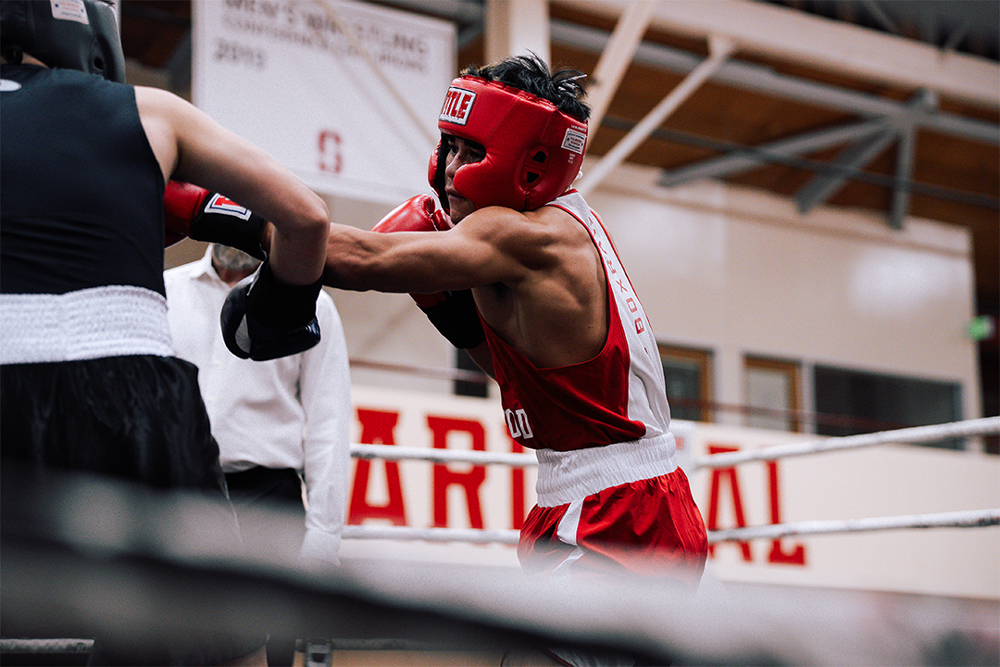 Photo: Xzavier Jauregui, ’28
Gloves were on, guards were up, and hundreds of students were in Burnham Pavilion as boxers competed in the first-ever Fight Night on the Farm. The tournament was sanctioned by USA Boxing, the primary governing body of amateurs in the United States, and featured athletes from Stanford, UC Riverside, Santa Clara University, and Oxford University. After 10 bouts, Stanford claimed the inaugural victory, with a 4-2 record. “I feel like us being allowed to have this event on campus is a product of our hard work and our accomplishments,” said senior Nicholas Aguirre, co-president of Stanford’s two-year-old boxing club.
Talking trash.
To keep cells spick-and-span, tiny structures called lysosomes act as cellular sanitation machines, cleaning up waste and recycling materials. When those lysosomes malfunction in brain cells, the risk of Alzheimer’s, Parkinson’s, and other neurological disorders goes up. But scientists don’t fully understand how lysosomes do their work or why their dysfunction leads to neurodegeneration. Fortunately, a new atlas offers clues in the form of proteins. A team led by Monther Abu-Remaileh, an assistant professor of chemical engineering and of genetics, has created a new atlas showing which proteins are associated with lysosomes in different types of brain cells. They’ve identified 790 lysosome-associated proteins and have already made a discovery using the atlas: They tied a rare neurological disorder, SLC45A1-associated disease, to lysosomal dysfunction. The new knowledge could inform approaches to treatments. “Now that we have the atlas, there are many proteins with potential disease relevance that we plan to investigate further,” said research scientist Ali Ghoochani, a co-first author on the new paper.
Stanford Olympian update.
On Monday, senior Eileen Gu won a silver medal in the women’s freeski slopestyle. It’s her first medal of these Games and fourth overall. Today, competition came to an end for senior Brandon Kim (short track speed skating) and sophomore Sammy Smith (cross-country skiing). But keep your Cardinal flags waving: Gu is set to compete in freeski big air as well as freeski halfpipe; the latter sets up a duel with senior Zoe Atkin.
But wait, there’s more . . .
Mark Marquess, ’69, Stanford’s head baseball coach from 1977 to 2017, died on January 30. A legend in college baseball, he led the Cardinal to NCAA titles in 1987 and 1988. Marquess (often known as “9” for his jersey number) was an ambassador for Stanford who put the development of young men both on and off the field at the forefront, said John Donahoe, MBA ’86, director of athletics. “Nine was a true icon in every sense.”
Kevin Warsh, ’92, a former central banker, has been nominated to be the next chair of the Federal Reserve, pending confirmation by the Senate.
The 2010 New Strategic Arms Reduction Act, which required the United States and Russia to reduce their strategic nuclear forces, expired last week. Steven Pifer, ’76, a fellow at the Freeman Spogli Institute for International Studies, warns of an arms race—and offers ideas that could prevent it.
Quantum computing is looking downright scalable thanks to a new light-based “optical cavity” array that can collect single photons from many atoms at once, making it easier to read information from many quantum bits in parallel. The development could help to address a bottleneck in quantum computing.
John Chowning, MA ’64, DMA ’66, professor emeritus of music and co-founder of Stanford’s Center for Computer Research in Music and Acoustics, received the 2026 Technical Grammy for his discovery of frequency modulation (FM) synthesis, which revolutionized electronic sound.
Using X-ray beams and a particle accelerator on thousand-year-old parchment, SLAC scientists have uncovered the oldest known attempt to catalog the entire night sky: star coordinates written by mathematician Hipparchus, the father of astronomy.
Did you meet in your frosh dorm or the lab? Fall in love over boba or . . . psets? (Hey, if there’s one place that can happen, it’s within Nerd Nation.) You might be Stanford sweethearts.
Note: The Loop sometimes links to articles outside of Stanford that may require a subscription to view.