Whenever Doris Fisher came back to the Stanford campus with her grandchildren, she walked it the way people do when they return to the places that made them. She pointed out buildings that had served other purposes—one had once housed a bowling alley. She noticed what endured (Roble Hall, where she served as an RA). Occasionally she would see a student sketching or just pausing in front of a piece of art. That, family members say, brought her a particular joy.
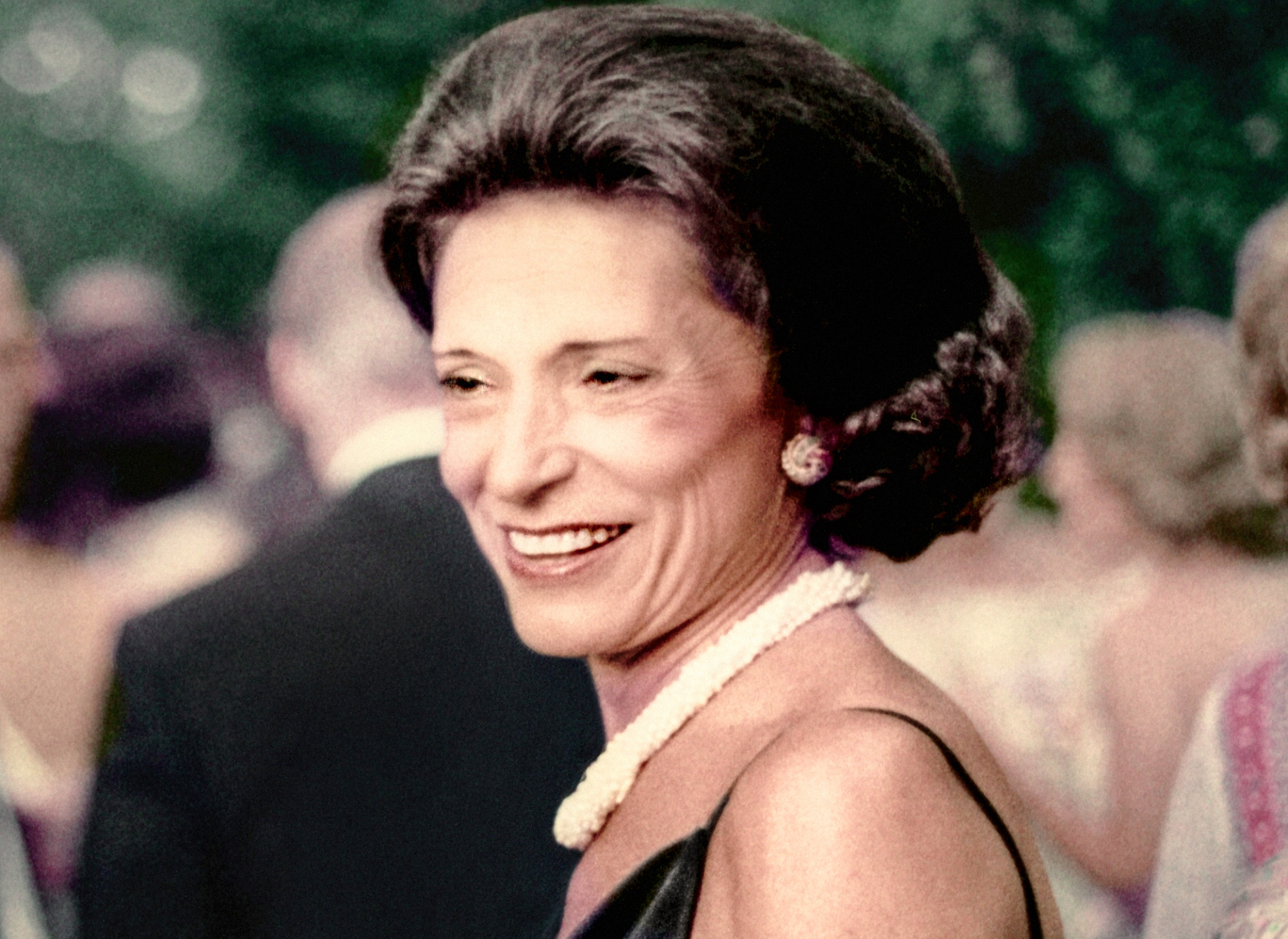 Photo: Gap Inc.
Doris Feigenbaum Fisher, ’53, who co-founded Gap Inc. with her husband, Donald, and built one of the most significant private art collections in the country, died May 2 in San Francisco. She was 94.
A San Francisco native, Fisher nearly didn’t make it to Stanford at all. She didn’t test well, says her son John Fisher, MBA ’89, but the head of her high school traveled to the Farm to make the case for her best student. Fisher was admitted, worked hard, and graduated with a degree in economics. The same year, she and Donald married.
The pair had three sons, and Fisher served on the boards of the schools they attended and volunteered at community organizations including Guide Dogs for the Blind. In 1969, the couple opened the Gap, a small shop in San Francisco, selling simply men’s Levi’s jeans, records, and cassette tapes. (Fisher named it for the generation gap.) Today the global retailer has more than 3,500 stores and includes the brands Old Navy, Gap, Banana Republic, and Athleta.
Encouraged by Fisher’s former roommate, the couple began collecting contemporary art. “Peggy [Walker, ’53] said, ‘Why don’t you go take a look at these artists?’ and then the more they did it, the more they fell down that rabbit hole,” recalls their daughter-in-law Sakurako “Sako” Fisher, ’82. “They both were deeply invested in the artists that they met.”
Today that trove counts more than 1,100 pieces, including works by Alexander Calder, Anselm Kiefer, Agnes Martin, Gerhard Richter, and Andy Warhol. The same eye for style that Doris brought to the Gap carried into their collection, wrote Donald Fisher in his 2002 memoir.
Doris Fisher worked as a volunteer at Stanford, serving on the Board of Trustees and advocating for art on campus. The couple supported the rebuilding of the campus museum after the 1989 Loma Prieta earthquake, and the building that arose—Cantor Arts Center—has been the beneficiary of many Fisher gifts and loans. Most physically prominent is artist Richard Serra’s Sequence, a pair of interlocking steel figure eights weighing more than 200 tons, which has its home on Cantor’s north lawn.
The family’s connection to Stanford now spans three generations. “This all started with my mom and her love for the school,” John Fisher says.
Fisher is survived by her three sons and daughters-in-law: Robert, MBA ’80, and Elizabeth; William, MBA ’84, and Sako (Daniel, ’82); and John, MBA ’89, and Laura (Meier, ’88); 10 grandchildren, including Claire, ’13, MA ’18, MBA ’18, Jill Bowen, ’14, MBA ’20, David, MBA ’26, Rose, ’17, MBA ’23, and Michael, ’19; and 13 great-grandchildren. Her husband, Donald, died in 2009.
Christine Foster is a writer in Connecticut. Email her at stanford.magazine@stanford.edu.