Steve Denning was attached to his antiquated Casio electronic organizer. When fellow Stanford trustee Isaac Stein, JD/MBA ’72, asked why a pioneering tech investor hadn’t updated to something more modern, Denning said he couldn’t risk losing all the data: birthdays, names of friends’ children, and decades of personal notes. “He wanted to be fully connected to people,” Stein recalls.
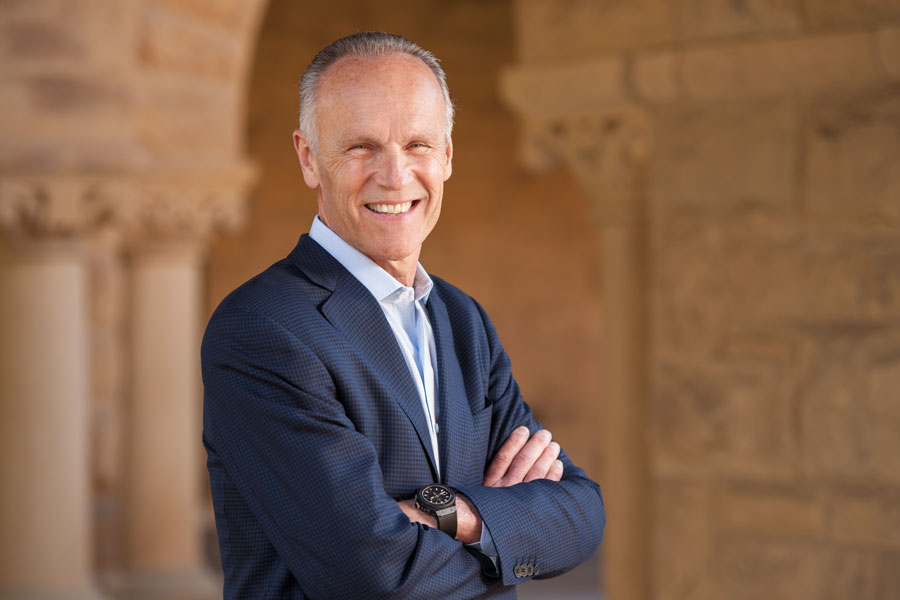 Photo: Linda A. Cicero/Stanford News Service
Steven Aaron Denning, MBA ’78, a former chair of Stanford’s Board of Trustees who helped shape many of the university’s most consequential philanthropic and visionary efforts, died April 27. He was 77.
A first-generation college graduate from Salt Lake City, Denning earned a bachelor’s degree from Georgia Tech. He served in the Navy, earning a master’s degree from the Naval Postgraduate School, before attending Stanford Graduate School of Business. There he met Roberta Bowman, ’75, MBA ’78, who became his wife.
After graduating from the GSB, Denning was hired by McKinsey & Company. In 1980, he left the consulting giant to work for General Atlantic, a fledgling investment firm. He stayed for four decades, eventually serving as CEO and chair, helping to develop a family office into a global institution. He brought the same expansive instinct to Stanford, pushing the university to think more globally, inspired in part by how his own horizons had broadened after he left Salt Lake City. “When he was at McKinsey, he was going to Amsterdam, and he wanted to make sure it was Amsterdam, the Netherlands, not Amsterdam, New York,” Roberta recalls, laughing.
Denning served on the Stanford Board of Trustees from 2004 to 2017, including five years as chair. From 2005 to 2012, he co-chaired the executive committee of the Stanford Challenge, the university’s largest fundraising campaign. “Steve had a rare ability to bring people together and inspire them to do more than they imagined they could,” Stanford president Jonathan Levin, ’94, told Stanford Report.
That vision of what was possible drew Denning to support the Stanford Institute for Human-Centered Artificial Intelligence. In 2018, he became one of HAI’s earliest proponents, helping computer science professor Fei-Fei Li build its founding circle. Denning insisted AI would fundamentally reshape the university, from medicine to law to English, recalls philosophy professor John Etchemendy, PhD ’82, a former provost who served as a founding co-director of HAI along with Li. “Steve was crystal clear,” he says. “He never had any doubts about how AI was going to affect things.”
His ability to think big extended to his support for Knight-Hennessy Scholars, a graduate-level, leadership- development program. He and his wife made the gift to build Denning House, which serves as the convening hub for the inter-disciplinary program.
Li, who now co-chairs HAI’s advisory council, remembers an early lunch in Palo Alto, where Denning quickly moved past fundraising and strategy to get to know her. “He wanted to support a human being,” she recalls. “He wanted to understand who I am as a person, why I could be the leader of this effort, and how to support me personally.”
Denning’s energy and foresight never waned. Li remembers that in some of their final conversations, he would say: “There’s a lot more to do. We haven’t done enough.”
In addition to his wife, a current trustee, Denning is survived by his daughter, Carrie Denning Jackson, ’08, MA ’09, MBA ’15; son, Robert, MBA ’11; and grandson.
Christine Foster is a writer in Connecticut. Email her at stanford.magazine@stanford.edu.