When Paul Ehrlich joined Stanford in 1959 as an assistant professor of biology, the chair of his department had one request: Could he teach a course on entomology and one on evolution? To Ehrlich’s delight, those would be the only administrative instructions he’d receive in more than 60 years on the faculty. “Stanford left you alone,” he wrote in his 2023 memoir, Life.
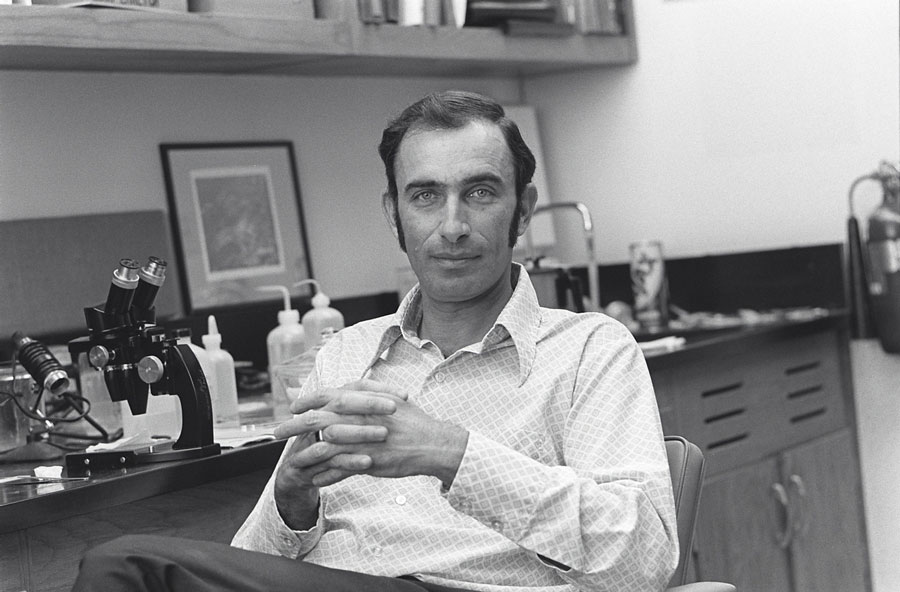 Photo: Chuck Painter/Stanford News Service
For Ehrlich, that freedom meant more time chasing butterflies, his life’s passion and the heart of his celebrated scientific career. But it was one of the requested courses, Evolution and Human Affairs, that would lead to his greatest fame—and infamy—as perhaps the world’s most recognized prophet of doom. In the 10-week course, Ehrlich devoted nine weeks to reviewing humans’ evolutionary past and one week looking ahead to a planet stressed by industrial pollution and an exploding population. It was a grim conclusion but also spellbinding material. Soon Ehrlich was invited to speak to outside groups, gaining the ear of David Brower, executive director of the Sierra Club, who urged him to write a book.
The result—written in “three weeks of evenings” with his uncredited co-author (and wife), Anne—was The Population Bomb, a slim book published in 1968 that predicted a litany of calamities tied to overpopulation. Despite its bleak message, the book was a runaway success, selling 3 million copies, turbocharging the movement to halt population growth, and launching Ehrlich into unlikely celebrity. He would appear on The Tonight Show Starring Johnny Carson some 20 times and was featured as recently as 2023 in a 60 Minutes piece on impending environmental disaster. But to some critics, he was a Chicken Little alarmist who never acknowledged that some of his catastrophic predictions, including worldwide famine and “hundreds of millions” of deaths, may have been premature or wrong.
Paul Ralph Ehrlich, a professor of biology emeritus, died in Palo Alto on March 13 due to complications of cancer. He was 93. Blunt to the end, says his daughter, Lisa Marie Daniel, ’77, he called out his doctor for soft-pedaling the inevitable. “He said, ‘Can I just die? I don’t want to ‘pass on,’ ” she said. “He hated euphemism.”
Ehrlich was a ceaseless worker, Daniel says, with little interest in downtime. If someone was picking him up in five minutes, he’d finish one project and start another. He was the author, co-author, or editor of more than 40 books and hundreds of scientific articles. In 1990, the same year he was awarded a MacArthur Fellowship, he won the Royal Swedish Academy of Sciences’ Crafoord Prize, established to recognize research in disciplines not eligible for a Nobel. Still, his most important scholarship was a 1964 collaboration with then-colleague Peter Raven that explained how interacting species—such as butterfly caterpillars and plants—develop together in an evolutionary dance. More than 60 years later, the paper stands as a seminal moment that introduced the concept of co-evolution.
Ehrlich’s legacy at Stanford is woven into the campus. In 1971, he helped found the human biology major—today Stanford’s second most popular after computer science—and was a driving force in protecting Jasper Ridge Biological Preserve, where he spent decades studying the bay checkerspot butterfly. Saving the site from development in 1973 was the most important thing he did at Stanford, Ehrlich said in a 2023 interview.
In addition to his wife of 72 years and his daughter, Ehrlich is survived by his two granddaughters; step-granddaughter; two great-grandchildren; four step-great-grandchildren; and sister.
Sam Scott is a senior writer at Stanford. Email him at sscott3@stanford.edu.