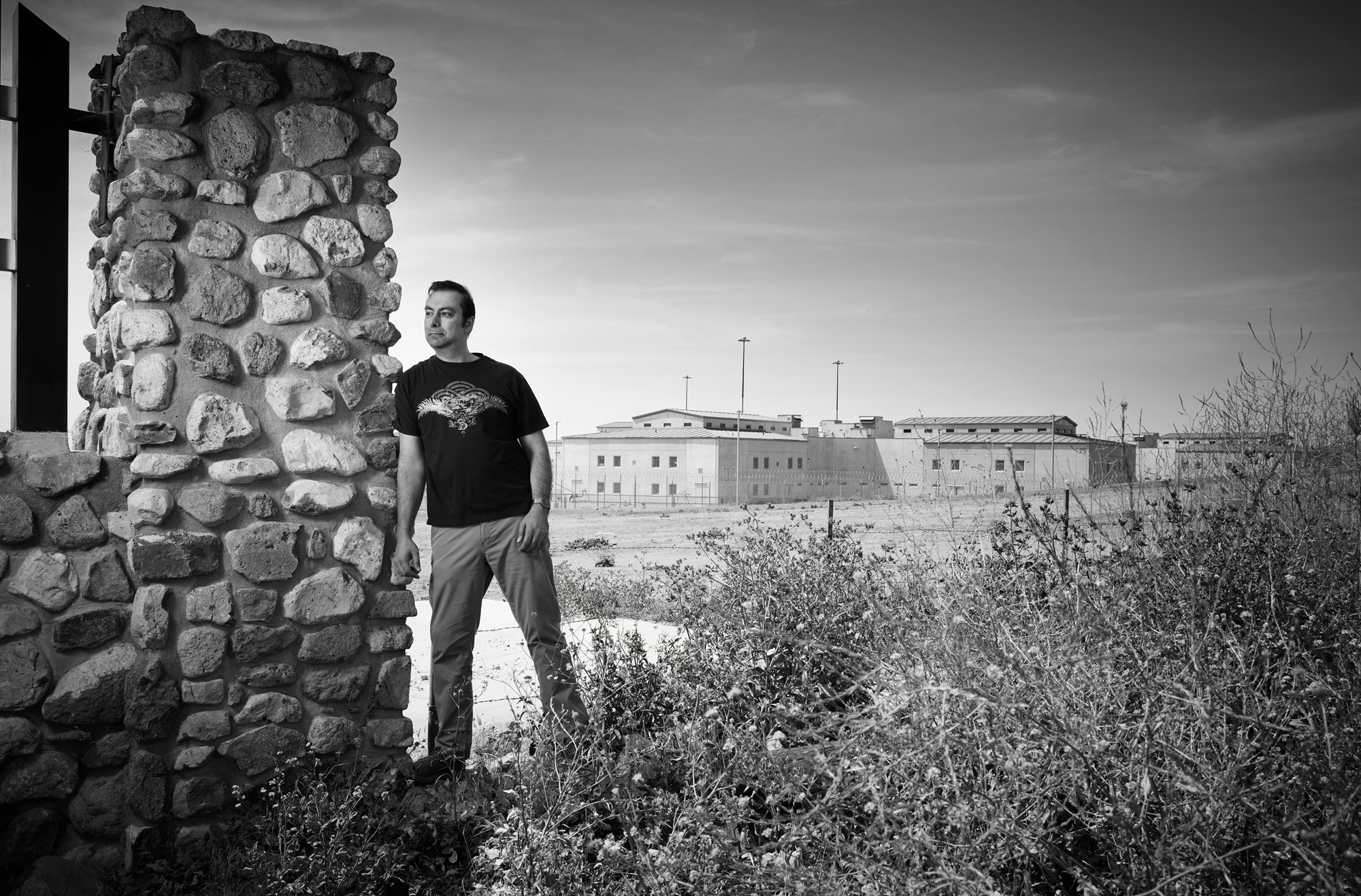
The session began like any other.
For safety, psychiatrist Zaid Yusufi Rafin wore a push-button alarm strapped to his belt and a whistle around his neck. An arm’s length from him sat his patient, Robert Nevels, wearing blue jeans and a blue shirt, the standard-issue uniform for the A Yard at the Richard J. Donovan Correctional Facility (RJD) in San Diego. It was 2021, and Nevels, then 57, had already served 28 years of a life sentence for murder. The two were alone in Rafin’s sparse 8-foot-by-12-foot office, with corrections officers roaming beyond the closed door.
Nevels grew up in what Rafin, ’00, calls “excruciating” circumstances, and his arms were crisscrossed with thick scars from cutting himself, a coping mechanism he’d used since childhood. His wife, daughter, and unborn grandson had died while he was in prison. Yet there was a moment during this session, Rafin says, when none of that weighed him down. In fact, if anyone had passed by, they would have heard a powerful bout of laughter.
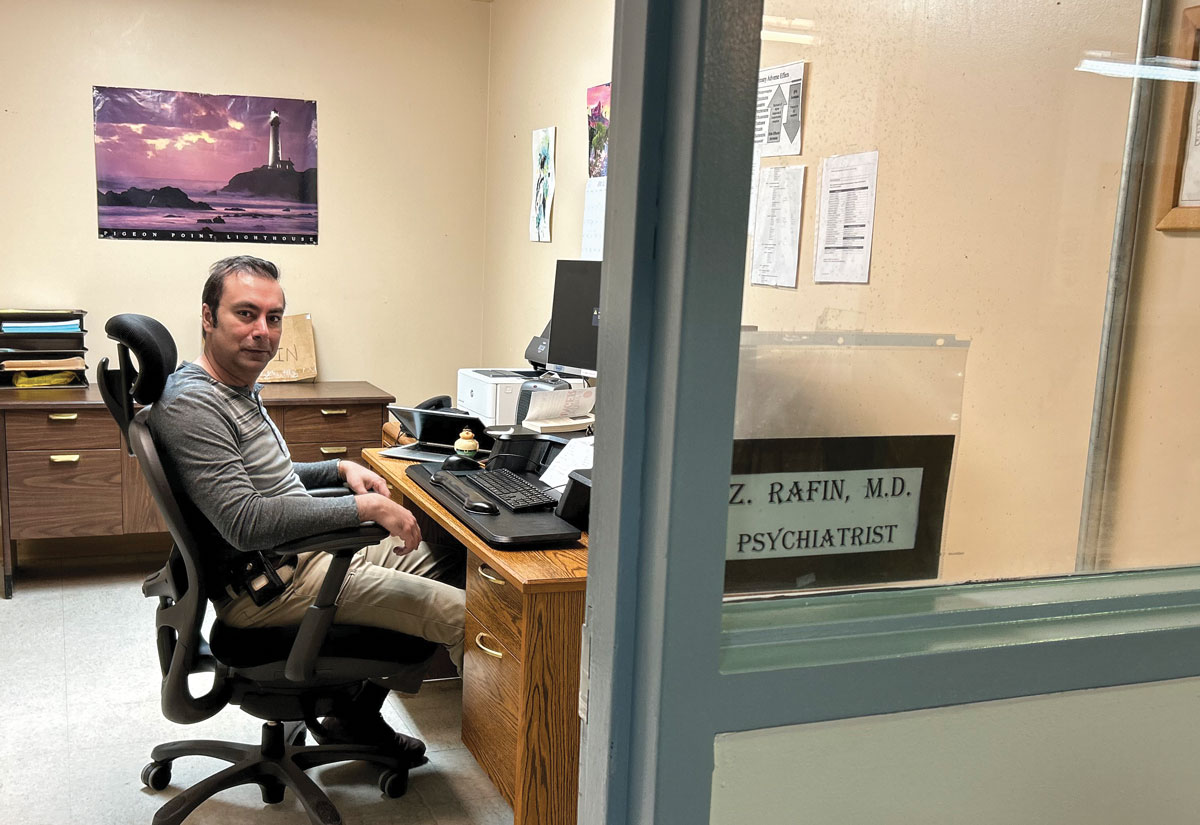 INSIDE JOB: Rafin wanted to be where the need was greatest. Often, that’s prison. (Photo: Adam Garvey)
“I don’t think we laughed that hard—ever—before then,” says Rafin.
They had been trying an exercise Rafin learned at Finest City Improv in San Diego, where he’d been a student for the past year. While absorbed in improv exercises, Rafin says he “noticed the change in myself when I got pulled out of my own thought process.” Sitting next to Nevels, he thought, Would this potentially work in a setting like this?
Over the past five years, Rafin has found that it can. Sometimes. But outside of patient sessions, improv has helped Rafin himself to embrace uncertainty. And it turns out that’s important if you want to thrive in a workplace like RJD. No push-button alarm will protect you from an apple chucked at your forehead, and no whistle on a lanyard can ease your mind when your patient is struggling with a life sentence. In prison, as in life, there’s only so much you can control.
On its face, RJD is the most controlled workplace Rafin could have chosen. It’s a maximum security prison and state-designated institution for inmates with severe mental illness, with some 90 psychiatrists, psychologists, and social workers. About 70 percent of RJD’s 3,000 residents have a diagnosed mental illness. That’s nearly twice the average rate in U.S. prisons, and more than three times the rate in the general U.S. population.
When Rafin first visited, “it was a little scary,” he says, “walking through all these chain-link fences, and they have cartoonishly large keys that open doors.” In one of the restricted housing units, a sign reminds inmates that security threats can be met with lethal force. It reads: No warning shot.
Beyond Rafin’s initial fear, however, he found familiarity—trauma, mental illness, and a lack of control that he recognized from his own life.
Rafin was born in Afghanistan in 1978, just before the Soviet invasion. When he was a toddler, his father, a law professor, was assassinated; when he was 5, his mother moved the family to housing projects in New York City, where Rafin remembers stepping over empty crack vials on the sidewalks.
‘I didn’t have to imagine what a patient has to go through. I could put myself in patients’ shoes at will.’
He found solace at Public School 165 in Queens. “School provided structure in an otherwise tumultuous situation,” he says. He felt great satisfaction in being organized and exacting, and he was an excellent student. But that mental willpower turned on him in high school, when he developed obsessive-compulsive disorder (OCD). The disorder flipped on like a switch one day, he says, beginning with part of a song chorus looping incessantly in his mind and expanding to include intrusive thoughts about contamination, harm, and other themes.
“It’s kind of like a mental prison of sorts,” Rafin says. His attempts to suppress those thoughts only made them worse, and by the time he entered Stanford, managing his mind was a full-time job. “That, I think, really was one of the most influential things that shaped my becoming a doctor,” he says. “I didn’t have to imagine what a patient has to go through. I could put myself in patients’ shoes at will.”
He eventually found some relief through a combination of medication and exposure and response prevention—a form of cognitive behavioral therapy—but he isn’t free of the disorder. During periods of increased stress, his symptoms can worsen.
In 2011, after medical school at USC and a psychiatry residency at Cedars-Sinai Medical Center, Rafin saw a job posting at RJD that piqued his interest. He wanted to be where the need was greatest and, when it comes to mental health, that place is often prison. About 95 percent of all incarcerated individuals are eventually released, so unmet needs in prison have impacts far beyond the barbed-wire barriers. “I wanted to give it a try,” he says.
The work, as he’d hoped, was meaningful, and there were lighthearted moments. Once, a patient showed up with three pet lizards on shoelace leashes. “He just plopped them on my desk,” Rafin says. But over the years, there were also patients who swallowed razor blades or amputated their own fingers. One patient had been incarcerated for more than 60 years. When he was placed in the prison’s psychiatric hospital for active suicidal intent, he tore his gown in a way that could have been used to harm himself. “They were trying to pull this smock away from him—like, the only thing he had in his cell—and I was just trying to think to myself, ‘What in my life has prepared me to try to say anything of use to this person?’”
“The extremity of the cases is definitely off the charts,” says Ben Alpert, a psychologist who works with Rafin. “They’re having hallucinations, they’re having delusions.” What’s more, there isn’t always a constructive outlet available. With wait lists to access educational and work opportunities, some patients have trouble filling their days, which Alpert says can lead to depression, substance abuse, and criminal activity.
All of which complicated Rafin’s goal of discerning each inmate’s psychiatric needs and framing treatment in a positive but realistic way. He felt a crushing responsibility to devise the perfect treatment plan for each of his 200 patients. But after nearly a decade and more than 24,000 psychiatry sessions, his doubts that he was succeeding were straining him. “Psychiatry has so many limits,” Rafin says. “There aren’t cures, and so people have to live with certain amounts of dysfunction.”
In early 2020—the cumulative stresses of work piling up—Rafin stepped out of his comfort zone when a friend invited him to a beginner improv class. “I was petrified,” Rafin says. But week after week, during exercises like A Thing It’s Not, in which participants rapidly point to objects around the room and say what they are not, he was forced to focus only on the present—trading mental rigidity for creative thinking. In the liberating unpredictability of Finest City Improv’s small theater, Rafin let go. “The whole training is to just be in the moment,” he says. “It made me lean into all sides of myself and put them out in the open.”
Back at RJD, he felt power in his newfound ability to relax his grip on his thoughts and feelings.
“There’s an improv saying that goes, ‘Bring a brick, not a cathedral,’” Rafin told an audience at Stanford’s 2025 Reunion Homecoming, where he spoke on a panel. “I stopped trying to find some perfect formula of meds and words to help each patient, which had made me uptight and afraid to fail.”
A few months after his first improv class, Rafin was in that 2021 psychiatry session with Nevels, who had made great strides toward overcoming his self-injury and drug abuse issues. “But an element was missing,” Rafin says.
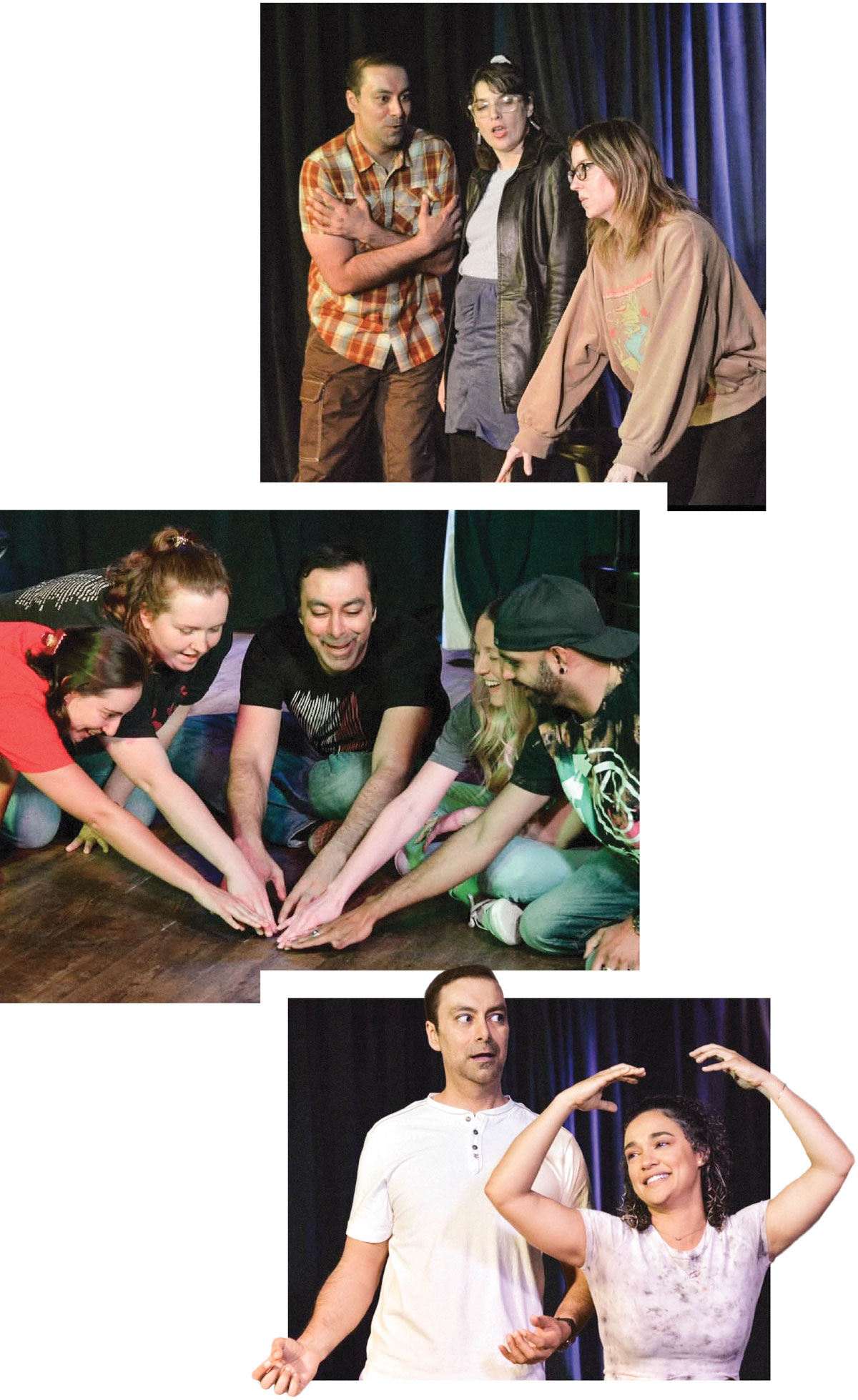 ONE SENTENCE AT A TIME: Rafin brings what he learns in improv to patients who have a healthy sense of humor and are emotionally open. (Photos: Finest City Improv (3))
What if we get off of this expected route of how people communicate? he thought. He asked Nevels to try an exercise called One Sentence at a Time, in which participants quickly build a story one line at a time by taking turns. The game often yields absurd twists as partners swiftly spit lines back and forth. “He exercises my mind,” Nevels says. “Instead of me trying to figure out what I’m going to say—complicate what I’m going to say—I have to react right then and there.”
Nevels has come to terms with his life sentence. He works as a clerk and a porter at RJD, cleaning and setting up rooms for group meetings. He’s devoted himself to religion and disavowed violence. “The time don’t bother me, because I got to pay the consequences for my actions,” Nevels says. “I took another man’s life because of my pain, so every day I wake up, I’m blessed.”
“His history is so violent,” Rafin says, “you would think this guy is thinking about violent things, but he’s changed so much.”
Then, in the middle of One Sentence at a Time, Nevels blurted out a violent plot point. It was so unexpected, so out of character, that they both started laughing. “It was such a huge relief, in a way,” Rafin says. There was something revealing about that line, insight into the thoughts that cross everyone’s minds, regardless of their past or penance. “Something was tapped by doing that that we could have sat in appointment after appointment and not really gotten to.”
Not every patient is in a place to benefit from improv, Rafin says, but over the past five years, he’s introduced it to several of them, including Derrick Palmer, who is serving 35 years to life for burglary. Palmer says he came to RJD “out of my mind” with hallucinations and “skittish” from a traumatic childhood. He fought with anyone who so much as touched him on the shoulder. Today, Palmer believes improv exercises have helped him be less impulsive in situations that might otherwise have erupted into fights. “I can stop and think things through,” he says. “[I can] listen to that person entirely before acting on everything that I’m thinking.”
Improv itself isn’t a cure to problems, Alpert says. But when a patient has experienced trauma and is suffering, “finding any way to connect is crucial.”
Rafin has worked at RJD for 15 years—longer than any other psychiatrist on staff. He credits his tenure to a new ability to see success in more than clinical outcomes. The goal of improv, he says, is “total engagement of one’s mental and physical faculties for the purpose of connection and creation.” The simple act of being with a patient, engaging with them in an honest way in the moment, is enough.
Kali Shiloh is a staff writer at Stanford. Email her at kshiloh@stanford.edu.