We Said, You Said
I read the article on the epidemic of sexual assault with a mixture of bemused wonder, puzzlement and outrage (“Untangling the Knot,” January/February).
Bemused wonder: It seems that we are to be surprised that we reap what we sow. For the past 40 to 50 years, as a society we have diligently worked to remove the restrictions that previously served to limit sexual activity in the young outside of marriage. External restrictions included limiting opportunity for sexual
adventure through curfews and mandatory chaperones. Long ago, society expected modest clothing, including long dresses, high necklines, veils and quite remarkable bathing costumes for the beach. This was not just a Western thing, as burqas continue to demonstrate. Society frowned on, and was not hesitant to express disapproval of, “inappropriate” sexual activity; witness “tramp,” “rake,” “slut” etc. No one would have dreamed of casting an approving eye on casual “hook-ups.” Fear of disease and pregnancy helped control behavior: Syphilis, gonorrhea, herpes were devastating. Illegitimate offspring were “bastards” and not subject to normal rules governing inheritance and social position. If AIDS had existed, it would have been a powerful motivator. Internal motivators included moral principles and fear of eternal damnation.
In place of these inhibitors, we seem to have adopted the principle that “If it feels good, one should just do it—now.” Few, if any, of the former inhibitors are strongly in effect. And we have added fuel to the fire by making alcohol and drugs readily available, despite the fact that we know these inflame desire, reduce inhibitions and cloud judgment.
In light of all this, why should anyone be surprised that sexual activity is rampant among students, that much of it occurs under the influence of drugs and alcohol, and that very often one of the parties will feel later that she (usually) or he was assaulted?
Puzzlement: When I was a student, there was much agitation against the principle of “in loco parentis.” Acting as a parent, the university was expected then to govern behavior (curfew, drinking, etc.). This was much resented and, I thought, eliminated. Now it seems to be back with a vengeance. Is it really true that Stanford is expected to be responsible for disciplining the behavior of two persons, legally adults, who are sexually active in Alaska between terms? What on earth?
Outrage: How has it happened that the university is required to institute kangaroo courts in which our long-standing legal presumptions of “innocent until proven guilty” are replaced with notions of “more likely than not” as determined by campus judicial boards? That decisions can be made without the ability of the accused to subpoena witnesses or cross-examine evidence? In my opinion, this is a major assault against our legal system, and the university should fight it vigorously. Do students give up their basic constitutional rights by attending school? We should not forget that accusers have been known to lie, that allegations are not always true, that proper, thorough investigation is absolutely essential in serious criminal matters.
Make no mistake, sexual assaults are serious criminal matters and should be treated as such by the proper authorities. But the university has no competence in investigating, prosecuting or adjudicating. It should be required to report complaints and cooperate with any investigation but not more than that. I will be glad to hear that the university has developed some spine and challenged the government. Or is the university now so dependent on federal monies that it cannot consider doing the right thing?
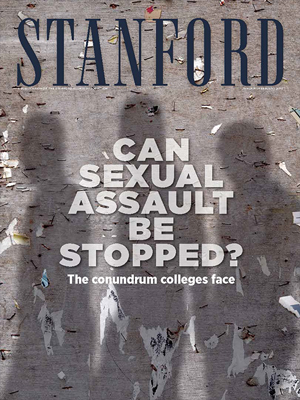
To answer the question posed on the cover, “Can Sexual Assault Be Stopped?” Yes, of course. It’s a matter of altering the costs and benefits of behaviors. Reinstituting curfews (for both sexes, if you like), eliminating coed dorms, requiring chaperones, prohibiting alcohol and drugs, and ruthlessly punishing violations would go a long way. Assuring that allegations of assault are turned over to competent civil authorities and prosecuted vigorously would help. Maybe we as a society—and students in particular—wouldn’t like this. But, to borrow a phrase, if we continue to do what we are doing, we will continue to get what we are getting.
Alvin Thomas King, ’66
Fayetteville, Arkansas
What justification can there be for not expelling perpetrators of sexual assault? Tolerating the presence of a sexual predator means consigning the victim to a life of fear and hiding. Tolerating the presence of a sexual predator means endangering other students who may be subject to a repeat offense. (Some research shows sexual predators have attacked four or five victims before being constrained.) Expelling violent aggressors from Stanford will not “ruin their lives”—life goes on even if you have to go to Cal. The Stanford community needs to be a safe place for all students. Sexual predators need help, need rehab, yes, but not at the expense of the mental and emotional well-being of the other 99 percent of Stanford students.
“Catch and release” makes sense for trout. It does not make sense for sexual predators. It is shameful that it has taken a federal crackdown and a California state bill to bring Stanford’s attention to the issue of sexual assault.
Allyson Johnson, ’66, MA ’67
Los Altos, California
The cover question—“Can Sexual Assault Be Stopped?”—was not answered by the article. The discussion sounded like journalistic mush to me, and the answer is no.
What has happened since I attended Stanford in the 1950s? Sexual assault was not even on the agenda, most likely because sexual relations were not casual, as they are today. For the most part, male students only dreamed about sex. In today’s world, liberated women are as eager as men.
In those days, “in loco parentis” was considered part of the university’s responsibility, which meant that if you misbehaved, count on being in trouble without lawyers or pseudojudicial proceedings conducted by persons who are incapable of conducting such procedures in a touchy matter like sex. If the matter was serious enough, the president of the university stepped in.
Now Stanford, under pressure from the Feds, is faced with enforcing a code of conduct that ought to make any male student quiver. Look at a woman the wrong way or say something that she considers offensive, and you are in trouble. He said, she said: Who is to be believed? The ability of Stanford to fairly adjudicate sexual assault issues is mostly a fantasy. This is a matter for the public authorities. Inevitably, attempts to legislate personal interactions lead to speech codes with free speech implications. Oh, what a mess! To make matters worse is California’s definition of sexual assault. Stanford will have an even tougher time of deciding if anyone said “yes” and when. Good luck.
Jackson McElmell, ’56, MA ’57
San Francisco, California
The problem with relaxing the evidentiary standard, and conducting trials using students and faculty members with no legal training, is that more students will be falsely found guilty of sexual assault. A campus conviction can lead to expulsion and a permanent record of sexual assault, which could brand the convicted student for the rest of his life. These are serious punishments that should require the same evidentiary standard as that of the U.S. criminal justice system.
Sexual assault is a matter that should be dealt with in actual courts of law, handled by trained lawyers and judges. Yes, sometimes prosecutors choose not to take cases on, because the evidence is insufficient to prove guilt. This means that sometimes guilty persons get away scot-free, but that’s the way the system works. Our judicial system is built upon the principle of presumption of innocence.
While Stanford must of course address allegations of sexual assault with seriousness and alacrity, the rights of the accused should never be sacrificed. It is disturbing to learn that a university of Stanford’s caliber does not see fit to protest against the infringement on students’ due process that is inherent in the lowering of the burden of proof imposed by the Department of Education.
Marjory Kaptanoglu, ’78
Belmont, California
The state (lowercase intentional) of California only made it worse, it seems. Stanford’s definition of sexual assault? OK as far as it goes. The components/steps of sex aren’t defined. It does start with hand-holding, the stolen kiss, an embrace, the French kiss, the hand on the knee, the nervous other’s fingers on the zipper or garter, etc.
No is declarative, positive. Yes is tentative, reversible afterward, and is a problem. When does the action stop? When one participant stops gasping “yes, yes, yes”? Does “more, more” equal yes; does “Don’t you dare stop” equal yes? There’s no question at No! Been there, heard that.
I’m glad that I started in the late 1920s and ’30s; we knew what no meant. I’m glad to be leaving this knotted, societal mess before long.
The proper lady, young or older, should be very discerning about those with whom she associates, to remain proper.
I hope you youngsters can figure it out!
M. Frederick Gates, Gr. ’63
El Granada, California
Colleges are bound to fail in stopping sexual violence on campuses when the interpretation of Title IX has forced colleges to investigate and adjudicate crimes on their own, as the Foundation for Individual Rights in Education has recently noted. Educational institutions should not be determining guilt and punishment in a criminal case based on a “preponderance of evidence”; that should be left to law enforcement and civilian courts, who have the necessary resources to do so. Is it any wonder that, for the same crimes, inconsistent decisions are made by the Title IX panels of various schools? The problem lies with Title IX. Fraternities and sororities, by their very nature, encourage groupthink, which can often perpetuate prejudicial sexual attitudes. At their worst, their members damage other students through hazing, peer pressure and intolerance, which can encourage sexual misconduct. Rather than enlist their help in changing sexual attitudes, colleges would be better off removing their on-campus presence altogether. The role of the college should be to ensure the safety of accuser and accused, and to provide as much training, counseling and protective services as they can afford. They should assist law enforcement in their investigations of sexual crimes on campus. They should not be passing judgment and meting out punishment, however. And isn’t there also a conflict of interest here?
Philip Tone, ’75
San Diego, California
The opening paragraphs of this article cite preposterous figures for the percentage of students who have been raped or experienced “unwanted sexual contacts”: 10 percent raped, 35 percent unwanted contacts. Even the much smaller number of 5 percent cited in national news media in recent months has proven to be seriously exaggerated. When examined by the Foundation for Individual Rights in Education, the 5 percent figure could only be reached by including off-color remarks or pats on the butt as “sexual assaults.”
This whole “crisis” has been manufactured by the feminist bureaucrats at the DOE’s Office of Civil Rights, to whom the Congress has unwisely delegated its lawmaking powers.
The fact that the bar for destroying the future prospects of male students has been arbitrarily reduced from “guilt beyond a reasonable doubt” to “preponderance of the evidence” in order to get more “convictions” speaks volumes. The odds against men are further stacked in these university courts by the widespread prohibitions of the accused being able to confront the accuser face-to-face or being represented by an attorney.
I understand that the Office of Civil Rights has a huge axe it now holds over universities: the loss of all federal money. And I understand that Stanford currently has no choice but to play by OCR rules.
But that does not mean that Stanford cannot join forces with other universities to fight these unjust federal impositions. If they do not do so, what will be the next area of university governance that federal bureaucrats will take over?
Tom Macdonald, MA ’65
Carmel Valley, California
I read the article on sexual assault with great interest. It is indeed a difficult issue to address at Stanford and in society. While sexual assault claims can be murky due to the use of alcohol or drugs, or the previous relationship between the alleged victim and attacker, the present culture around reporting sexual assault often leaves victims feeling marginalized by their school, their community and the process, in one of their greatest times of need.
Often the credibility of victims’ stories is questioned, and the circumstance of whether they were asking for the attack by engaging in drinking or partying arises as relevant information, despite the fact that it does not justify any assault or harmful act against them. Victims are often pushed out of or revictimized by a system that is meant to protect them, as panels search for justice with a preponderance of evidence. Due to the difficulty of these cases, it is best to have only trained professionals on the panels.
While Stanford has been working hard to increase sexual assault awareness and prevention by holding town halls with graduate and undergraduate students, and is in the process of hiring two professional sexual assault counselors, there is still much to be done to ensure that those who speak up and safely intervene are supported.
Some steps Stanford could take today are increasing psychological support for victims through Counseling and Psychological Services (CAPS) by hiring medical professionals trained in sexual assault counseling and then indicating this expertise with a symbol at the end of their names, as the website currently highlights professionals with special training in gender and sexual identity with a rainbow flag.
Furthermore, Stanford can align definitions of sexual assault with other universities, so statistics can be compared, and share best practices of addressing sexual assault across campuses.
In regard to perpetrators found guilty, they should be held accountable for their actions so students and society see that an environment where sexuality is used as a weapon will no longer stand. Perpetrators should also undergo offender treatment, as they may become repeat offenders posing a risk to society.
As Stanford and campuses across the U.S. continue to reform sexual assault policies and embolden services for survivors, we must consider what it is we expect from our alma maters legally and morally. Title IX dictates their legal responsibility, and the community defines the moral standard, which can be both more rigorous and amorphous. In Latin, alma mater means “nourishing mother,” and for the Stanford family that is the role its campus and services are expected to fulfill.
I encourage Stanford to not only focus on preventing sexual assault through awareness programming, but also, and importantly, to strengthen counseling and resources for victims after assault occurs. In doing so, Stanford may assuage the dark legacy of sexual assault, by helping victims rebuild their sense of self, of security and of trust, ensuring that while an attack will deeply alter the path a student will take, it can impart new power and community.
It is on all of us to ensure that our communities are strong and that we look out for one another. As it is on Stanford’s leadership to protect its students by fostering a campus where those who stand up and report sexual assault are valued, as they are champions for change and a just society.
Antonia Sohns, ’10
Washington, D.C.
You report that Stanford’s campus judicial board process from 1997 to the present held 18 hearings and found 10 people “responsible.” The 280 complaints during the same period were presumably a fraction of actual assaults, if they reflect rape reports in the outside world. Is this a picture of a safe campus?
When it comes to instances of student/campus rape, I propose the following changes in culture and procedure.
In any complaint of nonconsensual sex, the victim has the preliminary burden of coming forward with physical evidence of sexual contact and some evidence of lack of consent, ideally an official rape kit and police complaint, plus photos of scratches, cuts or bruises. This protects the complainant from being suspected of lying and protects the accused from completely unfounded accusations. It forces the victim to come forward immediately, while recollections, context and injuries are fresh. Victims must learn that passive resistance is dangerous; they are responsible for active resistance or some explanation of their lack of competence. (Blood-alcohol tests? Testimony from friends? DNA under the fingernails?) Students must learn that you don’t go home after a rape and take a shower before you tell your roommate. The failure to come forward and make an immediate complaint with physical evidence creates a presumption against its validity.
If there is physical evidence of sexual contact, then the accused has the burden of showing consent, particularly in the form of a previous consenting sexual relationship. [“We’ve been dating” with photos and messages.] This protects the accused from some rewriting of history but can be rebutted with evidence, preferably written, that the relationship was over, or with evidence of either resistance or incompetence. An official written breakup notice is a good thing.
In instances where the assault takes place between near-strangers and involves alcohol, there is a presumption that the sex was not with informed consent. This puts potential rapists and excited young people on notice that casual sex with drunken strangers (an unfortunately typical scenario) is extremely dangerous to them personally. They should plan their parties and dates accordingly. They should pull back from any sign of resistance or mental incompetence. They should seriously limit their sexual encounters to documented, consensual, ongoing relationships. The standard should be “Meet at the party, but don’t screw. Date first and use a condom.”
The penalty for nonconsensual sex is immediate suspension and loss of credit for the current quarter or semester. This is a significant cost, but without the life-changing implications that make judicial boards reluctant to recommend expulsion, which should be reserved for serial or violent offenders.
Peg Healy
Albany, California
I read the tabloid [cover] headline “Can Sexual Assault Be Stopped?” with horror. My alma mater appears to be either 1) grasping at sensationalizing these tragic crimes to sell magazines, or 2) completely losing its way in terms of leadership for women, or both. The cover headline is a glorification of doubt and impotence.
If you believe rape is evil, then you should learn from your very own Professor Phil Zimbardo, who points to the institutional responsibility in preventing evil. “You’ve got to act when other people are passive” (TED talk, February 2008).
Sexual assault is a crime. And with all crimes, the victims and the accused deserve their fair judicial process. But for Stanford to titillate with a cheap cover instead of a moral focus on creating a campus where sexual assault is unimaginable is a sign that my beloved college is losing its way.
Anne Bonaparte, ’79
Mill Valley, California
Thank you for “Untangling the Knot” in the January/February issue. Your article clarified several key points about how it is that academic institutions get mixed up in adjudicating rape cases involving their students. This Title IX issue had not been adequately covered in the national press; there, you were left to wonder what on earth schools thought they were doing in a kind of weird parallel universe to the criminal justice system.
But having read about the requirements in addition to all the recent stories in the press about campus rape, I have to point out the irony here: Accused rapists—men—benefit from private Title IX tribunals more than women, who are supposed to be protected by Title IX regulations. It appears that the victims— women—are often persuaded to use the internal system rather than go to the police, but then they are shown by these panels of “judges” that the trauma of their sexual violation is less important than the potential trajectory of academic, or sports or life glory of the rapist. I can’t imagine what it’s like to have one’s experience of sexual assault translated into an abstraction that occurred “more likely than not,” so it becomes just a story that can be manipulated into a compromise, meaning no real validation for the victim. Now her sense of justice is violated along with her body. Does this sound familiar? That’s what it was like 40 years ago in the big world, before advocacy groups were formed to support rape victims.
The internal “judicial boards” also struck me as, well, elitist. I keep thinking about that parallel universe, where a young man of the same age and profile but not a student, is accused of sexual assault. That guy goes through the real justice system, which can be brutal. I don’t wonder about an institution wanting to protect its own—certainly I would want to protect my own child—but is it justice in the greater sense that for the same crime one young man’s worst outcome is to be expelled from school, while his counterpart faces prison?
I just read in the New York Times that some sororities have decided to handle the issue of rape in a different way: They plan to host parties in their own houses, or at other sites, and serve alcohol, avoiding fraternity parties. The article said that these sorority parties have female bartenders, chaperones, door keepers and, apparently, they attract eager partygoers. I hope this works. I’m an old lady who delights in the power women can find in themselves to work out very difficult situations with dignity and creativity.
Lisa Volckhausen McCann, MA ’65
Redding Ridge, Connecticut
I am deeply concerned about the pressure to, in a perfectly good cause, abandon the presumption of innocence that is so important in our system of justice. Isn’t that pretty much the premise of To Kill a Mockingbird? Atticus Finch is defending a young man accused of sexual misconduct. There were severe consequences to the young man, because, yeah, it coulda been the way she said it was.
Yes, I have been the target of workplace harassment that I didn’t report because it would have been he said, she said. But you can be sure I was never alone with that guy again. And no, when the football player invited me up to his room, I didn’t go, because anything I wanted to say or do with him could be said or done in public.
I don’t know how you can invoke life-changing penalties when you don’t have any way to know the truth. If we want to be free, we have to accept the risks that accompany our behavior. If I get drunk and behave irresponsibly in a car, the law does not protect me. If I’m impaired and/or make really bad decisions, the university cannot protect me.
Patrice Dick, ’74
Castle Rock, Washington
Paper Chase
I was a reporter on the Daily from 1941 to 1943 and remember the national panic after Pearl Harbor (“That’s Old News,” January/February). There was a lot of to-do on campus, including a fuss over blackouts, which were difficult to enforce. I remember a headline—for a story I couldn’t find Googling the archives—that read something like “Chancellor Wilbur Regains Penal Power in Blackouts.”
William C. Dillinger, ’47
Sacramento, California
Unfinished Business
I am grateful for the planning that went into the 45th reunion for the class of 1969 (Reunion Homecoming, Farm Report, January/February). Particularly powerful for me were the Class Panel followed by the retrospective on the ’60s with Bill Chase, Tobias Wolff and David Harris. As we thought of the 1960s and what was accomplished, we were proud. We remembered a sunburst of creativity, progress on civil rights, progress on women’s rights and an end to the war in Vietnam. What struck me most, though, was the fact that our generation is not old at 68 or 70 and that the struggles begun in the ’60s are still with us. What struck me is that it is not enough for us to feel good about the past. To use the metaphor of the Occupy movement, we Stanford grads of the ’60s are at least the top 5 percent of the country. We have been very privileged. So the question that emerged for me and my classmates and those at Stanford now is: What do we owe the 95 percent whose riches have supported us? And what will we do now to create the economic justice, racial justice, sustainability and peace that Martin King died for? That will be the true measure of the class of 1969. Our grandchildren await the news.
The Rev. Bryan Jessup, ’69
Arcata, California
Posthumous Broadcast
In a letter to the editor in the January/February issue (“Hoover Findings”), Donald Shannon, ’44, mentioned visiting Hoover Library and seeing a copy of Czar Nicholas II’s abdication speech transcribed as delivered over Radio Moscow, and he commented that he didn’t know that Radio Moscow existed before the revolution. It didn’t. Radio Moscow began broadcasting on September 17, 1922. Radio technology in 1917 was not sufficiently advanced to support general voice broadcasting.
Edward Conklin, MS ’65, PhD ’69
Honolulu, Hawaii
Kingscote and Kerensky
It was with a rush of nostalgia that I read the article on Kingscote Gardens in the November-December issue (“Stanford’s Own Mystery House,” Farm Report). I first saw Kingscote Gardens when I stopped off at Stanford on my way home to Virginia after five years in Japan. It was the spring of 1961, and I was looking for a place to live on my return to Stanford that summer to take up classical Japanese in what was then the Asian languages department. I had lived in very pleasant surroundings near the International Christian University campus in Tokyo, but one look at Kingscote Gardens took my breath away—the beautiful lawn, the trees and gardens just across the way from Lake Lagunita, the plush red carpeting covering the spacious first-floor lobby and extending up the stairway that led to the upstairs apartments.
On inquiry, I learned that there were no vacancies, but the manager put my name on the waiting list. Without hesitation, I threw away the list of possible lodging places I had been given by the Stanford housing office and began imagining myself ensconced in an apartment in Kingscote Gardens. (This was a procedure that had worked for me ever since I was a small child.) Sure enough, soon I received notification that a studio apartment with bath and kitchenette had become available. Perfect. My $5,000 fellowship easily covered the rent of $50 a month plus an extra $5 for indoor parking. (Annual tuition at Stanford was then $1,260.) Thus began an idyllic period of my life, in a quiet atmosphere only 10 minutes’ walk from my department.
Soon after I moved in, I began taking morning walks around Lake Lagunita. On one of those occasions, I overtook an elderly white-haired gentleman, dressed in a dark suit and tie. We exchanged greetings and fell into step and continued our walk in companionable silence. When we returned to Kingscote Gardens, I learned that we were near neighbors on our second-floor hallway.
In the ensuing days and weeks, we would on occasion meet up again on our morning walks. Though we never introduced ourselves, we continued to enjoy our quiet walks together, commenting on nothing more than perhaps some fauna or flora or the changing beauty of our surroundings as the seasons progressed.
It wasn’t until several months had passed that I learned that my morning companion and neighbor at Kingscote was Alexander Kerensky. When I later asked, he explained something of what he was doing at Stanford and in turn asked what I was up to, but our new knowledge brought no change to our usual outward demeanor. We continued to enjoy our occasional, no-questions-asked morning walks.
My idyllic days at Kingscote Gardens continued for only a year. My Stanford mentor, who had been appointed director of the recently established Stanford campus in Tokyo (now the Inter-University Center for Japanese Language Studies), invited me to return to Japan to continue my classical studies with him there.
It was difficult to leave my new home, its beautiful surroundings and the “morning friend” I had made there. Even today, after the passage of over 50 years, my heart warms whenever I recall that idyllic portion of my life.
John G. McCaleb, MA ’69
Woodstock, Virginia
I enjoyed Hannah Brown’s article in Stanford. I was one of the students who was fortunate enough in 1965 to take one of the two courses that Alexander Kerensky offered. I was required to visit him three times at Kingscote to discuss my paper for his class. I also took him to my fraternity (Theta Xi) for dinner and discussion with my brothers.
Thomas M. Flood, ’66
Danville, California
Farm Teams
Mike Antonucci and Kevin Cool are to be commended for their thoughtful and balanced article in the September/October issue (“Game Changer”). The problem they did not address, however, is the enormous heterogeneity among the NCAA’s Division I institutions in their approach to men’s football and basketball. When universities admit athletes outside their normal admissions processes, provide them with minimal content and minimal requirement courses, known by various descriptors such as “pipes,” in order to “comply” with the NCAA’s scholarly requirements, and know that the best of these athletes plan from the get-go to jump to the NBA or NFL after one or two years, the institutions become nothing more than farm teams for the major leagues. Yes, many alumni ignore this behavior, indeed commend it, especially if their universities’ teams are top-ranked and make it into playoffs or bowl games. But from my point of view, the institutions involved have sold their academic souls to the devil. Stanford’s principled approach is commendable, and maybe Stanford ought to lead an effort to identify Tier 1 institutions that share and practice its values and form their own league. The egregious behaviors of so many Tier 1 institutions invite the kinds of reactions like the lawsuit won recently by Northwestern University football players. Why shouldn’t these farm club athletes be paid?
David Korn
Professor and founding chair of pathology, emeritus
Past university vice president and dean of medicine
Boston, Massachusetts
Money, especially TV money, is having a disastrous effect on college football, at least in the opinion of many of us crusty traditionalists. Maybe Stanford deludes itself (along with a few other soi-disant elite schools) that its roster is chock-full of “student/athletes,” but it’s really about whether your mercenary behemoths can beat ours. Though it wouldn’t entirely solve the problem, one simple way to reduce the astronomical costs of college football would be to return to single platoon football, which would shrink the roster and all the attendant costs significantly. It would also be more fun to watch and would differentiate the game from the bread-and-circus reality of pro football.
Doug Glant, ’64
Mercer Island, Washington