The week after he moved from Texas to join a lab at the Stanford Cardiovascular Institute, Nazish Sayed was blindsided by a headache so intense it changed the course of his research—and his life.
“I went back home, slept, and the headache did not go away,” says Sayed, a stem cell biologist and an associate professor (research) of surgery. “I started throwing up.” His wife was out of town, so he called his cousin to take him to Stanford Hospital. It was May 2015, and it had only been a year since he’d undergone chemotherapy treatments and surgery for bladder cancer.
“The first thing I thought was that the cancer had metastasized,” Sayed says. But the results of a CT scan ruled that out. Instead, Sayed had developed clots in the veins of his neck that were blocking blood flow from his brain to his heart. Had he waited a day or two to see a physician, those clots could have caused a stroke or a heart attack. He was immediately put on blood thinners and soon went home. But his ordeal was far from over.
Today, Sayed is among the 5 percent to 20 percent of cancer patients in the United States who suffer from cardiotoxicity, damage triggered by the chemotherapy drugs that save lives but can also wreak havoc with the heart and its vessels. As more people with cancer live longer thanks to improved treatments, these same treatments can cause serious complications—an unintended consequence fueling a new medical specialty known as cardio-oncology.
“I absolutely did not think about this when I was taking the chemotherapy drugs,” Sayed says. “As a cancer patient, I kept my scientist hat away. I didn’t care what the drug was. I just wanted them to cure me.”
When Sayed’s mentor Joseph Wu, a professor of medicine and the director of the Cardiovascular Institute (CVI), walked into his hospital room that day in 2015, he said, “Let’s try to figure out what happened.” Wu suggested that Sayed consider contributing to the lab’s research into cardiotoxicity—hunting for molecular causes and potential cures. Something clicked with Sayed.
“I made this my mission—not only to do this research but to make people more aware that there is much more to cancer treatments,” Sayed says. “I’ve gone through the gauntlet myself. I not only had cancer, which I’m free of now, but I still suffer from cardiotoxicity. I still get clots in my head. I live in fear of having a stroke. This is like a ticking time bomb.”
From physician to patient
Sayed didn’t set out to become a researcher. During medical school at the University of Mumbai, he was planning to specialize in cardiology. But over time, he gravitated toward understanding disease mechanisms as a scientist. In 2010, he came to Stanford for postdoctoral work in cardiovascular and regenerative medicine. After completing the program, he moved to Texas with his wife, Mehvish, and their 3-year-old daughter, Zara, to launch his career at Houston Methodist Research Institute. Before the year was out, however, he was hooked up to a chemotherapy drip.
“My back had started to hurt,” he says. “Then it became debilitating. My wife took me to the emergency room. I thought it was a kidney stone.” Tests showed a growth in his bladder. Next came the biopsy, then the cancer diagnosis. He sought care at UT MD Anderson, and his treatment plan consisted of chemotherapy followed by surgery to remove his bladder and prostate, which would leave him infertile. “The doctor was pretty blunt,” Mehvish says. “You don’t do this, and your chances of survival are very low.”
‘I still get clots in my head. I live in fear of having a stroke. This is like a ticking time bomb.’
Like many cancer patients, Sayed was given multiple medications designed to attack his particular type of cancer. He underwent four rounds with four different drugs that included traditional chemotherapy drugs, which kill rapidly dividing cells indiscriminately, as well as tyrosine kinase inhibitors (TKIs), which can home in on and block specific signals that tell cancer cells to grow and multiply.
After five weeks of recovery, Sayed returned to work. In August 2014, he published a study in Circulation on the transformation of certain skin cells called fibroblasts into endothelial cells, which line the inside of blood vessels—research that would one day inform his studies on cardiotoxicity. In November, Sayed met Wu at a conference, where they discussed his medical condition and his research interests. Intrigued by Wu’s work—and with greater family support in the Bay Area—Sayed raised the possibility of conducting research at Stanford.
“I hired him to work in my lab,” Wu says. But shortly after Sayed arrived at CVI, he ended up in the hospital.
When lifesaving becomes life-threatening
The field of cardio-oncology has expanded in recent years, alongside dramatic improvements in cancer treatments, says June-Wha Rhee, a former postdoc in Wu’s lab and now an associate professor of cardio-oncology at the City of Hope in California. While most patients are familiar with common chemotherapy side effects, such as hair loss, nausea, and diarrhea, she says there should be greater awareness of a far more serious side effect: cardiovascular disease.
“The important thing is to allow patients to receive these lifesaving treatments,” Rhee says. “But we need more treatments for cardiotoxicity, preventive strategies. Right now, there are no treatments for this.” Different cancer treatments cause various types of cardiovascular disease, from irregular heartbeats and high blood pressure to heart attacks and vessel damage. The toxic impact of the drugs can be immediate or take decades to emerge.
At Stanford, Wu’s lab has led the way in early research into cardiotoxicity, publishing dozens of articles on the molecular mechanisms that result in the disease. In 2016, a study on efforts to predict which breast cancer patients treated with doxorubicin, a traditional chemotherapy drug, are at highest risk of heart failure, triggered a flurry of research in the field. “Cardiotoxicity has gained more recognition as a real disease,” Wu says. “Ten years ago, Stanford didn’t have a cardio-oncology unit. Now we have a clinic staffed by three faculty. There’s been an explosion in research across the country.”
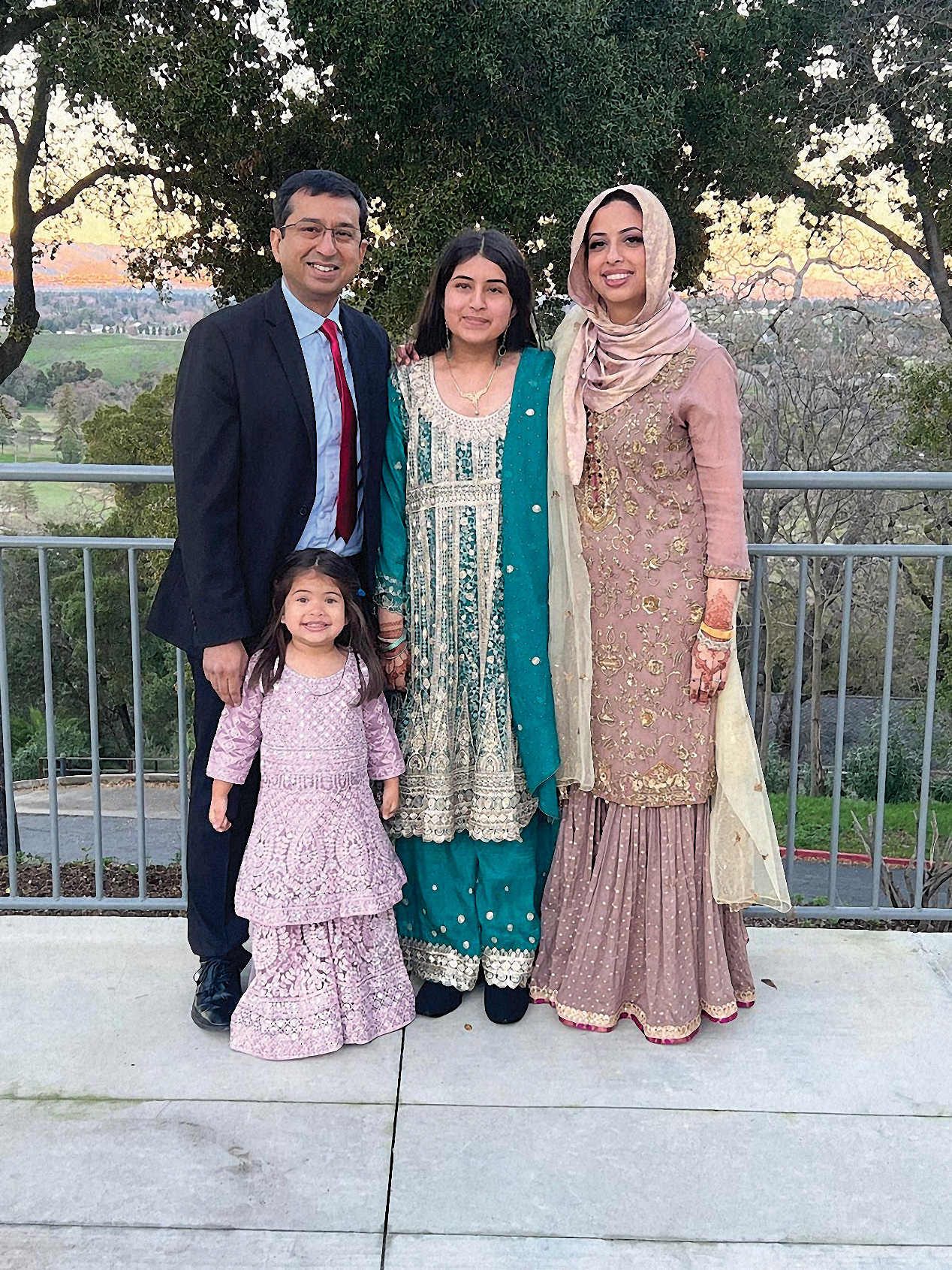 ‘I MADE THIS MY MISSION’: Sayed, with (clockwise from center) Zara, Mehvish, and Zainab, studies cardiotoxicity in patients like himself. (Photo: Courtesy Nazish Sayed)
Sayed spent six years in Wu’s lab contributing to about a dozen studies on cardiotoxicity that investigated both traditional chemotherapy drugs and TKIs. In 2021, he opened his own lab and started a new study to test a theory of his. Scientists understood from past research that cardiotoxicity could occur, but precisely how it happened remained unclear. Sayed wanted to investigate whether a disruption in the functioning of endothelial cells was contributing to vessel damage that, in turn, could lead to blood clots or high blood pressure.
In September 2022, after seven rounds of IVF, Sayed and Mehvish welcomed their second child, Zainab. They bought a new house in Union City, California. Sayed was grateful to be cancer free and, seven years after his blood-clot episode, he was hopeful the cardiotoxicity was also behind him. “OK, things are moving along,” he remembers thinking. “All of a sudden, a headache starts, and it doesn’t end after three days.” A trip to the ER and an MRI revealed another clot in his neck. Again, he was prescribed blood thinners, and he went home with the realization that he had a chronic condition.
“That was pretty depressing,” he says. “I’m still reeling from it.”
Mapping a new path
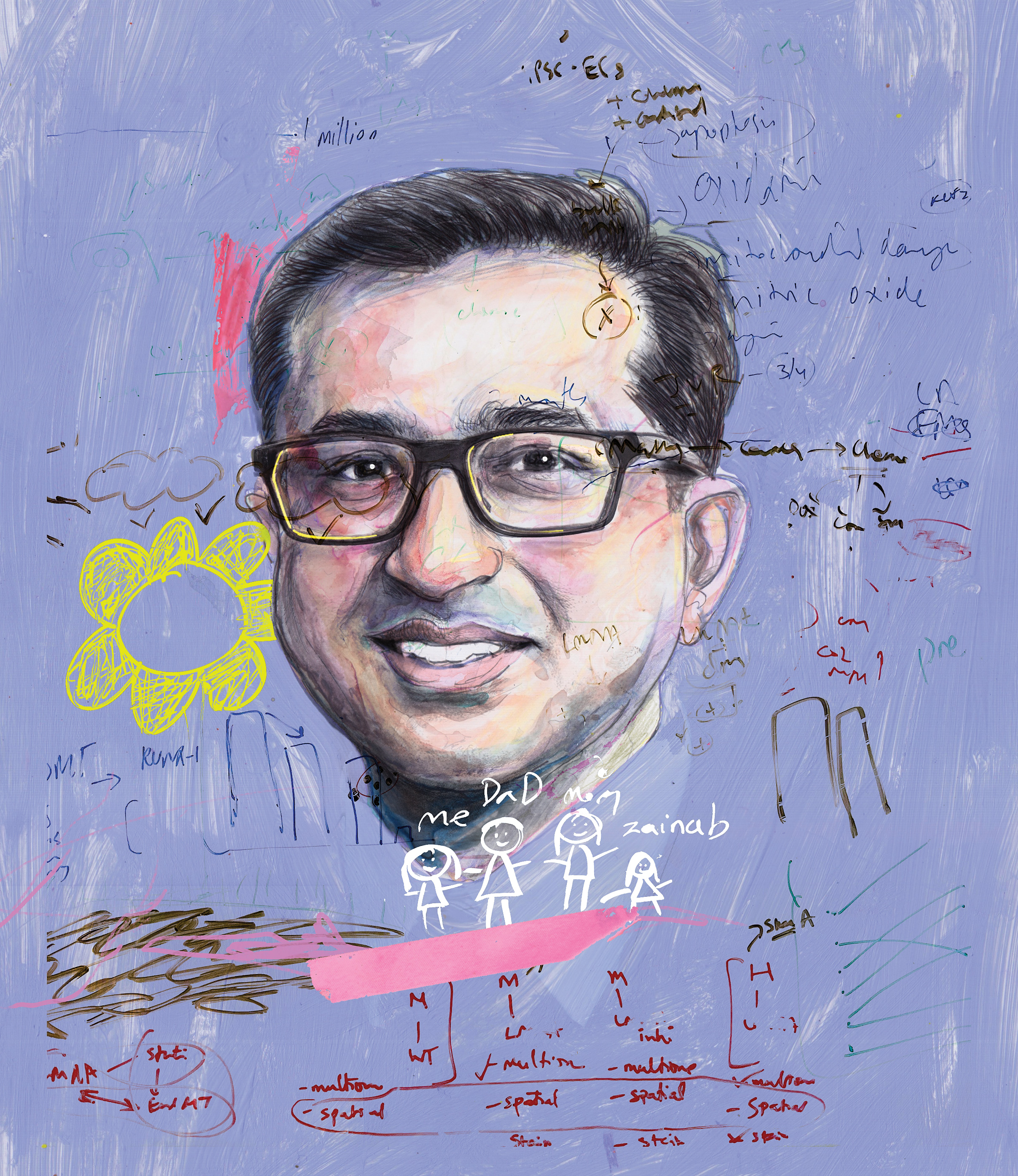
Sayed is seated in his office in Stanford Medicine’s Biomedical Innovations Building. Across from his desk is a whiteboard with a child’s drawing of a mother, a father, and two daughters. Zara, now 13, drew it years ago. Sayed has kept the portrait amid the swirl of constantly changing scientific equations to remind him of what’s most important.
In December, he published his lab’s first study on cardiotoxicity in Science Translational Medicine, including a proposal for a pharmacological treatment to prevent TKIs from causing cardiotoxicity.
“First, we made the patients’ vascular cells in the lab and then exposed those cells to chemotherapy,” Sayed says. The scientists also tested the drugs on lab-grown cardiac organoids—miniaturized models of the human heart derived from stem cells—as well as in animal models. Healthy endothelial cells line the insides of blood vessels like sardines, organized and aligned and all oriented in the direction of blood flow, he explains. But the drugs caused these cells to become disorganized and misaligned. In the human body, this could impair how blood vessels sense and respond to flow and communicate with surrounding tissues. Over time, that impairment can contribute to vascular stiffness, elevated blood pressure, and ultimately heart dysfunction. The scientists showed that certain cancer drugs disrupt a key molecular sensor in these endothelial cells that helps them respond to the physical forces of blood flow.
Next, the researchers tested potential drug therapies on the damaged cells in the lab and in animal models. They found that a molecule called Yoda1 can reactivate the molecular sensor and restore cell function. In the future, Sayed says, targeting this sensing function could help protect patients from cardiovascular side effects during cancer treatment. The research points toward a new strategy for making cancer therapy safer without reducing its effectiveness, he says. But the studies are still early stage. To transition their discovery into a viable treatment, Sayed’s team has filed a patent to convert Yoda1 into a drug suitable for testing on animals and, eventually, humans. In the meantime, Sayed is delving into the genetic causes of cardiotoxicity.
“Why doesn’t everyone who is treated with these drugs get the disease?” he asks. “It must be in their genetics.” His lab has started genetic studies that could one day be used to determine which cancer patients might be prone to drug-induced cardiotoxicity. It could help guide oncologists’ decisions on which medications to administer to which patients and at what levels, he says.
Sayed says he still struggles with depression and the fear a sudden blood clot could trigger a stroke or heart attack. He worries about what would happen to his family if he were to die. Last year, he published an essay in JAMA that describes the emotional roller coaster of his cancer diagnosis and living with treatment-induced heart disease. Many readers going through cancer treatment responded, thanking him, he says. “Like many survivors of cancer, I continue to live with the consequences of life-saving treatment,” Sayed wrote in the essay. “The fatigue, the vascular fragility, the anxiety before every scan. These are not abstract issues for me. They are part of my daily life.” His work to identify an intervention that could prevent cardiotoxicity helps him find value in the challenges he’s faced. “I can’t cure cancer, but I study cells,” he says. “Maybe through this work, I can help find treatments that spare other people from the suffering I experienced.”
Tracie White is a senior writer at Stanford. Email her at traciew@stanford.edu.