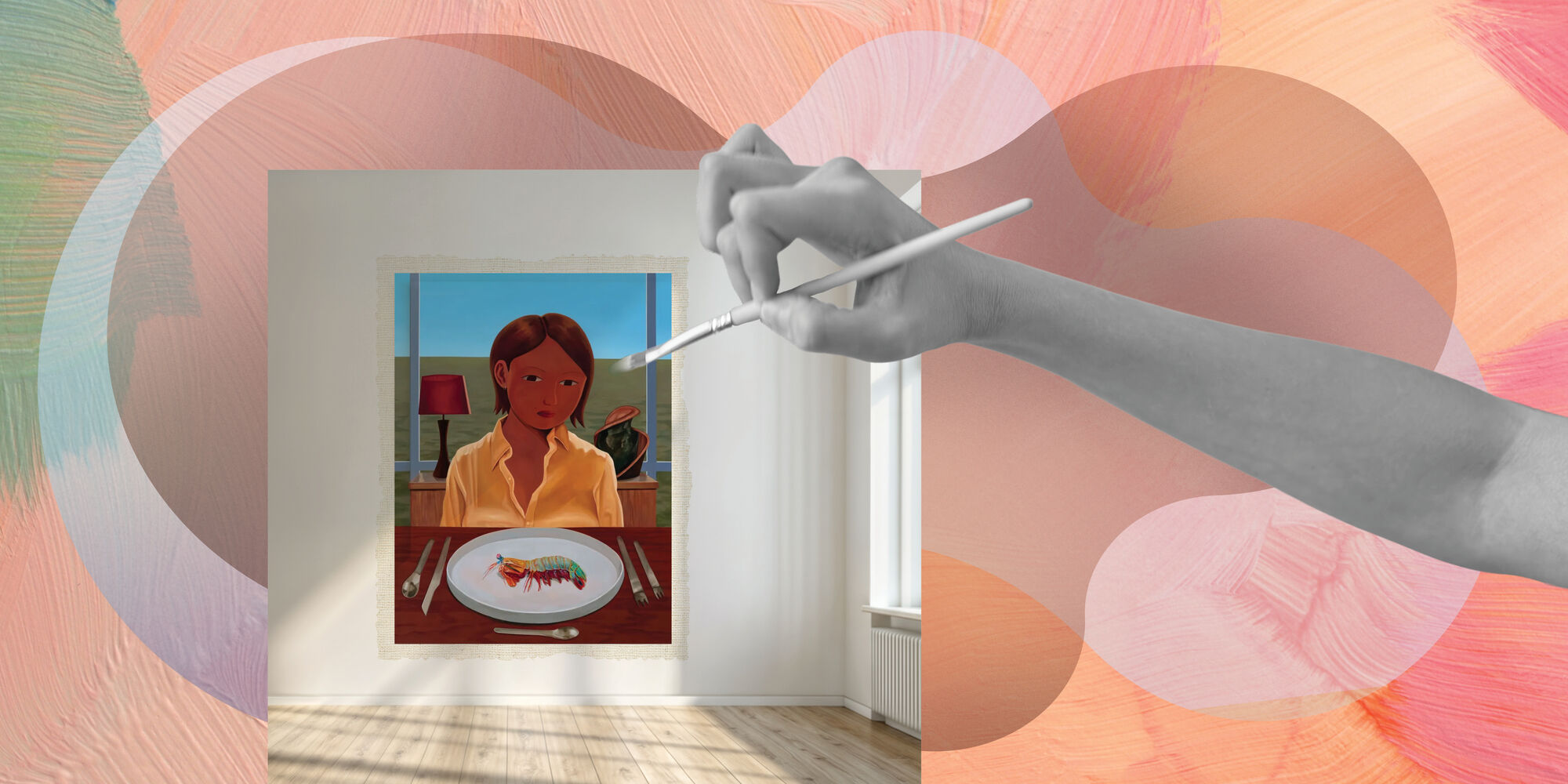
Sometimes The Simpsons, sometimes anime—cartoons were L. Song Wu’s introduction to art. When she was 6, she would watch her older sister do art assignments and then imitate them. By fourth grade she was making her own cartoons and manga. “I really enjoyed the narrative,” she says. Her dream of being a professional comic artist guided her until senior year in high school, when she began painting. “It felt a lot more manageable than making a comic,” she says. “I got too in my head when I made comics. I started a ton but could never finish them.”
Painting it was. In high school, Wu, ’23, was perusing Tumblr when she discovered Ren Hang, an artist known for his portrait photography of nude Chinese people in surrealist settings. “If I could pinpoint it, my approach [to figuration] would definitely be all due to him,” she says. “I love how sensitive and repulsive his work can be. That entanglement is what I aim to portray in my own work.” As a junior at Stanford, Wu was inspired by the Asian American Art Initiative, which inspired exhibitions at Cantor Arts Center and other spaces, and she reached out to a gallery attendant about showing her own work at the McMurtry Building for Art and Art History. Her exhibit included larger-than-life anime figures and modified self-portraits. Since then, Wu has shown her work in the United States and Europe, including at Elsewhere, her solo exhibition at IRL Gallery in New York in 2024, and at the Story Time exhibition at Rhodes Contemporary Art Gallery in London in 2025, which featured four contemporary female artists.
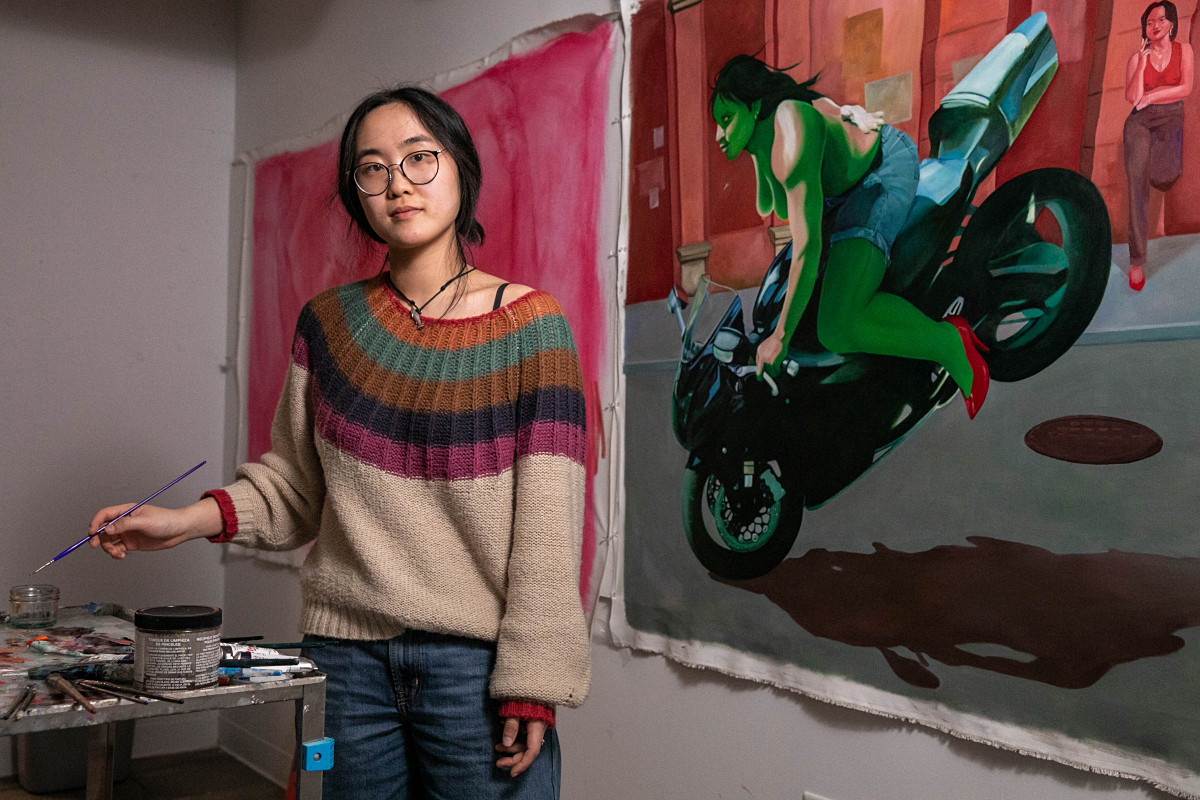 THE APPROACH: Wu painted “Stunter” for her senior honors exhibition from a studio in Stanford Art Gallery. (Photo: Krystal Ramirez)
Today, Wu works as the program coordinator at Stanford’s Institute for Diversity in the Arts (IDA). She spends nights and weekends cultivating her portfolio. She seeks to tell stories with her figurative paintings and sculptures, sometimes leaning into humor or surrealism to make a point. “I’m really interested in discomfort, confrontation, and alienation,” Wu says, “and how the viewer or spectator can be implicated, where you’re actively a part of the scene—or you’re being rejected from it.”
STANFORD: What were the steps you took to establish your work in the art community?
Wu: I reached out to the person who manages all the exhibition spaces at Stanford, wrote up a proposal, and submitted it months ahead of time, because they follow a pretty strict calendar. I set up a small exhibition in McMurtry, in the Miller Exhibition Space, of five paintings.
From there I was eagerly trying to get as many people I knew in the arts to see it. It was really serendipitous that one of my friends was visiting and suggested that I reach out to a gallery that he had been working with. He was like, “Send them a PDF of all the works here and a write-up.” I didn’t hear back for months, and then they followed me on Instagram and DMed me to set up a phone call. And from there on, they were like, “Let’s do a solo show.” I think I just got really lucky, honestly. With that being said, though, I think there are a lot of things that you can control as an artist, and one part of it is just doing the footwork. My first big push was visiting galleries in the Bay Area to understand the landscape more.
What does your job look like day-to-day?
As a program coordinator at IDA, I feel like my job branches out into so many different tendrils. I manage operations: the day-to-day finances, getting visiting artists paid, getting honorariums paid out. I also manage our student staff team. I handle a lot of the administrative logistical tasks, and I also help out with installing work. This year we did an off-campus art show for a culminating student project at a gallery in San Francisco. That’s always been a big passion of mine—hosting these really big all-campus-inclusive off-campus art shows. I’m always happy to bridge the Stanford arts into a larger dialogue with the Bay Area art scene.
I’m really lucky that, at my workplace, everyone is an artist. I work among creatives, and they’ve been really supportive of my goals outside of working there. For example, I just came back from an artist residency in Yosemite and was working remotely while I was there, and two of my colleagues were also at artist residencies during that time. From 9 a.m. to 5 p.m., I’m there working, and at home I focus a lot of energy on painting and making art. I am currently working out of my apartment. I paint on unstretched canvases on my wall. Everything starts out as a vision, and through the translation of ideas to sketches to realized painting, sculpture, or drawing, so much is lost but a lot is learned. I use a lot of reference photos for my work, but I’ve been slowly relying on them less and less.
It feels like I’m working two full-time jobs sometimes, but honestly, I wouldn’t have it any other way. My weekends are basically dedicated to making art and, being on an academic calendar, the summer and the winter are not busy for us, so I get a lot of time then to just grind.
What have you discovered to be the biggest challenges and the biggest joys of being an artist?
The day-to-day challenges are time and space. It does grind away at you when you have other obligations and still want to find time to make art. I want to have a healthy social life, I want to still be active, I want to have money that can pay for my rent and my groceries, I still have to cook and clean, and I still have to make time for art. I think of myself as kind of a Type A person, but for a lot of artists who are not Type A, the whole logistic aspect of being an artist can be a huge challenge.
I also think being young is not always easy for being an artist, because you have to accept that there’s so much that you just don’t know, that there’s so much growth that needs to happen to you organically, and you can’t just rush into being an amazing, wise sage of an artist. You just need to live your life a little and let the art kind of move through. You’re a medium for art, you know?
The joy of it is that being an artist is very special. Your life kind of moves up and down, but I prefer it a lot more than if my life was just, like, [holds her hand flat] all the time. You can translate something that didn’t exist before into something real in front of you now, which feels like magic.
What are your hopes for the future?
That I get to keep making work and keep getting an opportunity here and there to exhibit. I hope that my fellow artists and writers and friends who want to be singers and musicians and actors all make it. One of my dreams in life is to run an art residency. I want to publish a comic. And run a shop for my artwork, and of other artists and designers whose work I admire, that anyone can own, that’s not costing thousands of dollars. And make my magnum opus, or make really weird exhibitions, [and] meet more of my heroes.
Any advice for aspiring artists?
I really suggest thinking about a body of work, where you’re going to make X number of pieces that are exploring this one thing. I think it’s a good exercise in trying to be cohesive and seeing where a deeper exploration on one thing can lead you.
My last advice is not to rush things. I took a very linear approach to having an art career because I think that’s logically how a lot of people who are risk-averse would interpret how to be an artist. Make this number of paintings, try to get into a gallery, move up a gallery from there. You have this trajectory in your head of what it takes to get to where you want to be. But once you are able to take a step back, you realize most people are not “making it”—as in being a full-time artist—when they’re in their 20s. I had this advice from a gallerist years ago, who said, “Being an artist is a marathon, not a sprint.” The longer that you persevere, the more likely you are going to get opportunities. It will come to you if you just keep chipping at it.
Georgia Allen, ’28, is an editorial intern at Stanford. Email her at stanford.magazine@stanford.edu.