On the basketball court, Jason Collins’s impact could be subtle for a nearly 7-footer. The center—who helped the New Jersey Nets to back-to-back NBA finals in his first two years in the league—was sometimes dubbed a “no stats All Star” for the way his teamwork and defensive presence could change games without showing up in box scores. But it was an explicit act of bravery late in his 13-year pro career that would define Collins’s greatness beyond all else. “I’m a 34-year-old NBA center,” he wrote in the cover story of the May 6, 2013 issue of Sports Illustrated. “I’m black. And I’m gay.”
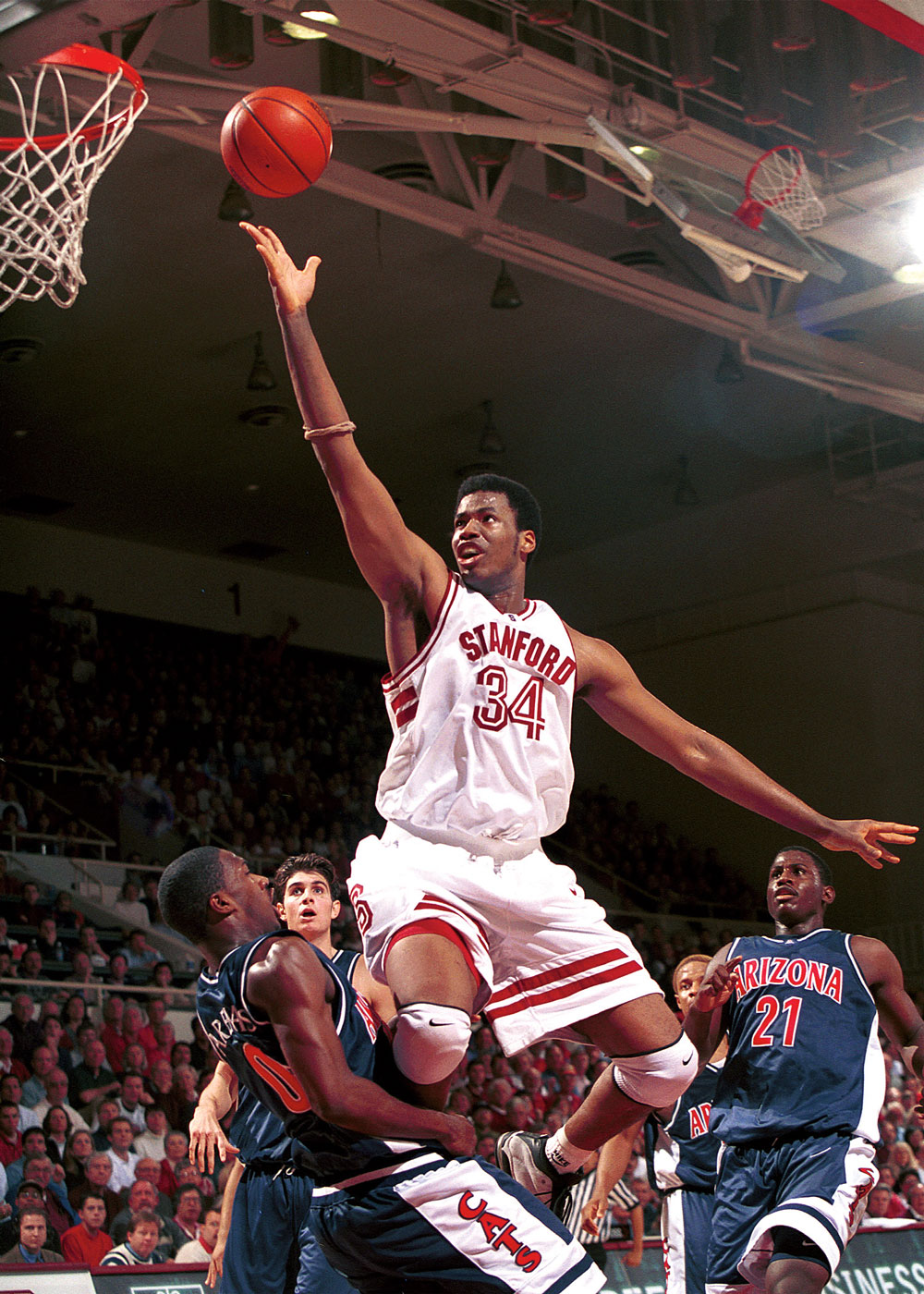 Photo: David Gonzales, ’93/Stanford Athletics
With that, Collins, ’01, became the first openly gay male athlete to play in one of the Big Four American professional sports leagues. Collins was then a free agent—the NBA season had just ended—and it was unclear whether his revelation would impact his ability to sign for a new team. But he was largely embraced by everyone from President Barack Obama to NBA star Kobe Bryant to Tim Hardaway, a retired NBA great who’d previously made headlines for homophobic remarks. When Collins took the court for the Nets for the first time the next season—his last before retiring—the crowd applauded. Two days later his jersey topped sales on NBAStore.com.
“My message to other athletes, period, is just be yourself,” he said at the time. “Never be afraid or ashamed or have any fear to be your true authentic self.”
Jason Collins—a Stanford Hall of Famer who still holds the school record for field goal percentage—died May 12 of glioblastoma. He was 47. After his death, the website OutSports declared him a trailblazer “who had opened more closet doors in sports than anyone will ever know.” Even today, it’s a door not many professional male athletes have passed through. There are currently no openly gay active players in any of the four major U.S. men’s professional sports leagues.
After retiring from basketball, Collins became a public speaker, inclusion advocate, and ambassador for NBA Cares, the NBA’s outreach program. In May 2025, he married film producer Brunson Green, his partner of more than a decade. That summer, Collins began experiencing memory loss, difficulty concentrating, and other symptoms that led to the discovery of a brain tumor.
In December 2025, he returned with another powerful first-person essay, this time as told to Ramona Shelburne, ’01, MA ’01, of ESPN, to reveal the gravity of his situation and to reflect on his decision to come out. “I can honestly say, the past 12 years since have been the best of my life,” he wrote. “Your life is so much better when you just show up as your true self.”
In June, Collins was posthumously recognized at the ESPY Awards with the Arthur Ashe Award for Courage, which recognizes a person who has made a difference beyond the field of play by fighting for their beliefs. His twin brother, Jarron, ’01, likewise a former Cardinal and NBA player, accepted the award in his honor. “I’m grateful every time people I don’t even know come up to me and say how . . . my brother’s decision to come out impacted their life,” he said. “He lived his life with authenticity, with grace, and strength and joy.”
Besides his husband and his brother, Collins is survived by his parents, Paul and Portia.
Sam Scott is a senior writer at Stanford. Email him at sscott3@stanford.edu.