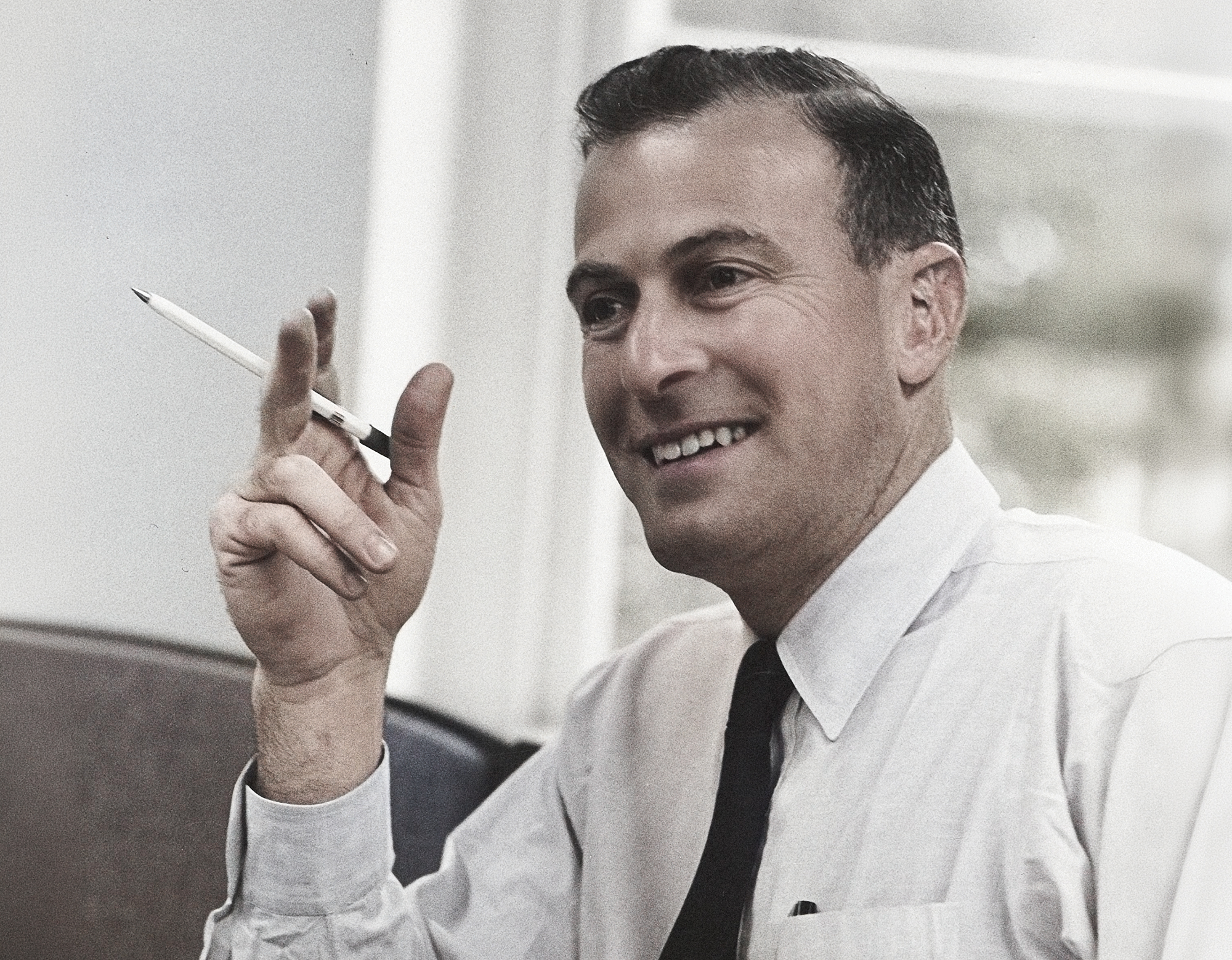
Among former senior class co-president Reiko Osaki’s keepsakes is a lacquered box containing years of typewritten letters: notes of encouragement when she started a business, had a baby, or simply needed to know that somebody cared. Each of them is simply signed “Pete.”
Osaki, ’00, met her correspondent, Peter Bing, ’55, at a commencement event. After he learned she grew up in the L.A. area, he tore a sheet from a notebook, wrote “Bing” alongside his phone number, and told her to call when she was in town. She did, and they met for lunch at an unassuming café on Pico Boulevard. “This person really cares beyond the boundaries of campus,” Osaki, the founder of a consulting company that serves the public sector, recalls thinking.
Bing, a trusted adviser to generations of Stanford leaders, a member of the Board of Trustees for 31 years, and one of the university’s most devoted champions and community builders, died June 10. He was 91. He is survived by his wife of 64 years, Helen; a daughter; two grandchildren; and a great-granddaughter. His son, Stephen, ’87, predeceased him.
Bing arrived at Stanford in 1951, a self-described shy kid who spent his evenings in the library because it was the place he felt most at home. He left the Farm having been elected student body president his senior year. His classmate Dianne Goldman—later Sen. Dianne Feinstein—served as vice president.
He went on to earn a medical degree at Cornell and a master’s in public health from Harvard, then served in the Kennedy White House. As executive director of the Presidential Commission on Health Manpower during the Johnson administration, Bing helped reframe the nation’s healthcare challenge around the shortage of medical resources outside major urban areas, says Jim Gaither, JD ’64, a staff assistant to Johnson at the time. “Virtually everything that we did in the next 2 1/2 years was based on advice from Peter,” Gaither says. In 1967, Bing moved to Southern California and took over his family’s real estate business.
Bing was elected to Stanford’s Board of Trustees in 1970. “There was almost nothing that we did at Stanford that didn’t bear his imprint,” says Gaither, who, like Bing, served as chair of the board. Bing Concert Hall and the Bing Overseas Studies Program are two of the most visible expressions of that imprint, exemplifying his decades-long commitments to the arts and to undergraduate education. The concert hall helped anchor an entire arts district on campus. Through the overseas studies program, generations of students encountered the world beyond the Farm, not only in classrooms, but through concerts, meals, excursions, and other cultural experiences.
Helen was an essential partner in the couple’s Stanford philanthropy, shaping the human details that would enrich a student’s education or bring beauty and comfort to patients and families. They often made their mark in subtle but meaningful ways: wildflowers seeded along campus roads, art installed in hospital corridors, or a summer orchestra tour arranged so students could see the world along with playing music. “We all stand on the shoulders of those who came before us,” says Stanford vice president and chief external relations officer Martin Shell. “On the campus, we are all standing taller in many ways because of Peter and Helen,” some of which, he adds, “we may never know about.”
Isaac Stein, JD/MBA ’72, saw two sides of Bing up close: the grand vision and the granular follow-through. A pilot who often flew himself north in his small plane, Bing came to campus regularly during Bing Concert Hall’s construction, personally testing seats to make sure they were comfortable for people of different sizes and having red and green occupancy lights installed above the restroom stalls. “I think of Peter when I walk into that restroom and see his lights, which are still functioning,” Stein says. “He took great pride in attention to detail.”
‘There was almost nothing that we did at Stanford that didn’t bear his imprint.’
Bing’s reach extended into every corner of university life. Dick Gould, ’59, MA ’60, Stanford’s longtime director of tennis, credits the Bings with “adopting” the women’s program as Frank Brennan built the team into a national powerhouse. “He was just a great supporter of Stanford, but also Stanford Athletics, and especially the tennis program,” Gould says. “We’ll be forever grateful for what he’s done.”
For all the scale of his philanthropy, Bing was remarkably unassuming. Friends remember him driving aging cars that seemed incongruous with his means, including a station wagon he refused to give up even after it was rear-ended and left sitting, smashed, in his driveway. He and Helen also routinely chose a modest hotel near campus for their frequent visits. Their reasoning, recalls retiring Stanford Sierra Camp director Dave Bunnett, ’83, was simple: “If we stay here, we can give more money to Stanford.”
At Stanford Sierra Camp, where the Bings spent a week each year, Bunnett remembers them quietly funding cabin renovations and fire pumps. Once, upon learning that student staff members were crowded into their cabins, the Bings offered to fund improvements. When Bunnett returned with the cost of adding lofts, they had one question: “Can we write a check?”
But Bing’s connections always went deeper than money. A few days after Bunnett underwent major surgery in 2023, he received a late-night call from Bing. They talked for half an hour. Bing called again the next night and the next, always asking about Bunnett’s recovery and trying to take his mind off his hospital environs. It was not until their fourth conversation that Bunnett noticed something unusual in his friend’s voice.
“Peter, are you doing OK?” he asked. “You sound a little tired.”
“Oh, yeah,” Bing replied. “Well, I’m in the hospital too.”
John Bravman, ’79, MS ’81, PhD ’85, now president of Bucknell University, spent 11 years as Stanford’s vice provost for undergraduate education. He recalls watching Bing handle disagreement gently and without rancor, even when he felt strongly. “I try to learn from that, and I try to emulate that to this day,” Bravman says. “He just is Mr. Stanford, and he loved this place deeply.”
Leslie Hume, MA ’71, PhD ’79, saw him take the same care in mentoring newer trustees, including her husband, George, JD/MBA ’75, who joined the board in 1990. Bing took him hiking during a retreat at Fallen Leaf Lake and informally mentored him in the ways of the Stanford board. When Leslie became chair in 2008, Bing took her to lunch and, through stories rather than instructions, gave her his vote of confidence. “Peter was such an empowerer of other people,” she says.
That investment in others carried an invitation to pass it on. “I know that you felt the warmth and support that Stanford provided to you, as it did to me half a century ago,” Bing wrote to Osaki four months after her graduation. “But the real appreciation of Stanford’s caring only comes retrospectively, as you are now experiencing, and that appreciation and gratitude is what keeps all of us involved with the university throughout our lives.” Whenever they got together, Bing would ask her what she was doing for Stanford, fueling in her what has become a lifelong volunteer commitment to the university, as well as its students and youngest alumni. In July, Osaki was elected to the Board of Trustees. Her predecessor and friend Peter Bing “created a culture of belonging and a culture of giving back,” she says. “That, I think, is his legacy.”
Christine Foster is a writer in Connecticut. Email her at stanford.magazine@stanford.edu.