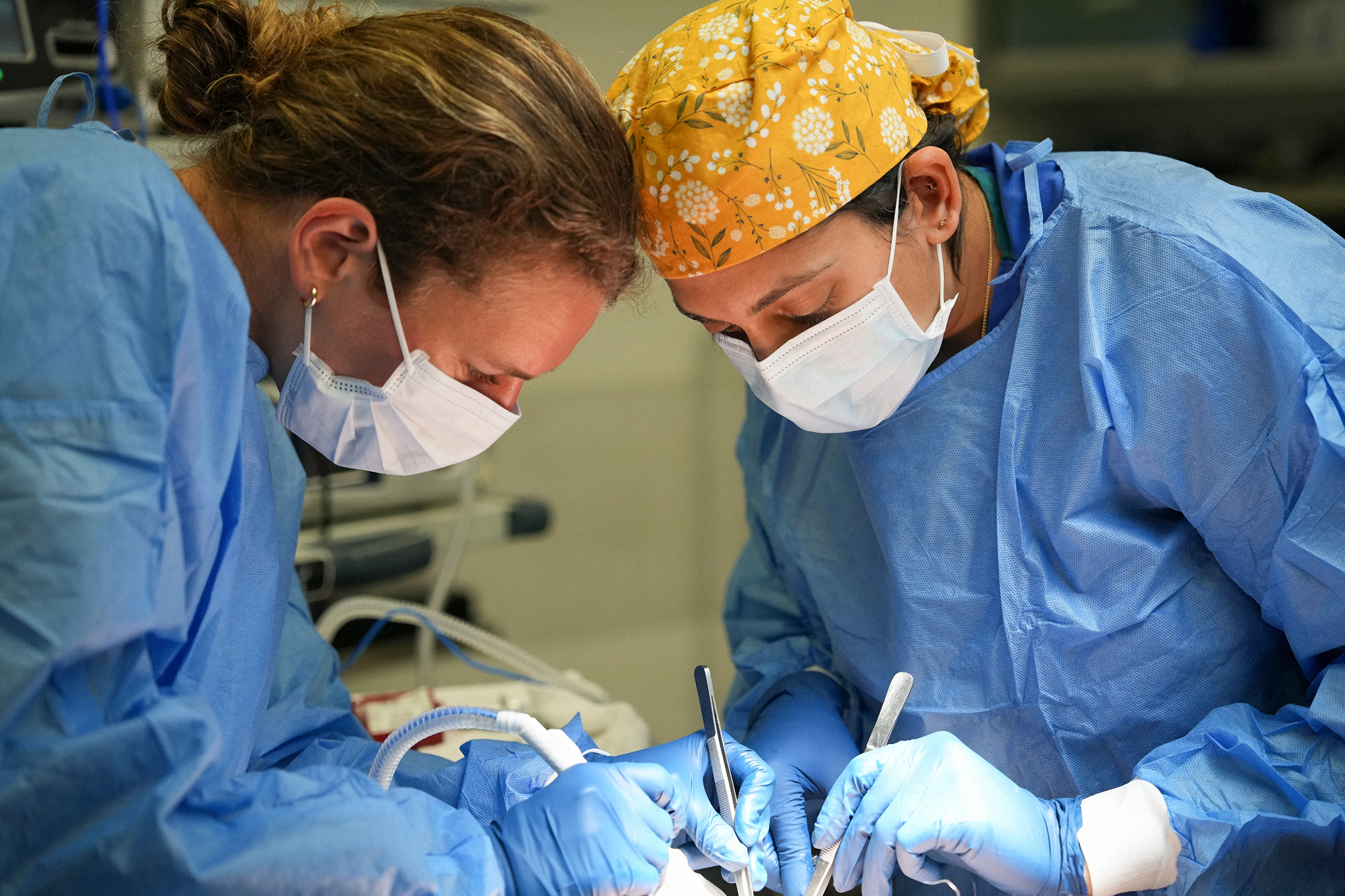
Each August, during the School of Medicine’s first week of classes, the clinical anatomy course begins with a moment of silence. A handful of faculty members and 120 students, most in their first year of medical school, gather around 28 stainless steel tables topped with blue body bags. Inside each is someone who donated their body to Stanford.
“We [have] a brief reflection, making the students aware of the importance of the donation of bodies,” says Miguel Angeles, a clinical assistant professor of surgery and one of the course instructors. “This is your first teacher,” he tells them. The students will spend their inaugural quarter of medical training learning about the structures and functions of a human body, gaining knowledge from the donors that will stay with them throughout their careers.
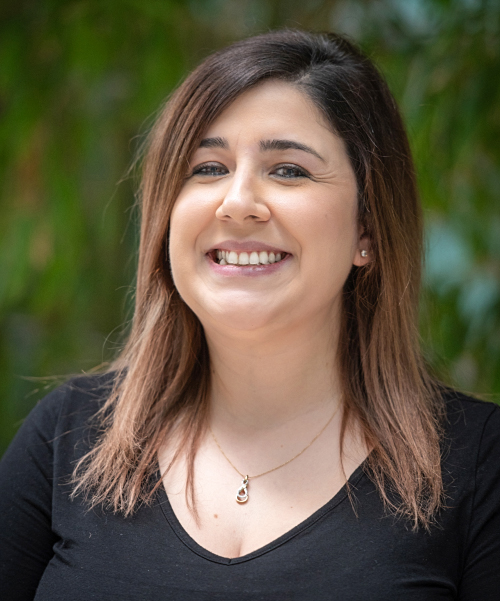 Gaitan (Photo: Rachel Baker/Stanford Surgery)
Arica Gaitan, the lead of Stanford’s Anatomical Gift Program (AGP), oversees more than 110 donations per year. She ensures that the division of clinical anatomy has enough donors for upcoming courses and trainings and that each is preserved appropriately for its designated use.
Most donors have a Stanford connection.
Donors must preregister for the program, which can happen years—or just minutes—before they die. Most are Stanford alumni, former patients of Stanford Health Care, or the relatives of former patients. But anyone may donate their body to Stanford if they meet the program’s criteria, which include being located within 150 miles of campus, weighing less than 220 pounds, and being free of contagious, blood-borne diseases such as hepatitis B. AGP must be notified within 12 hours of a donor’s death so that its third-party transport service can deliver the body to campus within 24 hours. The quick turnaound is vital, but Gaitan says it’s also important for families to spend a few minutes with their loved one after they’ve passed. “We want them to have their goodbye too.”
They’re at Stanford for the long haul.
“Our donors can be in our care for several months to several years,” Gaitan says. Most will be embalmed (a process that slows decomposition), but some remain “unfixed” (i.e., not embalmed), depending on the needs of the division of clinical anatomy. Donors that aren’t needed immediately are preserved in a temperature-controlled room on campus, where Gaitan and her staff ensure they are properly cared for.
They support all kinds of medical education.
Many donors become those first teachers for new medical students. Others are destined for scholarly research, specialized case studies, or skills-based instruction such as intubation training. Some unfixed donors help teach future surgeons to, for example, remove a gallbladder. “The gallbladder is very close to the liver, and the liver has a special consistency,” says Angeles. To learn how best to keep the liver safe during the procedure, it’s important for students to understand “how it feels when you touch it with instrumentation.”
It’s a personal process.
The AGP urgent phone line, intended for people who want to register right before they die, can ring at any time. Gaitan answers it day or night, and the emotional work stays with her long after she leaves campus. “I go home,” she says, “and I think about my donor families that I’ve talked to for the day.” Each member of the AGP team has the utmost respect for the gift and sacrifice of body donation, she says. She traces her own professional path to a family car accident she was in at age 12. While she sustained a broken pelvis and traumatic brain injury, her father and younger sister were killed. Seeing her sister unrecognizable in a casket inspired her to become a licensed embalmer at a local funeral home, attending to the smallest details so grieving family members could better recognize their loved ones. “It has a deeper meaning to all of us,” she says. “It’s not just our job.”
This year marks the fourth AGP memorial service.
Each November, family members are invited to a memorial service for donors. Faculty members, medical students, and loved ones gather in Memorial Church to honor donors with words of reflection, musical performances, and other presentations. Donors “are not here among us anymore,” Angeles says, “but they are still present.” Theirs is a gift that helps not only every medical student at Stanford, but every patient that student serves in the future, he says. “Very few people can claim that legacy.”
Kali Shiloh is a staff writer at Stanford. Email her at kshiloh@stanford.edu.