As a kid, Ellie Wen spent weekends curled up next to her mother, marathoning movies—a ritual that sparked a lifelong love of film. When she was 8, her family moved from Hong Kong to Los Angeles, where she found herself surrounded by adults who made movies for a living. A career in film, she says, suddenly felt “possible and tangible.” As a Stanford student, she set out to explore every facet of the industry. She did internships with film production companies and with casting and talent agencies, and she helped with marketing and outreach for independent films. She took a summer acting course at the American Conservatory Theater. She majored in drama and minored in sociology, and for her senior thesis, she wrote and performed in BroadwAsian, an original play at Prosser Studio Theater in Memorial Hall about Asian representation on Broadway.
A bachelor’s in hand, Wen, ’09, MFA ’19, returned to Los Angeles and spent several months auditioning for roles in films. She found that she didn’t like how the roles for Asian American women were written—they seemed either stereotyped or small—so she pivoted to producing, in hopes of bringing more minority voices to the big screen. She co-wrote and produced the independent film White Frog, which follows an Asian teenager with autism spectrum disorder after a tragic accident befalls his brother, starring Booboo Stewart and Harry Shum Jr. She also worked for CBS Films as a coordinator for acquisitions and co-productions, where she traveled the film festival circuit looking for works to acquire and distribute. For the studio Super Deluxe, she helped produce digital and TV series for new, underrepresented voices.
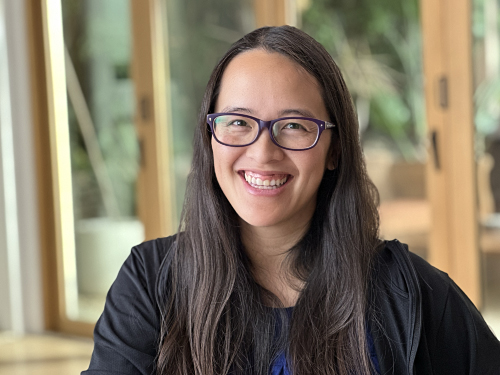 Photo: John Shenk
In 2017, she returned to Stanford to complete an MFA in documentary film and video, making four shorts along the way. Her film 25 Hours follows a firefighter balancing motherhood with a grueling 24-hour shift. In Share, a teenage influencer struggles with his mental health. With On Mother’s Day, an intimate look at how mass incarceration shapes a mother’s holiday, she won the Best Local Filmmaker Award at the UN Women Global Voices Film Festival. Her fourth documentary, The Missfits, turned its focus to an all-girls high school robotics team.
Wen freelanced as an editor and filmmaker for a few years, then returned to producing in 2022, this time in documentary, when she joined Actual Films, a production company in San Francisco where she’s currently a producer.
STANFORD: You’ve worn a lot of hats—as an actor, filmmaker, and, most recently, producer. How would you describe what a producer does?
Wen: Every day looks different, and it usually depends on where the projects I’m in charge of are at. If a project is in the development phase, I’m finding the people we want to interview for the documentary, hiring crew members, and working out logistics. I research and find the story too. When we move onto preproduction, I’m spending most of my time in the office doing lots of meetings and calls with crew members, directors, and clients to plan out shoots. When I’m on set and we’re shooting, days can run as long as 8 a.m. to 8 p.m. I’m doing everything from conducting interviews to building sets, managing the crew, and winding everything down at the end of the day. When we wrap, I oversee the postproduction process with our editor until we’ve got a finished project back to the client.
With Actual Films, I’ve worked on Marlee Matlin: Not Alone Anymore, which went to the Sundance Film Festival. Right now, I’m juggling three projects, one of which is the The Coral Rescuers. It’s about this group of people in Miami working to save coral reefs through some incredible, innovative solutions. It just premiered in July and will continue playing at film festivals.
Were there any classes or experiences at Stanford that were formative in shaping your path?
[When I was] an undergrad, [senior lecturer in art and art history] Adam Tobin’s [’93] screenwriting analysis class was wonderful. It was an introductory class where we got to watch a lot of movies and analyze the screenwriting. Stanford Students in Entertainment also had an application-based spring break trip to Hollywood during my senior year. On that trip, we got to meet a bunch of Stanford alumni who were writers, producers, directors, etc. That experience was really formative because I got to see people from Stanford who were actually making it in the film industry.
Why did you get an MFA, and how would you say it has contributed to your career?
I was doing work as a producer that I found really exciting and meaningful in Hollywood, but at the same time I was getting a little bit antsy to make something of my own again. Back then, there were a lot of personal documentaries coming out, and it was sort of a golden age of documentaries. So, I started taking this 10-week UCLA Extension class at night on documentary films on a whim. I fell in love with it, and being in that class also made me really miss being in a school environment. Around the same time, my husband was interested in attending grad school, so I applied to Stanford’s MFA program. It was the only program I applied to!
It was the best decision I could have made, and I absolutely loved my MFA program. It was just an amazing experience to dive so deeply into this field and live and breathe documentaries. I got to focus on making art for two solid years and walked away with four documentaries that I was proud of creating. I also came out of that experience familiar with every aspect of directing, producing, editing, and recording sound, which was empowering.
What trade-offs have you had to make in pursuing a career in the film industry?
I love learning, so one of the great things about working with films and documentaries is that I get to dive into so many different issue areas. It’s deepened my respect for people [and] the diversity of lives humans lead and expanded my idea of what’s out there in the world. And if you have the right magic of ingredients, films and documentaries have the ability to cross borders and help you reach people that you might not normally be able to interact with.
However, it can take a really long time to see a project through. And at the end of the day, not everything gets made, which can be heartbreaking, since you put a lot of your own blood, sweat, and tears into the process. This industry also requires a lot of grueling years in the beginning, so it can take a long time to feel like you’re successful at what you’re doing, even if the payoff is worth it in the long run.
What’s something unexpected you have discovered about making documentaries and films?
Making a film is hard, but it’s not as intimidating as you’d expect. It’s very doable. As a kid, it all felt so magical, but now that I’m on the other side, I’ve realized that it’s very possible to learn all the needed skills.
Do you have any advice for aspiring filmmakers?
Don’t be afraid to put yourself out there and reach out to the Stanford alumni network. Stanford alums are generally very open and willing to share their advice. When I was a student, I was heavily inspired by David Henry Hwang [’79], a very prominent playwright. After I finished my senior thesis project, I invited him to the show on a whim, thinking it would be a long shot that he would even reply. Unfortunately, he couldn’t make it to my show, but we ended up getting into regular contact. When I was producing my first feature film, White Frog, he came on as an executive producer, and he’s been a great mentor ever since.
Networking is also a big part of the entertainment industry. Of course, there are the grimy aspects of it, but there are also a lot of really good, genuine people out there that want to help. During internships, I would regularly grab lunches with assistants to get a foothold on who was out there that I wanted to work for and what companies were creating. I was part of the board of Stanford in Entertainment in Los Angeles when I lived there, and they’d regularly organize interesting social events.
Also, make stuff with your friends. Use your school years while you have easy access to collaborators and equipment. Making creative projects allows you to fail, refine your taste, and figure out what you like as a creator.
Sidney Suh, ’26, was an editorial intern at STANFORD. Email her at stanford.magazine@stanford.edu.