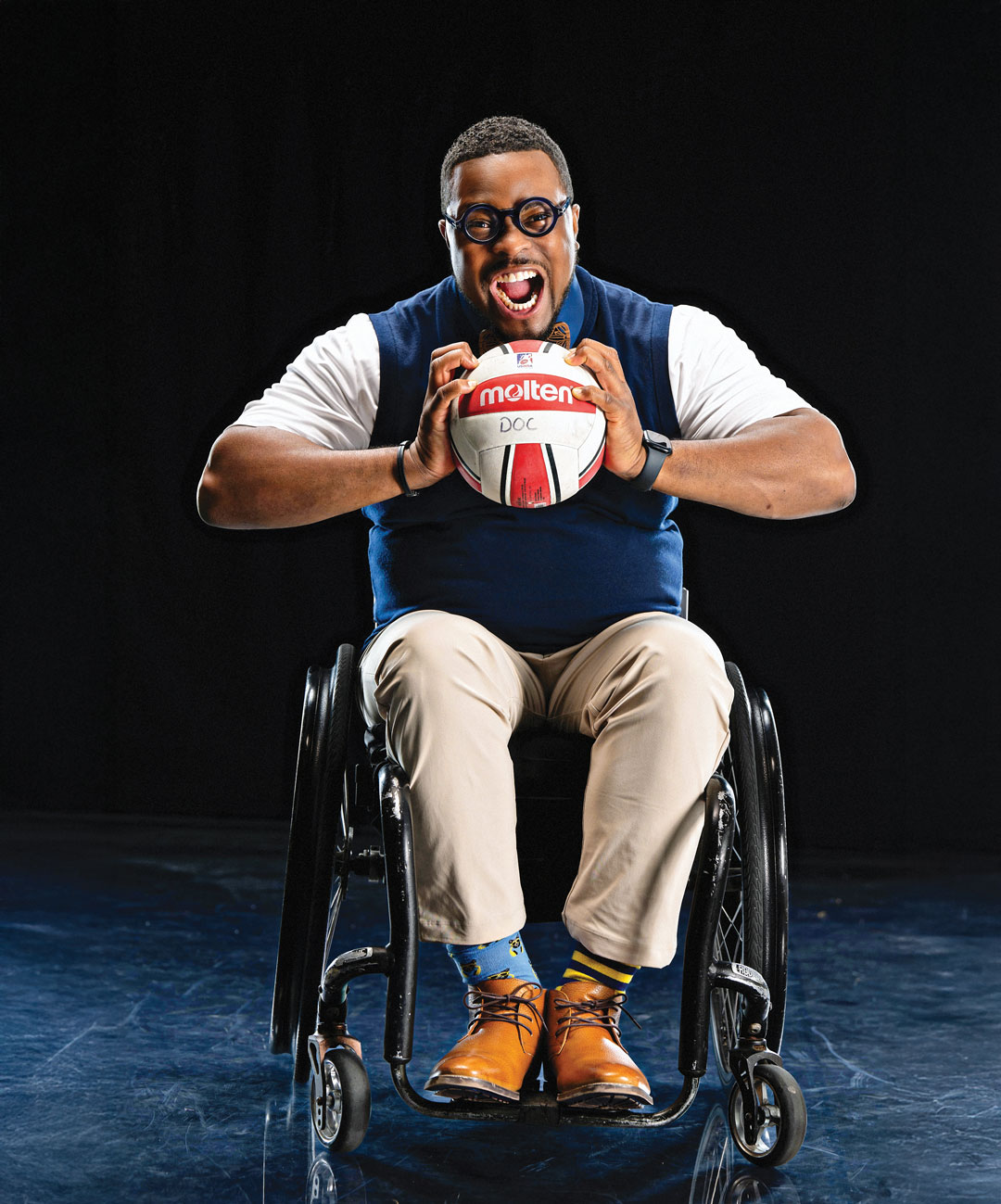
Oluwaferanmi Okanlami, ’07, may head up the University of Michigan’s adaptive sports program, but on Tuesday evenings, he’s just another member of its wheelchair rugby team. The sport is generally played indoors, on hardwood, and it’s as rough as its namesake suggests. Athletes use specially designed chairs to slam and block one another, and Okanlami, who plays when his schedule permits, arrives with force. “He can bring it pretty good when he wants to hit,” says Chuck Aoki, a four-time Paralympian and the team’s coach. Aoki would like Okanlami to work on being more selfish, pushing with the ball himself. “He is always looking to pass,” Aoki says. “He is a distributor, which I suppose kind of fits his ethos. He just wants to make things happen.”
The scene at practice is itself a testament to Okanlami’s instinct to provide an assist. On one side of the gym is the Michigan wheelchair rugby team, on the other, the Michigan wheelchair basketball team. Neither existed five years ago, when Okanlami took his position as director of adaptive sports and fitness, nor did the school’s wheelchair tennis team, its para powerlifting team, or its adaptive track and field team. All told, Michigan now has five teams made up of more than 50 student and community athletes. Only about 30 American colleges offer any. “The growth of our program in the last five years is definitely unprecedented,” says senior Maria Velat, who became the school’s first wheelchair track athlete when she arrived as a freshman in 2022.
That expansion is thanks to many people, including athletes, donors, trainers, and coaches, but it’s clear who the engine is: Okanlami, aka “Dr. O,” an assistant professor on Michigan’s medical school faculty and the dynamo in charge of the university’s services for students with disabilities—sports included. “You’ll listen to him give a speech, and you’re like, ‘Man, I could run through a brick wall right now,’ ” says Christopher Kelley, who played on Michigan’s wheelchair tennis team and is now the assistant director of adaptive sports and fitness. “He’s able to communicate his passion for something [in a way] that just makes you want to be part of what he’s building.”
‘You’ll listen to him give a speech, and you’re like, “Man, I could run through a brick wall right now.”’
Sports and leadership have long been part of Okanlami’s life. In boarding school at Deerfield Academy in Massachusetts, he starred in soccer, basketball, and, most notably, track and field, where he flourished in triple and long jump. At Stanford, he was voted captain of the track team his junior and senior years and was an Academic All-American. He still holds the fourth-best indoor triple jump in Stanford history. (Other honors include winning the J.E. Wallace Sterling Award from the Stanford Alumni Association, given to the senior whose undergraduate leadership and volunteer activities have made the largest impact on the Stanford community.)
Adaptive athletics, however, was nothing he had ever heard of. That would change in the wake of an accident at a Fourth of July party he hosted in 2013. Okanlami—then a third-year resident in orthopedic surgery at Yale—dove into an apartment pool. He doesn’t know if his head hit bottom, the side, or someone’s leg, but his neck fractured at the sixth vertebrae. His friends—fellow residents—pulled him from the water. At the hospital, he was attended by the same techs, nurses, and surgeons he’d been working with for years.
He was paralyzed at the chest. The familiar phrasing is that such injuries are “devastating.” Okanlami resisted that outlook from the beginning. As a doctor, he knew he was in the care of experts. And as a man of faith, he leaned into another kind of trust. “I know that the Lord works in mysterious ways,” he says. “I was not worried about what was going to happen.” Even in the uncertain early days of his recovery, he says, he considered himself someone to whom much had been given—education, insurance, supportive parents, a sports background that had taught him to persevere—and much was still expected. “I never allowed it to feel like it was this earth-shattering thing.”
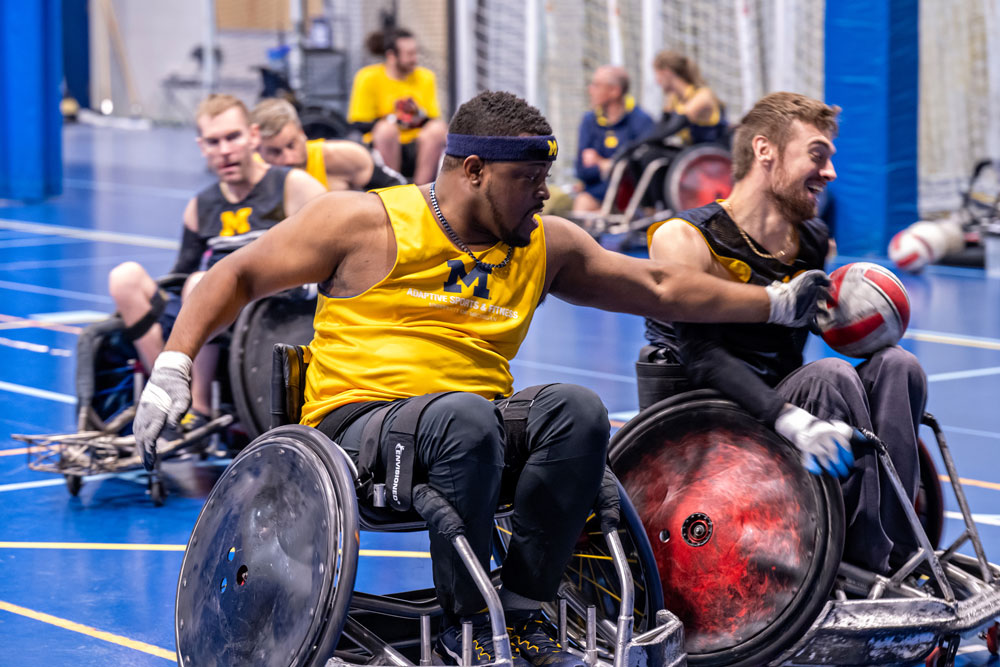
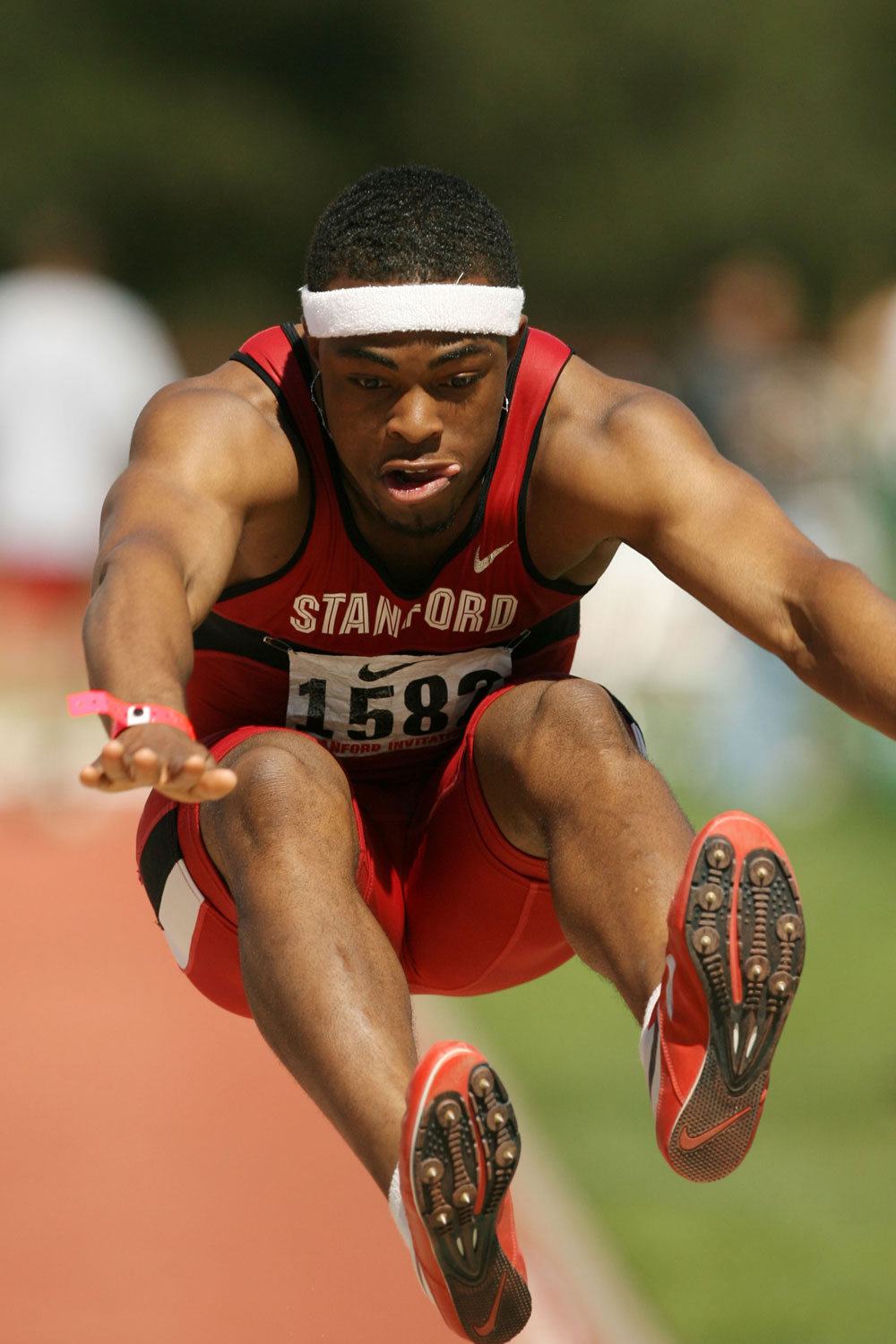 NOW AND THEN: Okanlami repping the Wolverines and the Cardinal. (Photos from top: Leisa Thompson/Michigan Photography; David Gonzales / ISI Sports)
After returning to his parents’ home in Northern Indiana, he earned a master’s degree in engineering, science, and technology entrepreneurship from Notre Dame and started a second residency in family medicine at Memorial Hospital of South Bend, where his duties ranged from delivering babies to providing care in nursing homes. During his own care, he’d felt left in the dark at times. Now back on the listening side of the stethoscope, Okanlami says he had new awareness of the need to be communicative. And he began to recognize that some patients sought him out precisely because of his wheelchair. “I had a lot of people, both based on my disability and my race, who were like, ‘You get it in a way that other people haven’t gotten it,’ ” he says. In response, he became more open about his personal experiences with surgery, rehab, medication, side effects, and wheelchairs. “It gave my patients a sense that I was not only their doctor, but I was a patient just like them.”
Okanlami had been introduced to adaptive athletics in the months after his injury while recovering at the Rehabilitation Institute of Chicago—now the Shirley Ryan AbilityLab. It required a little bit of matchmaking. “I just wanted to be good, and I wasn’t right away. Which just says more about how difficult para sports are,” he says, “even if you are very athletic.” While he loved wheelchair basketball from the start, his core strength and hand function affected his ability to maneuver his wheelchair, dribble, and shoot as effectively as he wished. Tennis, too, presented a challenge. “I couldn’t even hold onto the racket because I still didn’t have enough finger strength to hold onto the racket and push,” he says. “Later on in life, I found out that I can tape the racket to my hand.” One of the reasons Okanlami embraced wheelchair rugby was that it was something new that didn’t invite comparison with his former skills. Another is that—unlike in basketball—he has a relatively high classification among those who play the sport, so he can do more on the court. As he got more involved, he began to see some familiar upsides. Adaptive sports were not only fun and invigorating; they were ways to build connection, community, and wellness. And he realized they were not nearly as available as they should be.
When Okanlami got recruited to Michigan in 2018 as an assistant professor, he arrived with hopes of building an adaptive sports program when the chance arose. Two years later, after the previous director of services for students with disabilities retired, he was tapped as interim director, a position that would become permanent in 2021. At the time, the adaptive sports program on campus consisted mostly of rec wheelchair basketball, says Caiden Baxter, then a freshman, who knew Okanlami from South Bend. Okanlami wanted to start an intercollegiate team, which could be most easily done in a sport that didn’t require a large roster. He recruited Baxter and another student to join him in establishing a Michigan wheelchair tennis team. “That was kind of the idea—it was low budget, get it started, get the university to recognize it, and then build from there,” Baxter says. They spent the COVID shutdown practicing five days a week and recruited veteran players such as Kelley. (Some teams allow nonstudents to join, which can broaden both community impact and competition options.) In 2021, the team placed second to Alabama in the national championships. This year, the wheelchair tennis team has 10 student members, which Okanlami says makes it the largest collegiate one in the country.
“He has my complete admiration and respect,” says Brent Hardin, director of adapted athletics at Alabama, one of the most established collegiate parasports programs. “He didn’t wait until he had all of the ideal resources in line. He just started putting things together and putting teams out there.”
‘Dr. O has been a pivotal leader in accessibility at Michigan.’
Adaptive sports is only a part of Okanlami’s purview as director of student accessibility and accommodation services. His job involves overseeing equal access to facilities, classrooms, and testing as well as advocating for more inclusive planning. “Anyone can use the ramp while not everyone can use the stairs—so why do we keep on building stairs to everything?” is one of his maxims. Vincent Pinti, a wheelchair user and a Michigan graduate student in law and public policy who doesn’t play sports, credits Okanlami for the improvement in responsiveness to disabled students he has seen since his freshman year in 2019. “Dr. O has been a pivotal leader in accessibility at Michigan,” he says. “He values student input greatly, and he marks a dramatic change in the history of this department.”
Sport and fitness, though, have particular significance for Okanlami. He sees access to them as a fundamental issue of equity and of well-being. Exercise is especially important for a population that often has other health risks. And he believes Michigan’s adaptive teams, with the school’s iconic ‘Block M’ on their chests, are a beacon even to those who can’t be bothered with box scores. Having the recent fifth annual Wolverine Invitational wheelchair basketball tournament light up the marquee outside Michigan Stadium, for example, broadcasts a message well beyond sports. “Our adaptive athletes are a visible representation of the support that we provide disabled students on this campus,” he says. “I want any disabled student out there to be able to say, ‘Wow, the University of Michigan cares about disability.’ ”
Okanlami wants to go further. While adaptive athletics has a foothold on a few dozen campuses, and about half of U.S. Paralympians compete in college, the field remains wide open. Okanlami likens it to women’s college athletics before the sweeping reforms caused by Title IX. One of his goals is to bring para-sports into the National Collegiate Athletic Association. “That’s just a no-brainer,” he says.
Okanlami’s commitments—which include parenting his son, Alex, a high school freshman—have led him to stop seeing patients, a recent decision tinged with the awareness that he will no longer provide medical care to those who especially sought him out. But he’s come to understand his new path as an extension of his old one. “The elements of what I loved in medicine—using my mind or my hands to effect change in people’s lives and give people access to as healthy a life as they want and as they can have—I still get to do.” In other words, Okanlami is still playing for the assist.
Sam Scott is a senior writer at Stanford. Email him at sscott3@stanford.edu.